
BoSox, Cubs Step Up; Cardinals Step Back at Trade Deadline
The trade deadline is the final ultimatum for many teams. Step forward and compete, or step back and look to the future. This season, the Metro-Milwaukee Dynasty Baseball League (MMDBL) experienced its most dynamic trade deadline period in its 4-season history with some teams decisively responding to the ultimatum.
For 8 teams which have yet to start Game 55, there is still an opportunity to cut a last-second deal. For the other 12, the deadline is passed and the rosters are frozen until after the World Series when the trade window once again opens. In all, from June 4 through June 22 (the scheduled date for Game 55) there were 16 trades involving 58 players and 7 draft picks.
Who stepped up, who stepped back and who stood pat? Let’s take a look:
Baltimore – The Orioles (33-24) are currently 3.5 games up on the Angels and Phillies in The Natural’s Whitey Division. They’re on a 4-game winning streak and in the pole position for a playoff spot. Baltimore made 2 deals, both of which should improve its chances of winning the division. On June 7, Baltimore acquired Jonathan Loaisiga and Jake Woodford from the Yankees. The deal cost them Randy Arozarena, but the addition of Loaisiga greatly shored up the team’s weakness – its bullpen. With Arozarena gone, one outfield spot was left to Austin Hayes. On June 16, the Orioles dealt Hayes for an upgrade, getting Andrew Benintendi from Detroit. In that deal, Baltimore also landed Tucker Barnhart and Brendan Rodgers. Rodgers greatly improves the team’s defense at shortstop and Barnhart gives it a legitimate bat versus right-handed pitching and solid defense behind the plate.
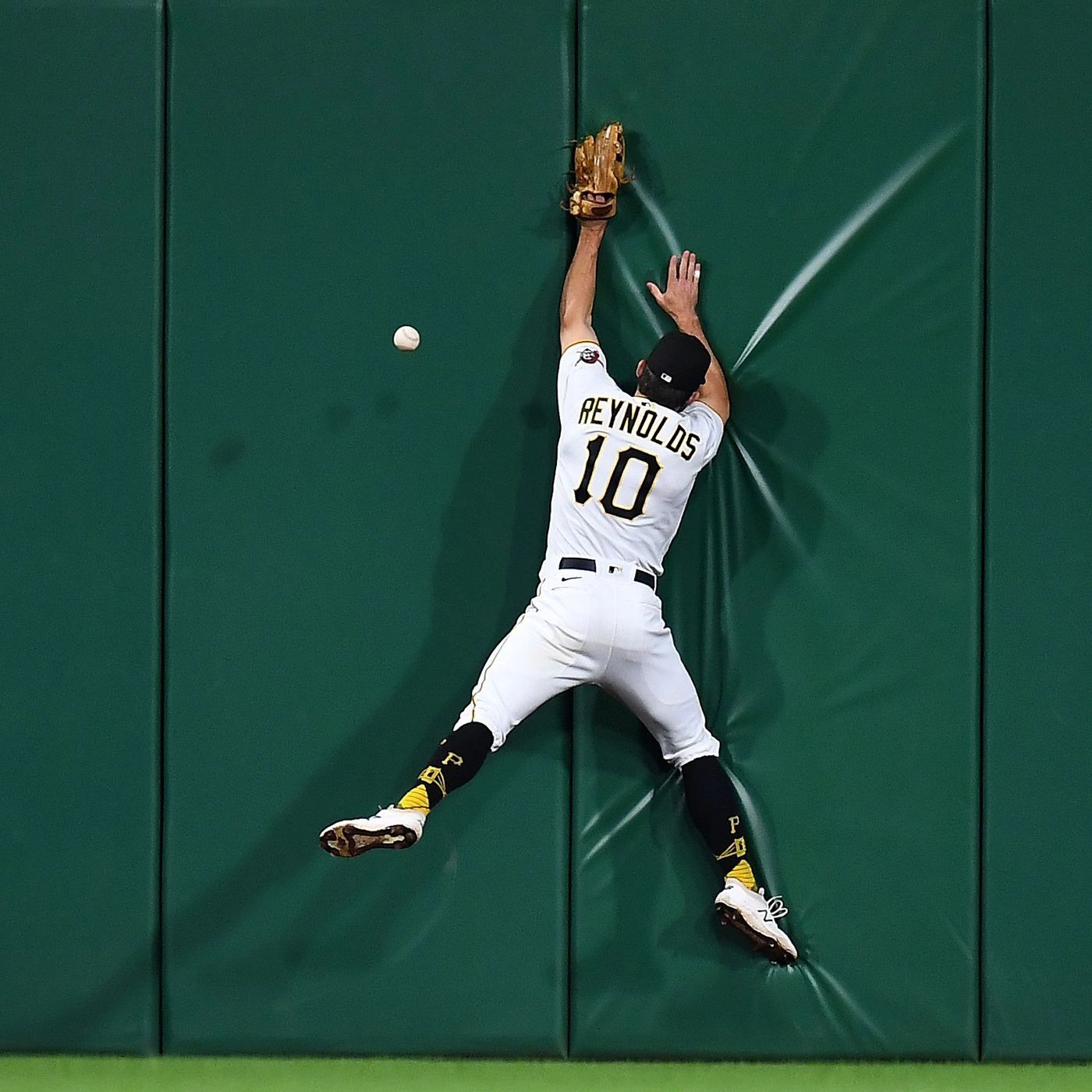
Boston – Perhaps no team embraced the opportunity to step forward more than the Red Sox. Boston (31-26) remains 3 games behind Toronto and San Francisco in the Bull Durham’s Casey Division, but the Red Sox are 7-3 in their last 10. Boston completed 3 deals, improving their starting and relief pitching, their offense and their defense. On June 8, the Red Sox added Zack Greinke and James McCann in a swap with the flagging Dodgers. On June 14, the BoSox then completed the Big One, landing star outfielder Bryan Reynolds and Austin Meadows in a deal with St. Louis. Boston gave up a lot to get Reynolds, who arguably has one of the best cards in the deck when you add his stellar defense to incredible offensive numbers (he’s currently 2nd in batting average, 3rd in OBP and 3rd in OPS with a slashline of .348/.437/.639). In its final deadline deal, Boston added a pair of lockdown relievers in Giovanny Gallegos and Chad Green, and now seems like an extremely well-rounded team in every aspect that will be tough for the Blue Jays and Giants to hold off down the stretch.
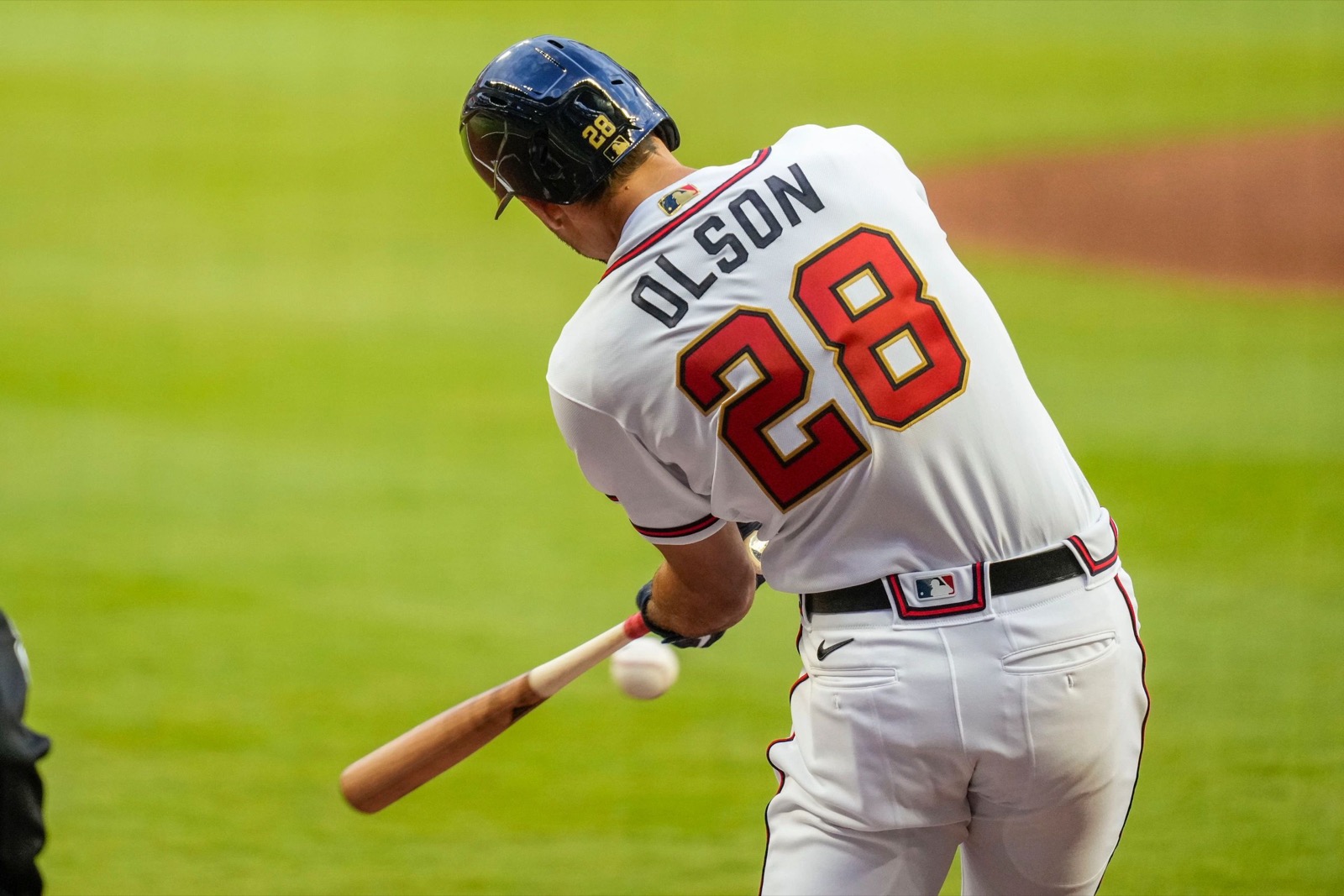
Chicago Cubs – Perhaps because they saw the Detroit Tigers flagging badly, or perhaps because their GM is “Trader” Tommy Tuepah, the Cubs completed a pair of deals that make it the favorite to win the Bull Durham’s Sparky Division. At one point, the Cubs were 4 games behind the Tigers. Chicago (28-26) is now ½-game ahead of the Tigers and still has an opportunity to cut a deal before Game 55. On June 5, the Cubs added a high average and OBP guy to their lineup in swapping Adam Wainwright for Adam Frazier. Two weeks later, on June 19, and after some controversy, they added two more key pieces – Matt Olson and Robbie Ray – in a trade with the fire-selling Cardinals. Olson slots into an already sturdy lineup and, with Frazier, now makes the Cubs one of the toughest lineups to navigate. Ray replaces Wainwright in the rotation. Like Boston, however, the trade deadline haul didn’t come cheap. More on that – and the noted “controversy” – when we cover the Cardinals.
Chicago White Sox – It was a disappointing season for the ChiSox and a sell-off at the deadline seemed inevitable. At 23-31, the White Sox remain just 4.5 games behind the Tigers for a playoff spot but the team’s inability to produce runs consistently has neutered the benefit of having the league’s best one-two rotation punch of Kevin Gausman and Zach Wheeler. The White Sox cut 3 deals in June and improved their prospects for 2023 and beyond. On June 19, Chicago took fliers on Michael Lorenzen and Luke Voit by trading the final 27 games of Yuli Gurriel to Detroit. They then acquired Andrew Vaughn and a 1st round pick from the Giants for Eric Lauer and Trevor Larnach. In its last deal, on June 22, the club acquired Byron Buxton and Isaac Paredes for Gausman and Cole Sulser. The team’s Achilles heal was its lack of bash and pop. In Vaughn, Buxton, Voit and Paredes, the White Sox added significant bash and pop for next season. The 1st rounder acquired from the Giants figures to be in the 14-20 pick range.
Cincinnati – The Reds dangled Xander Bogaerts all year, hoping to land a true top-of-the-rotation ace. They finally found a trade partner for Bogaerts and got their ace, and then completed 3 more deals to add another ace and two solid relief options. The Reds entered the season with one of the best offenses, even without Bogaerts, but their pitching was suspect. They now have preserved their offense and appear to have the pitching to compete. At 33-24, the Reds are 4 games behind the Twins in The Natural’s Tommy Division and will have to hold off the Nationals and Rangers, which are 1 and 2 games back, respectively. The Reds are on a league-best 5-game winning streak and appear to be getting hot at the right time. After adding Wainwright for Frazier from the Cubs, the Reds days later added Charlie Morton for Bogaerts in a trade with the Angels, giving them a pair of aces to lean on down the stretch. Later, in 2 separate deals with Seattle, Cincinnati added relievers Andrew Chafin and Tony Watson to shore up its bullpen.
Detroit – The Tigers’ (29-28) season was crumbling well before the trade deadline. Currently in the throes of a 5-13 stretch, the Tigers were once 24-15 and looked like a juggernaut. But the team never really hit consistently and its pitching has been a disappointment. Entering the trade deadline, management didn’t want to sell since the team was still in first place. It didn’t want to buy, either, as it felt the team was more than 1 or 2 pieces away from truly competing for a championship. The Tigers have the league’s 3rd worst batting average (.236), is dead last with runners in scoring position (.212), and 3rd worst against both right-handed pitching (.229) and left-handed pitching (.249). Those numbers were the impetus to shake things up a bit. In a surprise deal, Detroit acquired Hayes, Willie Adames and Zach Collins from Baltimore. We already said the deal helps Baltimore for this season, so how could we also suggest it helps Detroit? Maybe if you buy into Adames being the stick that stirs the drink and jump starts the lineup a case could be made. But that’s not realistic. The deal was made because management likes Hayes and Adames going forward more than Benintendi and Rodgers, though many observers might not see it that way. To add even more pop to the lackluster lineup, the Tigers then added the stellar offensive card of Yuli Gurriel from the White Sox. The acquisition forced Alex Bregman to the minors and greatly improved the offense, on paper at least. The defense? Not so much. Finding places to play Adames and Gurriel just to get their bats in the lineup will hurt. The Tigers did nothing to improve pitching because they still believe in the rotation of Brandon Woodruff, Logan Webb, Shohei Ohtani, German Marquez and Jack Flaherty, and they still believe in a bullpen anchored by Ryan Pressly, Ryan Tepera, Edwin Diaz, Tanner Houck, Connor Brogdon and Deolis Guerra. The club, however, currently sits with the 5th worst WHIP (1.40). In its first games after the trade deadline, in just 25 innings of a rain-shortened series, the club yielded 31 runs on 69 earned base runners. So much for the pitching coming around.
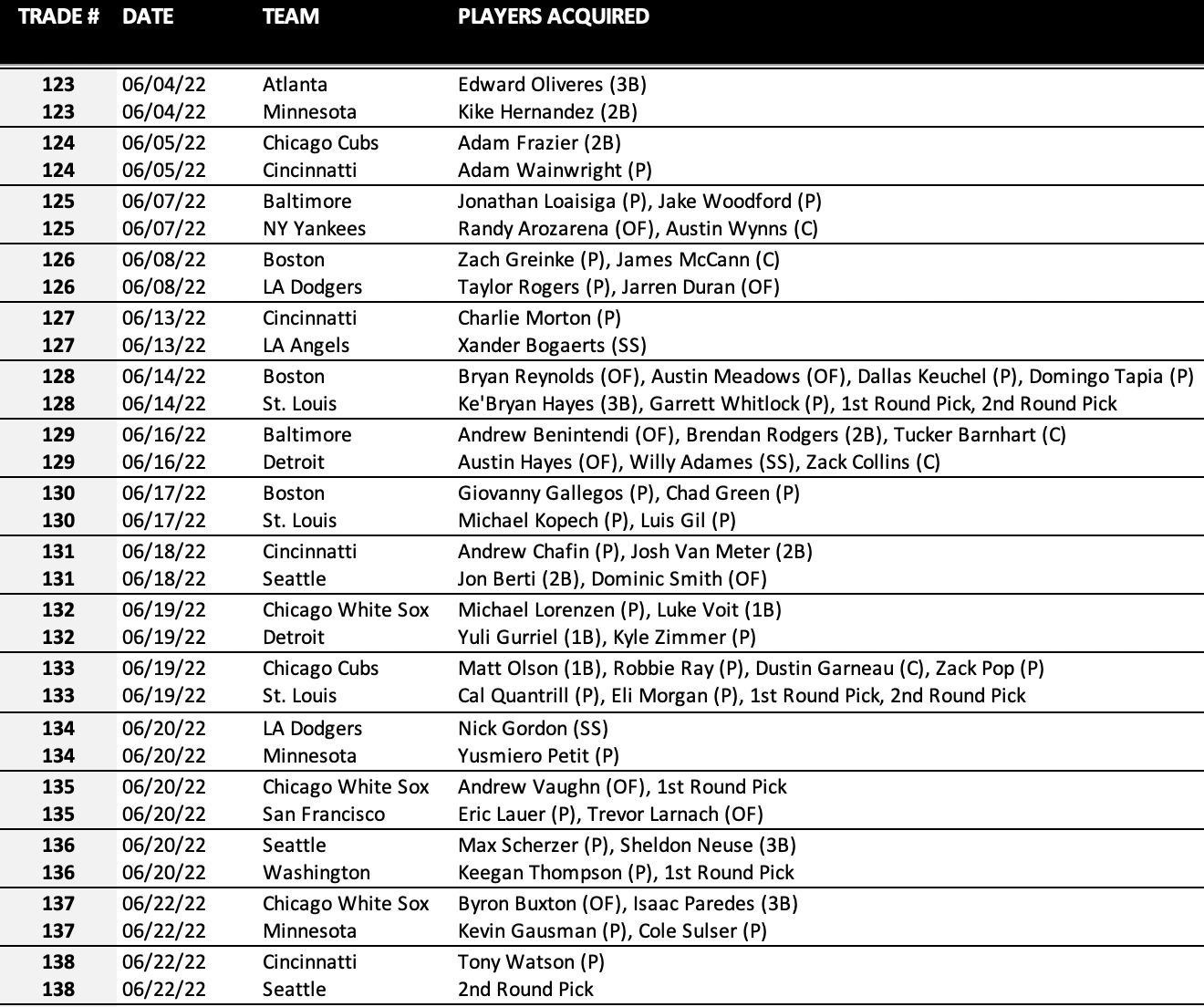
Los Angeles Angels – The Angels (28-26) are tied with the Phillies at 3.5 games behind the Orioles in the Whitey Division. The club made one move, dealing the aging ace Charlie Morton for Bogaerts. The X-Man adds to a potent offense featuring Buster Posey, Pete Alonso, Austin Riley, Fernando Tatis Jr., Yordan Alvarez, and Raimel Tapia. The subtraction of Morton reduces the Angels’ pitching depth and they will now need to lean more heavily on Jose Berrios, Lance McCullers and Hyun-Jin Ryu.
Los Angeles Dodgers – The Dodgers (20-37) are vying for a top 3 pick in the Winter Draft. They made a pair of deals. On June 8, Los Angeles added Taylor Rogers and Jarren Duran in the Greinke trade with Boston. On June 20, the Dodgers acquired Nick Gordon from Minnesota for Yusmiero Petit. Duran and Gordon are young players with considerable upside, and Rogers gives the club a closer for 2023 and hopefully beyond.
Minnesota – The Twins completed 3 deals that addressed gaps largely caused by an unfortunate run of injuries. At 37-20, the Twins are the league’s best team and they just got better. The season-ending injury to Buxton left a gaping hole that needed to be filled. On June 4, the Twins struck the first “deadline deal” of the season when they added Kike Hernandez from Atlanta. Hernandez can capably play centerfield in place of Buxton, who was shipped to the White Sox. Minnesota looked like it was willing to nibble when, on June 20, it received Petit from the Dodgers to add bullpen depth. Two days later, however, the Twins quit nibbling and took a big bite, acquiring Gausman to add to a stellar rotation of Gerrit Cole, Lance Lynn, Framber Valdez and Carlos Hernandez; and adding Sulser to an already deep bullpen. Don’t overlook the addition of Sulser, who has lockdown tendencies. This deal might just help the Twins pull away from the Reds, Nationals and Rangers and enter the post-season with the best record.
San Francisco – The Giants have historically been the most active franchise in the MMDBL when it comes to trading, which is why it was so surprising to see them make only 1 deal this season. The Giants (34-23) are tied for 1st with Toronto in the Casey Division, 3 games ahead of surging Boston. In the lone deal consummated by the Giants, the club acquired Lauer and Larnach from the White Sox, giving up Vaughn and their 1st round pick. Lauer was hurt when the deal was completed but he’ll soon come off the disabled list and join the big club. The deal was a “straddle” trade as the Giants improved their pitching for this season and for next – keeping a foot in both the current and the future.
Seattle – The Mariners (23-31) had a lot of work to do to field a competitive team this season. The club has navigated its 1st season of a rebuild quite nicely and is still competitive in the Sparky Division, just 4.5 games out of a playoff spot. The team made 3 deals in the trade deadline window of June 4 – June 22, but it also made 2 deals in late May. In the May deals, Seattle added Cristian Javier and Ketel Marte, yielding Lucas Giolito and Carlos Carrasco. Then, on June 18, it added versatile speedster Jon Berti and Dominic Smith in the deal that sent Chafin to Cincinatti. The big deal came on June 20 when the Mariners added future hall of famer Max Scherzer and Sheldon Neuse while dealing its 1st round pick and Keegan Thompson to the Nationals. Two days later, the club acquired the Reds’ 2nd round pick for reliever Tony Watson. When the dust had cleared, Seattle added Javier, Marte, Berti, Scherzer, Neuse, Smith and a 2nd rounder – that’s a total of 5.3 WAR based on 2022 real-life stats. Of note, Scherzer has started his rehab assignment. So who’s the highest WAR player of the new additions? Guess again. It’s Jon Berti at 1.8 WAR.
St. Louis – See below.
Washington – The Nationals (32-25) traded their ace, Max Scherzer, even though they are just 1 game out of a playoff spot in the Tommy Division. Getting Seattle’s 1st rounder, which is likely to be a top 7 pick, was too alluring to a club that, quite honestly, is still in a rebuild of its own, even though the rebuild appears to be ahead of schedule. Another asset acquired in the Scherzer trade, Keegan Thompson, looks like a decent keeper who’ll provide future value out of the bullpen and as a spot starter in the mold of 2021 Tanner Houck.
St. Louis – Back again, saving the best – or at least most complicated – for last. One of the MMBDL’s winningest franchises and one of only 2 to make the playoffs in every season, the Cardinals (26-28) are currently 6.5 games out of a playoff position in the Casey Division. As the trade deadline neared, the Cardinals participated in 3 transactions and one controversy. Since all of the deals have been discussed above, let’s sum them up from a Cardinals-only perspective:
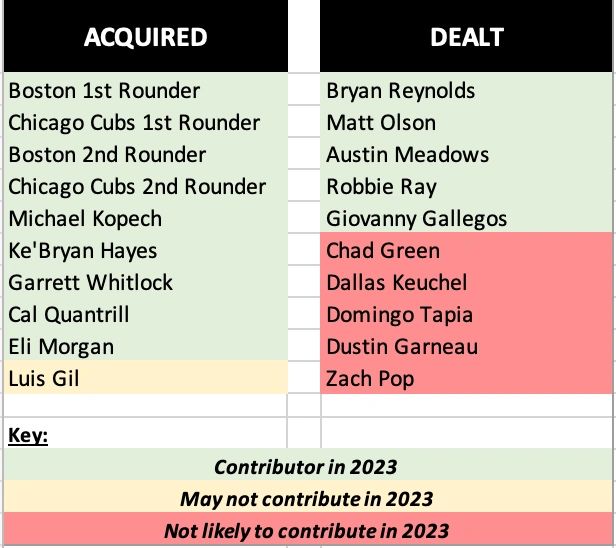
If you’re looking at that and thinking the Cardinals’ future is bright, you’d be correct. While they lost 2 key offensive pieces, getting Ke’Bryan Hayes and 4 more early draft picks should help them find replacements for Reynolds and Olson. Meanwhile, adding Kopech and Whitlock to a rotation next year that will likely feature Dylan Cease and Shane Baz is a strong move. And while it’s impossible to replace Gallegos, who may be a top 3 reliever in the game now, Eli Morgan looks like a guy you could depend on in the late innings for a while. In summary, St. Louis will have 6 of the first 35 to 40 picks, including potentially a top 5 pick (their own.)
The Cardinals deal with Boston stirred some controversy as 2 more players needed to be added to the deal to make it an equal parts-for-equal parts deal. In the process of reworking the deal, Cardinals’ management learned that the acquired picks must occupy a roster spot. As such, the Cardinals will only be able to keep up to 19 players in addition to the 4 picks they acquired. Once the Boston deal was reworked to include Keuchel and Tapia, St. Louis found itself challenged to construct a roster capable of finishing the season. This prompted the Commissioner to make an ad-hoc ruling by executive fiat that will allow teams acquiring picks instead of players to temporarily claim free agents to fill the 40-man roster. At the end of the season, the claims are required to be released and the acquired picks will then join the 40-man roster and must be retained on the roster up until the draft.
The ruling will be voted on by team owners in the offseason.