
The Twins and Jays Prove Its Best to Be Hottest and Healthiest
The 8th MMDBL regular season has come to a close. 12 teams are still alive and the playoff seeding took until the last day of play to settle. Toronto and San Francisco went to the final game tied at 59-30. Toronto won 3-2 at St. Louis, San Francisco lost 2-3 at Texas, and a bye that had belonged to the Giants since the middle of August changed hands in the final innings of the 90-game schedule.
That is the short version. The long version is worse for San Francisco: they won 7 straight to build the lead, then lost their last 5 — 2 at home to Detroit, then a 3-game sweep at Texas. Both of those clubs are in this bracket. San Francisco still owns the best run differential at +133. It spent the final week of the season being beaten by teams it may have to beat again.
The other No. 1 seed is the real story. Minnesota was 26-24 through 50 games and looked like it might have to settle for a low seed, or perhaps miss the playoffs altogether. Over the final 40, the Twins went 27-13 – including 13-2 across a July stretch – and that .675 finish was the best in The Natural and second-best overall behind Toronto’s 28-12, underscoring that it’s good to be hottest latest. Nobody in the league improved more from the first half to the second — a swing of 155 points of winning percentage. The Twins did not back into the top seed. They took it.
One League Is Carrying the Other
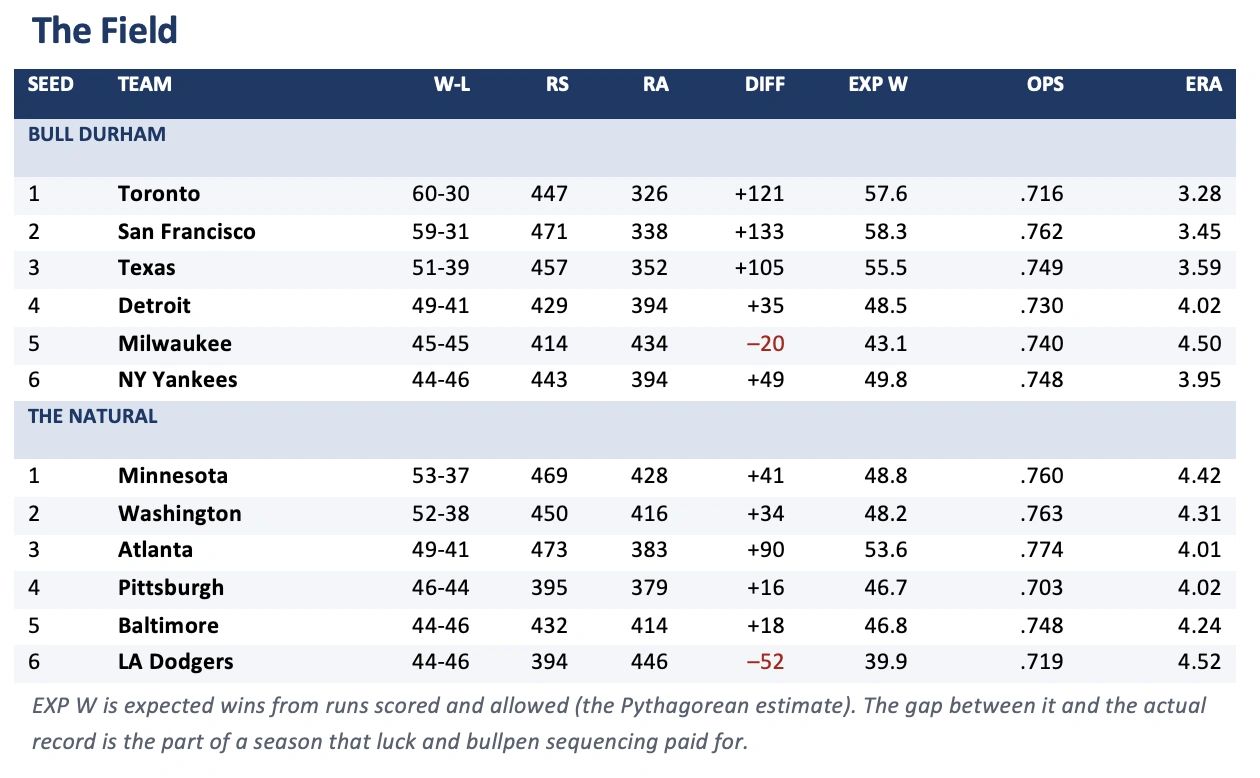
The Bull Durham finished with the 3 best run differentials — San Francisco at +133, Toronto at +121, Texas at +105. The Natural’s best belongs to Atlanta at +90, and Atlanta is a No. 3 seed that has to play its way into the final four. The byes went to Minnesota (+41) and Washington (+34), which means both were outscored across the season by a narrower margin than the Bull Durham’s No 6 seed. The Yankees are 44-46 with a +49 differential and open on the road.
None of that decides a 7-game series. It does tell you where the traps are, and in the case of the 2 clubs that just finished 27-13 and 28-12, it undersells them.
Bull Durham Wildcard
No. 6 NY Yankees at No. 3 Texas · Season series 3-3
The most interesting team in the bracket is a No. 6 seed that finished under .500, and the argument about the Yankees is really an argument about which half of their season you believe. Through 50 games they were 32-18 — the best record in the league. Over the last 40 they went 12-28. No other playoff team fell apart by even half that much.
The season-long numbers still like the Yankees. New York outscored its opponents by 49 runs and finished 5.8 wins below expectation, the largest shortfall in the field, on a 14-17 record in 1-run games and a 5-9 mark in extra innings. But a +49 run differential built almost entirely before July is a different asset than one earned all year, and they limped in at 3-7 over their last 10. A big part of their swoon were the long absences of Roman Anthony, Tyler Soderstrom and Treat Turner, with Turner expected to miss most of the series, if not all of it.
When healthy, the lineup is real. George Springer posted an .869 On-Base Plus Slugging (OPS) with 26 steals, Soderstrom slugged .510, and Anthony reached base at a .400 clip. Shōta Imanaga (2.17 earned run average, 0.93 WHIP) and Nick Pivetta (2.72, 153 strikeouts) are a genuine playoff front two, with Brandon Woodruff ready for a Game 3 start.
Texas is the better team on the standings page yet there were soft spots below the surface that felled the team from the late-season competition for a bye. An OPS of .749 (5th best), 99 home runs and a 3.59 ERA (3rdbest) are legitimate, but 15-19 in 1-run games and 13 blown saves point at a bullpen that has been modestly undependable when dependency was important. Tarik Skubal struck out 173 and went 8-8, and is the undisputed ace; Emmanuel Clase is the back-end stabilizer with 13 saves and a 1.91 ERA.
The Yankees are 12-16 against left-handed pitching, and that is the thread Texas might pull, with southpaws Skubal and Martin Perez expected to anchor the rotation. Here’s where the loss of lefty Kris Bubic for the season could hurt the most for the Rangers.
No. 5 Milwaukee at No. 4 Detroit · Milwaukee won the season series 4-2
Milwaukee is 45-45 with a –20 run differential, but don’t be fooled. The Brewers are scary for two reasons. Paul Skenes made 17 starts with a 1.78 ERA and 145 strikeouts, and Freddy Peralta backed him at 2.97. In a 7-game series that is a top of the rotation neither bye team would enjoy. The third starter is Logan Webb (5-3, 3.72 ERA), who made 13 starts since being acquired and will face the team that hastily dealt him after he went 0-2 with a 9.39 ERA and 2.22 WHIP in 4 starts for the Tigers.
The second compelling reason the Brewers are scary is geography: they are road warriors. The Brewers were 18-27 at home and 27-18 on the road, and this series starts in Detroit. Kyle Schwarber hit 30 home runs, Mike Trout got on base at a .365 clip, and the club’s 125 home runs are the 2nd-most in the field. The Brewers are expected to get Shea Langeliers back from injury early in the series, which will provided a needed boost to the offense.
Detroit answers with the most strikeouts of any staff here (883) and Hunter Brown, who was the best pitcher in the league nobody talks about – a Cy Young candidate, in fact, after finishing with 10-5 with 7 complete games and a 1.98 ERA, 179 strikeouts, a 0.92 WHIP across 154 1/3rdinnings. Shōhei Ohtani and Eury Perez are back to pitch in the playoffs after being shut down early. On offense, the Tigers woefully underperformed except for Brendan Donovan, who hit .317, and Ryan Jeffers, who hit .311 with a .400 OBP. Detroit will be without Pavin Smith due to injury and will need to complete with a platoon of Justin Turner and Victor Varatini at first base.
The split that decides it: Detroit went 16-9 in 1-run games and 9-3 in extras, Milwaukee went 6-13 in 1-run games. But Detroit also blew 17 saves, the most of any playoff team, while Milwaukee blew 7, tied for the fewest. For closers, Detroit has nobody – yes, Justin Slaten assumed the duties after Emilio Pagan was dealt to the Twins and saved 5 of 11. And Milwaukee as the MMDBL’s all-time saves leader, Kenley Jansen. If late innings decide this series, Milwaukee has a huge advantage.
The Natural Wildcard
No. 6 LA Dodgers at No. 3 Atlanta · season series 3-3
This is the largest gap on paper anywhere in the bracket. The Dodgers were outscored by 52 runs, the only playoff team worse than –20, and their expected record of 39.9-50.1 says 44-46 already flattered them by 4 wins. The staff allowed a .263 batting average with a 1.41 WHIP, worst in the field in both. Then there’s the fact the Dodgers – in the season after winning the World Series – were the first team to tap out on the 2026 campaign when it dealt Schwarber to the Brewers early in the season. Yet here they are, with a chance to defend their championship.
They do have James Wood (21 home runs, .872 OPS) and the best closer nobody drafted early: Dennis Santana saved 25 with a 1.26 ERA. And they got here the hard way, with 8 games under .500 after 26, 23-27 through 50, then 21-19 down the stretch to nose into the last spot in The Natural. Kansas City missed it by a single game.
Atlanta is the most dangerous team not sitting out the Wildcard round. The Braves led the MMDBL in OPS (.774) and home runs (131), and they finished 8-2 over their last 10. Rookie of the Year (ROY) candidate Nick Kurtz slugged .577 with a .956 OPS, Jeremy Peña hit .310 with 19 home runs and 14 steals, Pete Alonso posted an .866 OPS and Cal Raleigh hit 25 bombs. The Braves +90 run differential says they were 4.6 wins better than their record.
Unfortunately for the Braves, ace Chris Sale is gone for the rest of the year, so they’ll have to survive with Ranger Suarez, Tanner Bibee, Quinn Priester and, thankfully, Cade Horton, who was acquired in an early season deal with Baltimore.
An underachieving 49-41 team playing its best baseball, against an overachieving 44-46 team with the worst season-accumulated pitching results in the tournament. Read into that what you like, but don’t expect the Dodgers to back down from defending the championship flag now that they’ve made it this far.
No. 5 Baltimore at No. 4 Pittsburgh · Pittsburgh won the season series 4-2
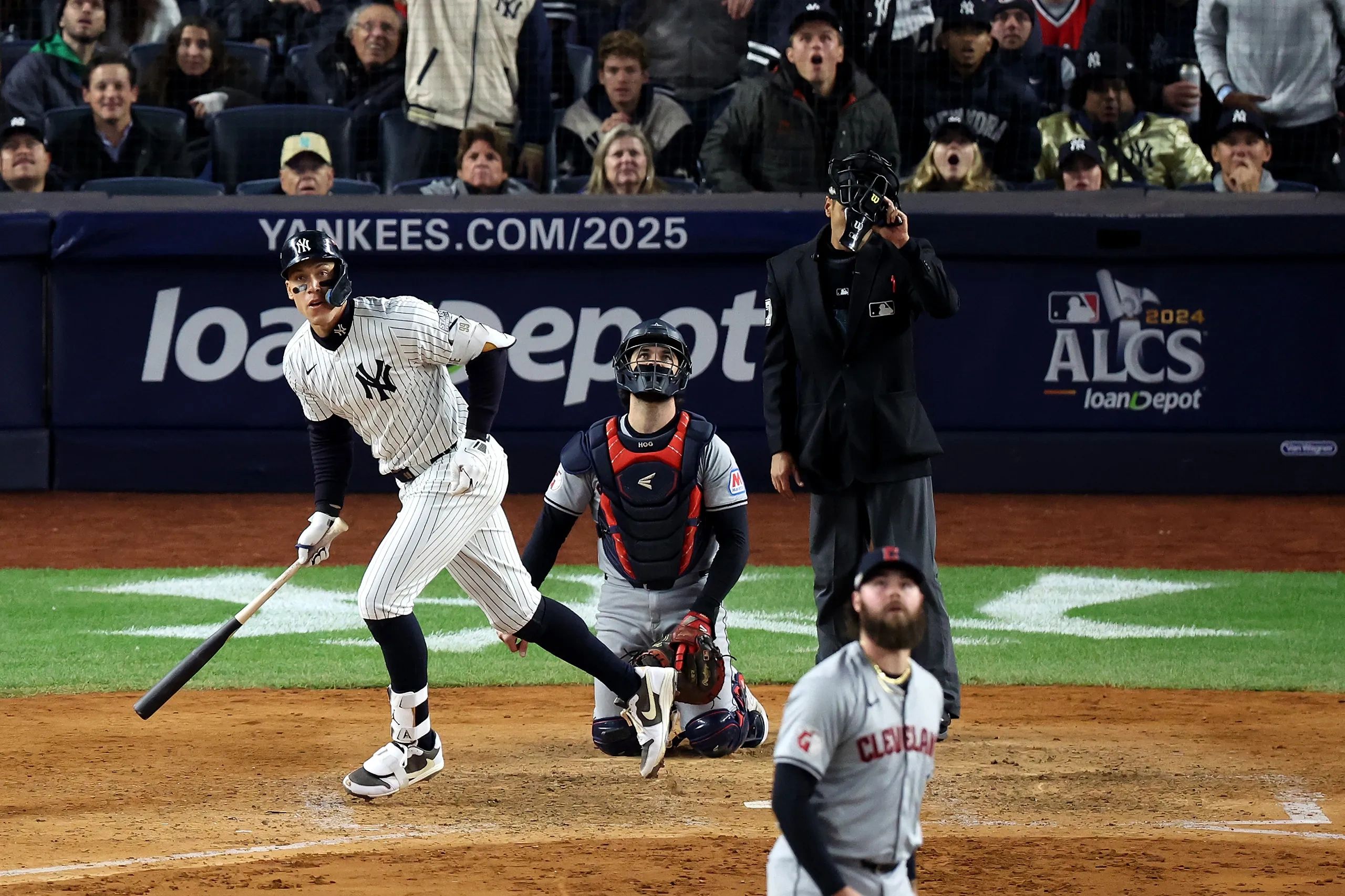
The lowest-scoring season series of the 4, and the one most likely to turn on a single swing. Aaron Judge was the best hitter in the field by a margin — a .986 OPS, a .411 on-base percentage, 18 home runs in only 207 at-bats — and Noelvi Marte (.874) give Baltimore a pair of hitters nobody wants to face. And this doesn’t even count Freddie Freeman, who came over with Judge from Houston in a mid-season trade. Unfortunately, Ronald Acuña Jr. (.837) will be missed as he still has 26 days remaining on the Disabled List (DL).
Then you turn the page to the pitching. Baltimore allowed a .260 average, Sonny Gray carried a 5.79 ERA through 15 starts, and the club went 9-16 in 1-run games, the worst mark of any playoff team. They were also 20-25 away from home, which is where this series opens.
Pittsburgh is the inverse: the weakest offense in the field (.703 OPS, 74 home runs) attached to Max Fried (12-6, 2.91, 166 strikeouts) and Devin Williams, who saved 19 games and blew none. If the Pirates get a pair of lock-down starts from Fried, the arithmetic works, and it helps that the Pirates’ ace is a lefty as it plays away from the strength of Judge and Freeman, which is slaughtering right-handed pitching.
The Pirates’ offense is best described as “grindy.” All year long the club found ways to score just enough. Alex Bohm (.325 average), Bo Bichette (.308 average), and Ian Happ (.856 OPS, 14 homers) form Pittsburgh’s offensive core. While Acuna is out for Baltimore, the Pirates loss of Gabriel Moreno could be even more debilitating as he will remain out no matter how far Pittsburgh advances.
In terms of run differential, this series is close – +18 for the Orioles, +16 for the Pirates.
The 4 Teams Already Through
Toronto (60-30) was the best team in the league and did it in the least fashionable way available: a 3.28 ERA, a 1.10 WHIP, 151 stolen bases and only 75 home runs. Eric Lauer went 11-1 with a 1.36 ERA, Cristopher Sánchez went 15-4, Nico Hoerner stole 39 bases, and Giancarlo Stanton supplied the thunder with 31 home runs. They also went 34-11 on the road, so home field is a courtesy rather than a necessity.
With 60 wins, Toronto became the third member of the 60-win club, joining Detroit (60 in 2023) and Texas (60 in 2024). It should be noted that neither Detroit nor Texas won the World Series in their 60-win seasons.
San Francisco (59-31) owns the best run differential in the MMDBL at +133 and is the most complete roster here — a .762 OPS and a 3.45 ERA, with Edwin Díaz having not blown a save or allowing an earned run all season across 30 appearances for the Astros and Giants. The blemish is the calendar. The Giants held the top seed from August 17 until the final afternoon and then lost 5 in a row to hand it back, and the teams that did it — Detroit and Texas — are both in this bracket. A bye is still a bye. It is just not the one they spent 5 months earning.
Minnesota (53-37) is the best story of the regular season. The Twins opened 6-9, sat at 26-24 through 50 games, and then went 27-13 the rest of the way — a 13-2 run through the July stretch that turned a middling season into the top seed in The Natural. Juan Soto and Will Smith carried the offense, Kevin Gausman made 23 starts, and Kade Strowd has not blown a save.
Two caveats worth keeping. The Twins’ +41 run differential is 6th among the 12 playoff teams and 4.2 wins short of their record, most of that bought with a 19-6 mark in 1-run games. And they were 21-24 at home against 32-13 on the road, which makes the reward for finishing first the one venue they played worst in. The last 40 games say they are dangerous, but the underlying math says there are pathways to challenging the Twins.
Washington (52-38) limps in at 2-9 over its last 11 – including an 0-5 stretch against the non-playoff Phillies and Astros – with a +34 differential that ranks 8th among the 12 playoff teams. Byron Buxton was excellent (24 home runs, .899 OPS) and Robert Suárez was steady at 2.06, but the Nationals were 3.8 wins better than their run scoring supports and they picked a poor moment to go cold.
How It Sets Up
All rounds are 7 games and the bracket reseeds — lowest surviving seed plays the highest — so no bye team can steer its draw. The most likely bad news for Minnesota is Atlanta: the Braves are the highest-differential team in The Natural, they are 8-2 over their last 10, and reseeding will push a winning No. 3 seed Atlanta straight into the No. 2 seeded Nationals in the League Division Series (LDS). Worth noting the Braves were only 20-20 across the final 40 — the hot streak is 10 games old, not 40. If this matchup happens, Washington was 5-1 versus the Braves this season.
For what it is worth, the numbers like San Francisco and Toronto to meet with something enormous at stake. The Bull Durham is deeper on the season, The Natural has the team playing the best baseball in it, and the 44-46 club in the Bronx is either 6 wins better than its record or the team that just went 12-28. Pick one.
Somebody is going to find that out the hard way.