Trade Deadline Retrospective: The Big 4 Got Bigger
This season has been shaping up to be a race between the Nationals and the Twins in the Natural Division, and the Blue Jays and Giants in the Bull Durham. Those 4 teams have been busy winning and putting significant air between them and the next batch of competitors.
Yes, a proverbial Big 4 has emerged; and by the end of the trade deadline, the Big 4 got bigger.
The Nationals (37-23) made their improvements early, adding reliever Camilo Doval just before Opening Day – a move that added depth to a bullpen that now ranks 3rd in the MMDBL in WHIP (1.22). While Doval enhanced the club’s expected wins (ExW) output by 1 game, Doval himself has been God-awful (2.88 WHIP, 15.58 ERA, and 17 walks and 33 hits in 17 1/3rd innings). The Nats have been frontrunners all year, jumping out to a 13-6 record to open the season, running their record to 27-13 after a 13-4 stretch, and keeping it going to their current 37-23 record. Washington was the league favorite of the MMDBL Advanced Analytics Department (MAAD) in its pre-season forecast – MAAD projected the Nationals for a 59-win season and went on to pick the club to beat the Giants in the World Series for its first-ever title. So the Nats didn’t seem to need much help at the trade deadline, which explains their relative quietness; and if Doval can pitch more effectively, then the early trade may pay dividends down the stretch.
The Twins (35-25) were very active in the days leading up to the deadline, adding 2B Romy Gonzalez and closer Emilo Pagan in a deal with Detroit, and then adding P Tyler Mahle and 2B/SS Edmundo Sosa from Philadelphia. The deal added +2 to Minnesota’s ExW – boosting it to a league-best, post-deadline 61 – and bolstered the back end of the bullpen, the lineup versus left-handed pitching, and added a consummately pesky reverse-righty to the rotation. The Twins, on a 14-2 run, may be the league’s hottest team right now. It didn’t start out that way. In fact, the Twins spent much of the first half outside of the Natural’s top 6 spots and didn’t get above .500 to stay until July 2 (game date, May 27 real date). Since, they’ve been red hot, sweeping the Brewers, taking 2 each from the playoff-bound Giants and Yankees, and sweeping playoff-cusp Detroit and Seattle. As it stands now – post-trade deadline – the Twins ExW is the highest in the MMDBL and they seem well-positioned in their chase for a league-best 3rd World Series title.
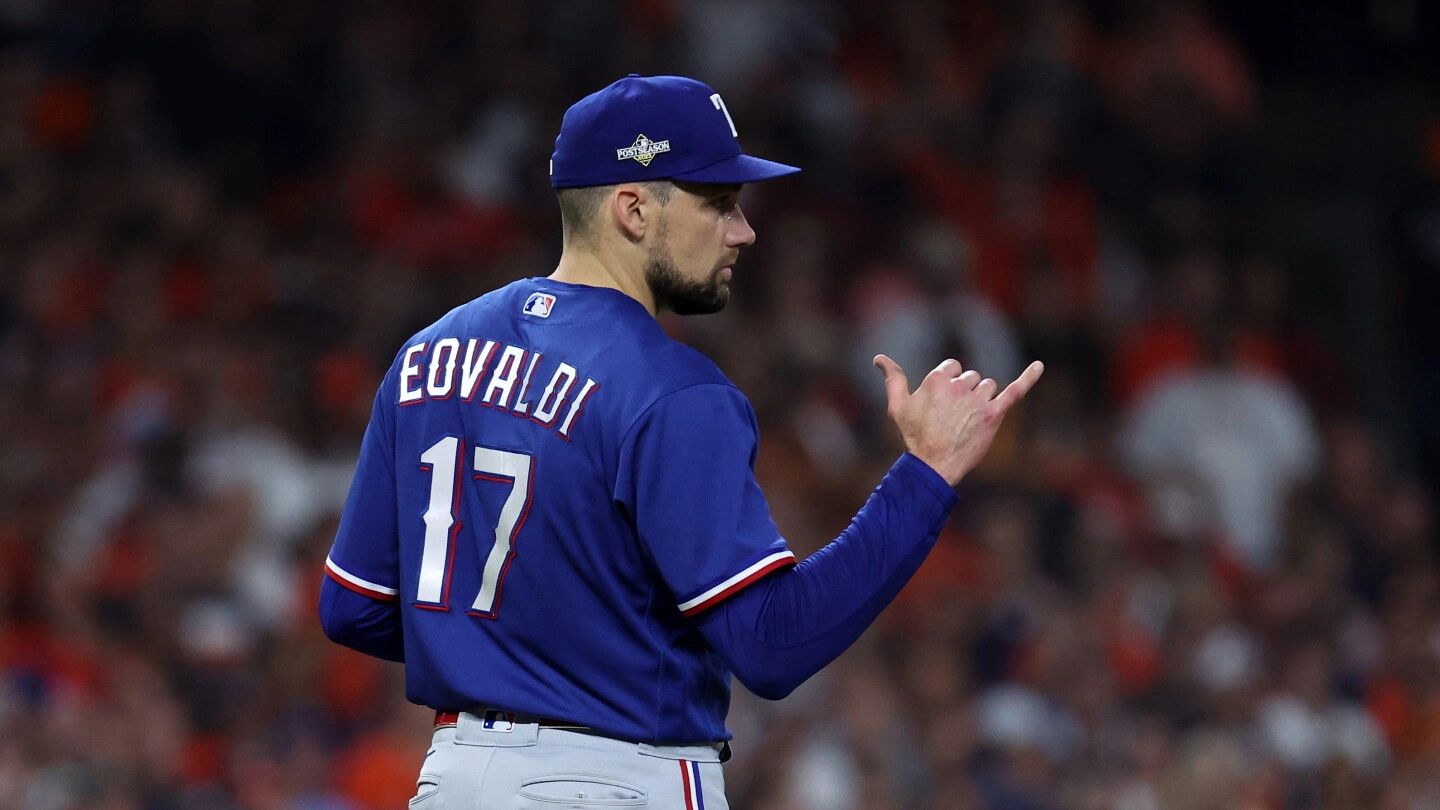
Toronto (40-20) added ace Nathan Eovaldi in a May swap with Cincinnati, which has helped offset the injury loss of ace Zack Wheeler. Eovaldi alone was worth +2 in ExW, however, the ExW calculation is based on the full 40-man roster, weighted by real-life playing time, and it does not exclude players who are injured. In other words, it includes Wheeler even though Wheeler is out for the remainder of the regular season. Earning a bye is critical for the Blue Jays because it means Wheeler may be ready for the divisional series, giving the Jays a ridiculous playoff rotation trio of Wheeler, Eovaldi and Christopher Sanchez. Toronto is on pace to match the MMDBL’s record for most regular season wins (60, Texas and Detroit); and they currently rank 1st in WHIP (1.08) and ERA (3.23) as they play the run prevention card to make up for an offense that ranks 14th (.716 OPS) but has speed and bat-to-ball skills that manufacture runs seemingly when needed.
The last of the Big 4 – the Giants (39-21) – did more than any of the top contenders at the trade deadline to improve their title chances. Long before the deadline loomed, they added closer Edwin Diaz and lefty ace Trevor Rogers in separate deals with Houston and Baltimore, respectively. Right at the deadline, they added OF Heliot Ramos in a trade with Milwaukee. The addition of those 3 players increased their ExW from 55 at the start of the season to 58 at the trade deadline, giving them the highest post-deadline ExW in the Bull Durham and 3rd highest in the MMDBL (behind Minnesota and Washington). Since starting 8-8, the Giants have gone 31-13 – a whopping .705 winning percentage. The Giants may be the most balanced team among the Big 4. They lead the league in hitting with a .286 batting average and .779 OPS, and they are 4th in pitching with a 1.24 WHIP. This all adds up to a +94 run differential – best in the MMDBL.
Outside of the Big 4
Other contenders also added at the trade deadline. The Yankees (36-24) snagged Brandon Woodruff from Detroit to bolster their rotation and make a real run for a Top 2 seed in the Bull Durham and the wildcard round bye. The Yankees are 3 games behind the Giants for the No. 2 seed and have the league’s second-best run differential (+86). The Rangers (33-27) sit 3 games behind the Yankees, currently No. 4, and went on a 4-day acquisition spree running up to the trade deadline. Earlier in the season, Texas acquired SS Anthony Volpe and SS Ronny Mauricio; and then in the days before the deadline, the Rangers added SS Corey Seager, C Salvador Perez, OF Jackson Merrill, closer David Bednar, P Tyler Glasnow, and 2B/OF Jahmai Jones. The lefty-killer Jones his 2 homers in his debut for Texas, and Bednar saved a game in his first chance to do so for his new team. Atlanta (32-28) also grabbed some talent, using precision-like trades to fill specific needs. Rob Refsnyder and Jorge Polanco fill in the lineup versus left-handed pitching, which was a blind spot for the Braves. And the early season acquisition of P Cade Horton strengthened a rotation that was average at best before his arrival. The Braves currently sit No. 3 in the Natural, 3 games back of the Twins.
There were many sellers. Cincinnati traded away 6 players in June and acquired some major-league talent and picks for next year. Detroit traded 3 key players, acquiring 2 picks and a prospect in the process. The Tigers also made a bit deal to snag 1B Justin Turner, who will now retire in Detroit. Philadelphia dealt 3 players and brought back a couple picks for its rebuilding effort. And Houston and Chicago largely emptied the clip early in the season, acquiring 2027 draft capital and some key players. Houston, in fact, saw its ExW fall by 14 wins from the start of the season – the product of trading away Aaron Judge, Freddie Freeman, Edwin Diaz, Dean Kremer, and Calvin Faucher. Baltimore was both a buyer and a seller as they were the recipient of the Judge-Freeman duo, then moved on from Rogers and closer Kyle Finnegan, before tapping back in with a deadline deal to acquire reliever Randy Rodriguez. When the dust settled, Baltimore increased its ExW by +3 to 47 – a post-deadline 4th best in the Natural.
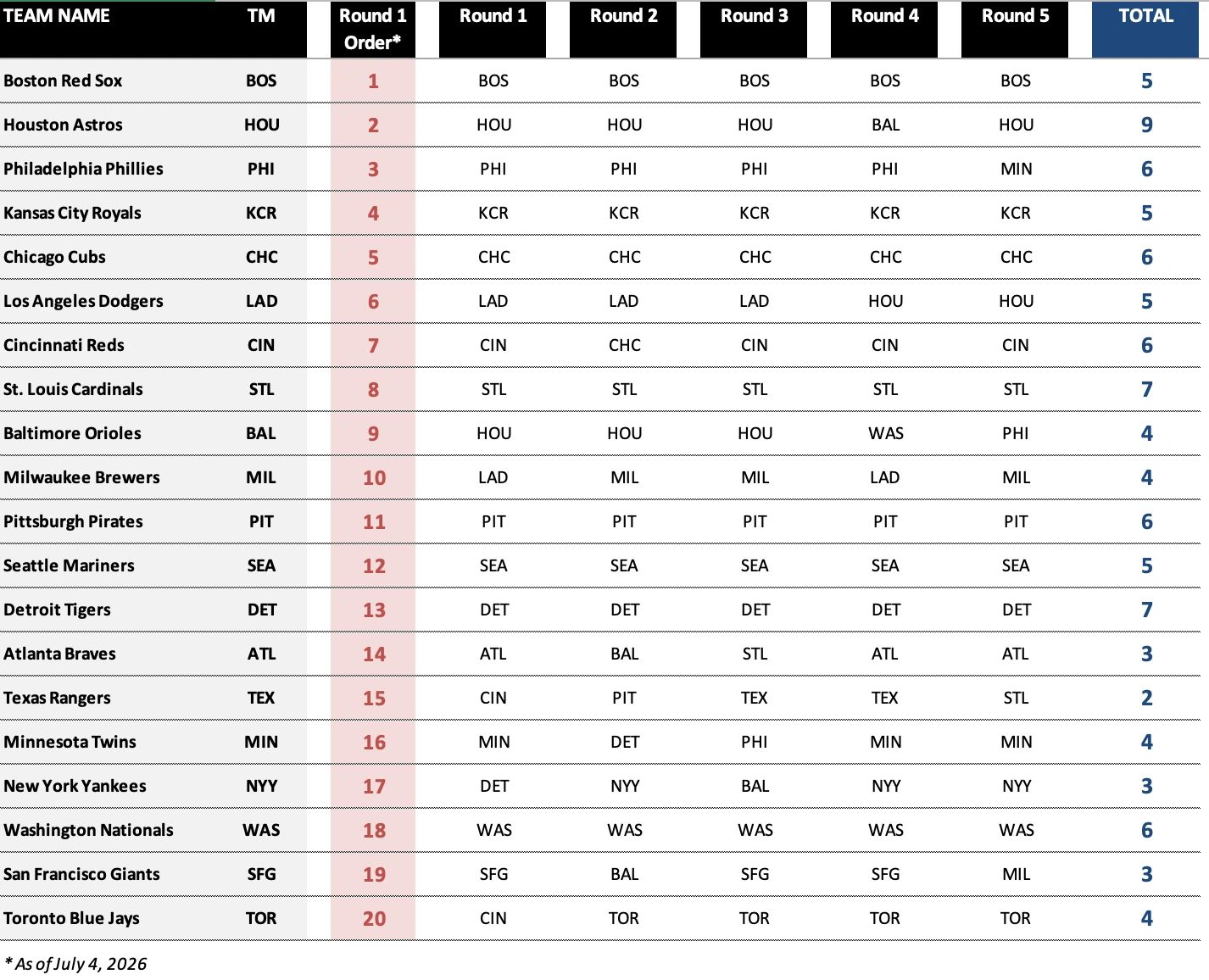
For non-contenders, the focus now shifts to off-season talent acquisition. The trade window will reopen after the World Series, sometime in October. The Rookie & Free Agent Draft will again take place in January. Between now and then, teams who have tapped out on the 2026 MMDBL season will be looking to improve their 2027 rosters through the acquisition of players other teams can't keep or are willing to move on from, as well as through the draft. If the season ended today, Boston, Houston, Philly, Kansas City and Chicago would have the first 5 picks; and 3 teams would have multiple 1st round picks -- Houston (2 and 9 - Baltimore), Cincinnati (7, 15 - Texas, and 20 - Toronto), and Detroit (13 and 17 - Yankees). In terms of picks in the first 5 rounds, Houston currently has the most (9); followed by Detroit and St. Louis (7); and Chicago, Cincinnati, Philadelphia, Pittsburgh, and Washington (6). Texas used 2027 draft capital to significantly improve its playoff prospects and currently has the fewest picks in the first 5 rounds of the 2027 draft with just 2.
The ExW Metric and Let's Not Forget About Team WAR
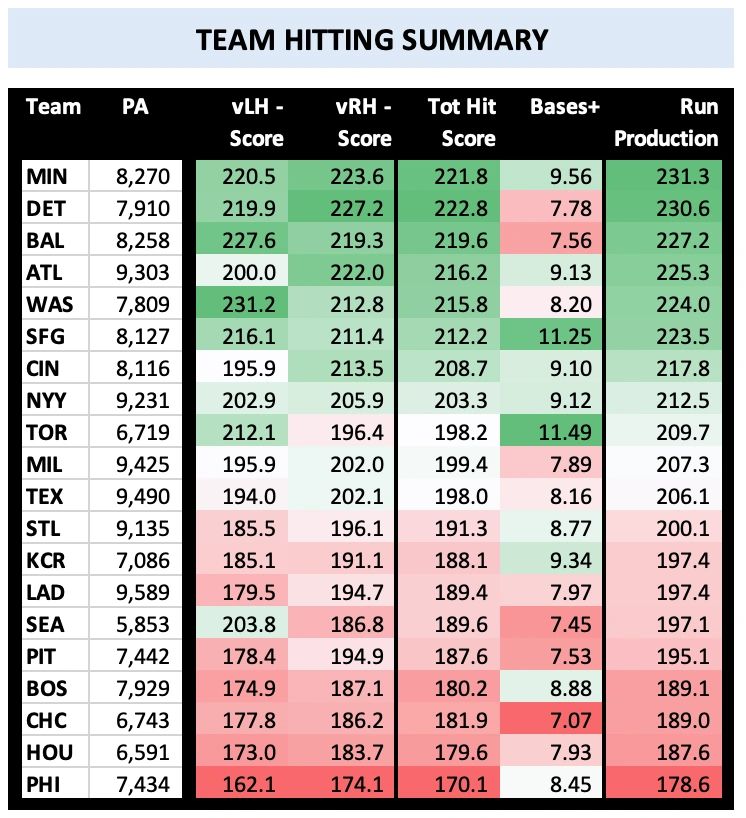
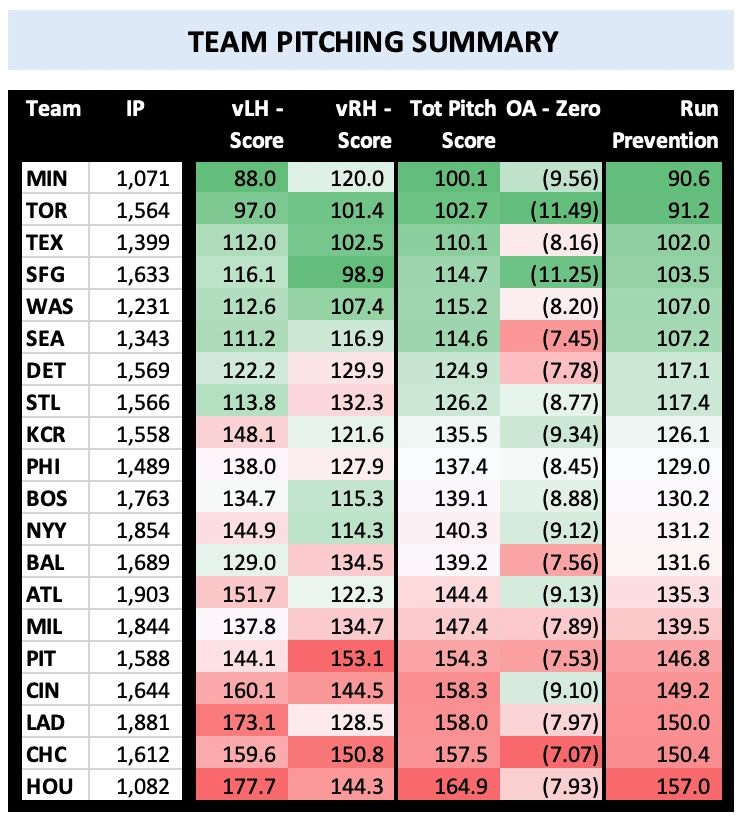
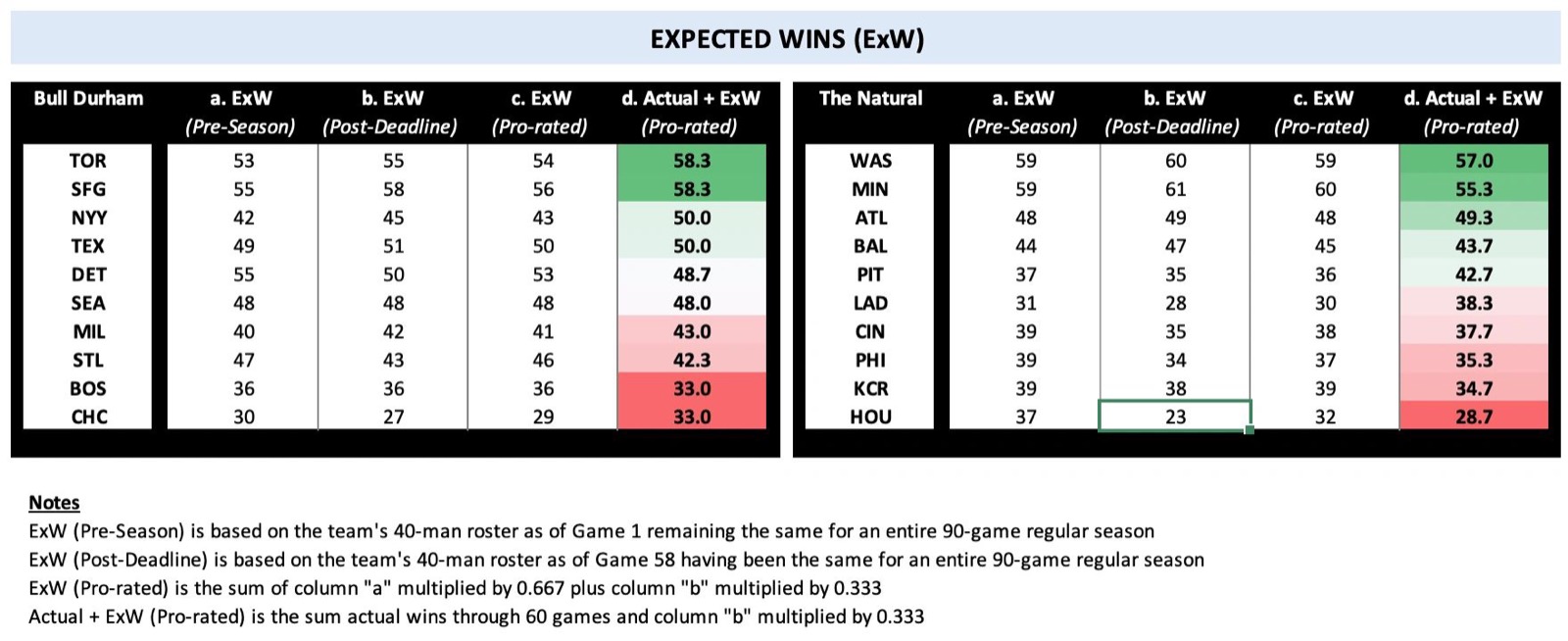
The tables below reflect updated Run Production and Run Prevention scores based on MAAD’s probabilistic analytical platform. Keep in mind that every player’s contribution to the scores are weighted based on their MLB usage – not their expected usage in the MMDBL – so the scores reward 40-man roster depth. With a record 37 DL claims this season – the average was 22 per season from 2023 through 2025 – roster depth has certainly been tested. A higher Run Production Score and a lower Run Prevention Score are best. The Run Prevention Score is subtracted from the Run Production Score to produce a Total Team Score. That score is then applied to a bell curve distribution of wins from 0 to 90 to determine the raw ExW of each team. Small out-of-model positive and negative adjustments to the raw ExW may be made to account for defensive and base running attributes not fully captured in the analytical approach.
When reading the “Expected Wins (ExW)” table (see above), column “a” represents the final pre-season ExW, column “b” represents the post-deadline ExW, column “c” is pre-season expected wins multiplied by 67% plus post-deadline wins multiplied by 33%, and column “d” represents a team’s actual wins over the first 60 game plus post-deadline wins multiplied by 33%. Column “d” represents the revised divisional standings and wins forecast.
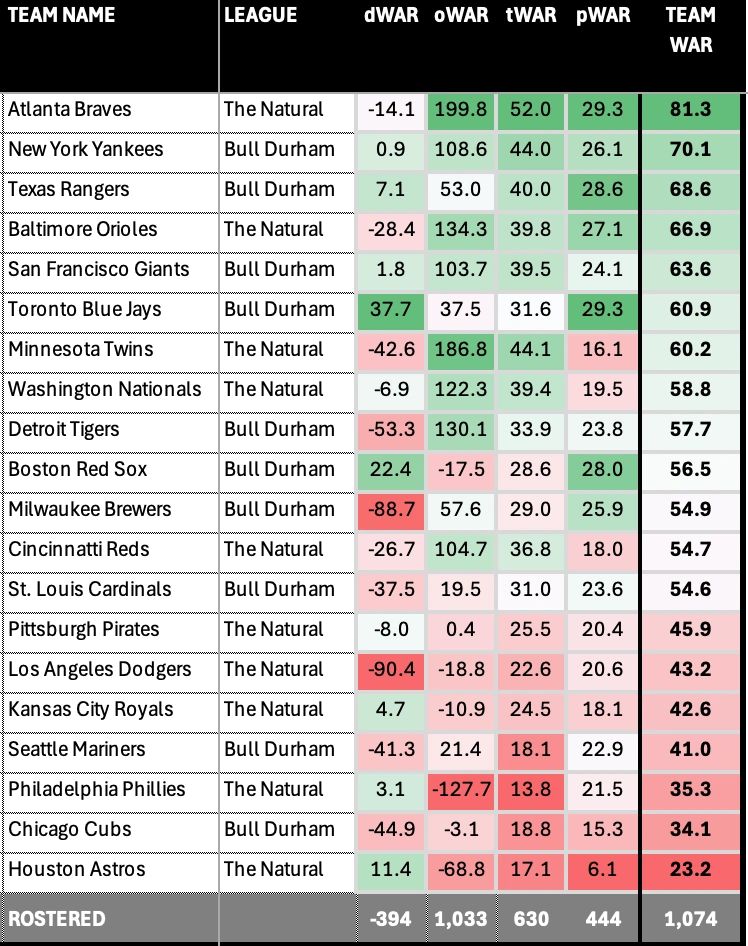
While MAAD's ExW is the core metric for outcome forecasting, total Team WAR remains a corollary metric which, in the past, has been predictive of outcomes. With a roster producing 81.3 of Team WAR), Atlanta continues to lead the MMDBL by a wide margin (+11.2) over the Yankees (70.1) and leads in total position player WAR and pitching WAR (tied with Toronto). Behind the Yankees, there are 5 teams with 60 WAR or better, in order: Texas, Baltimore, San Francisco, Toronto, and Minnesota. The next-closest division contenders outside of the Big 4 are on this list of 60+ WAR teams -- New York and Texas in the Natural, and Atlanta and Baltimore in the Bull Durham. Interestingly, one of the Big 4 -- the Nationals -- is not on the list. The Nats sit 8th in Team WAR at 58.8.