
Can't Miz Prospect: Royals Aced the 2026 Draft
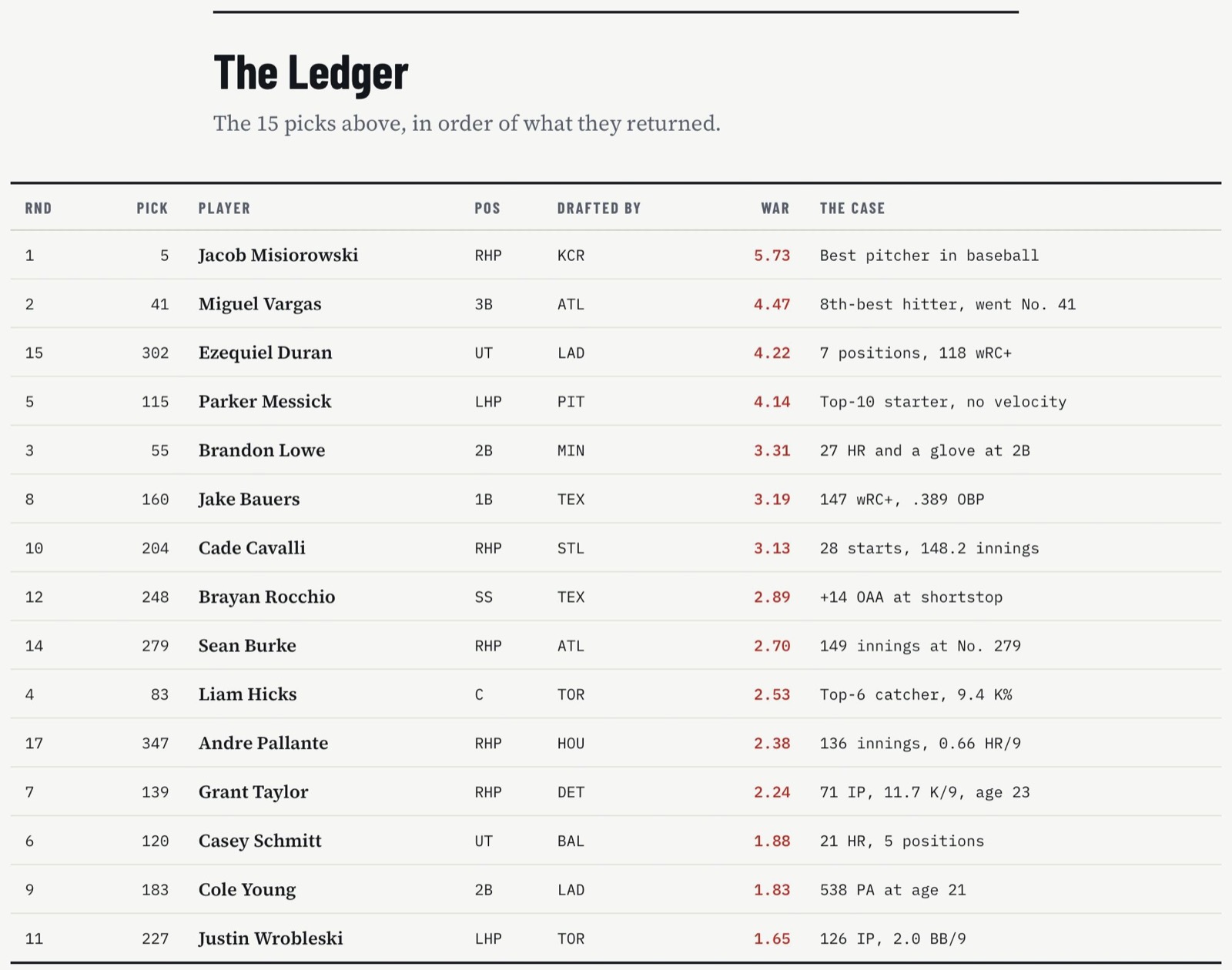
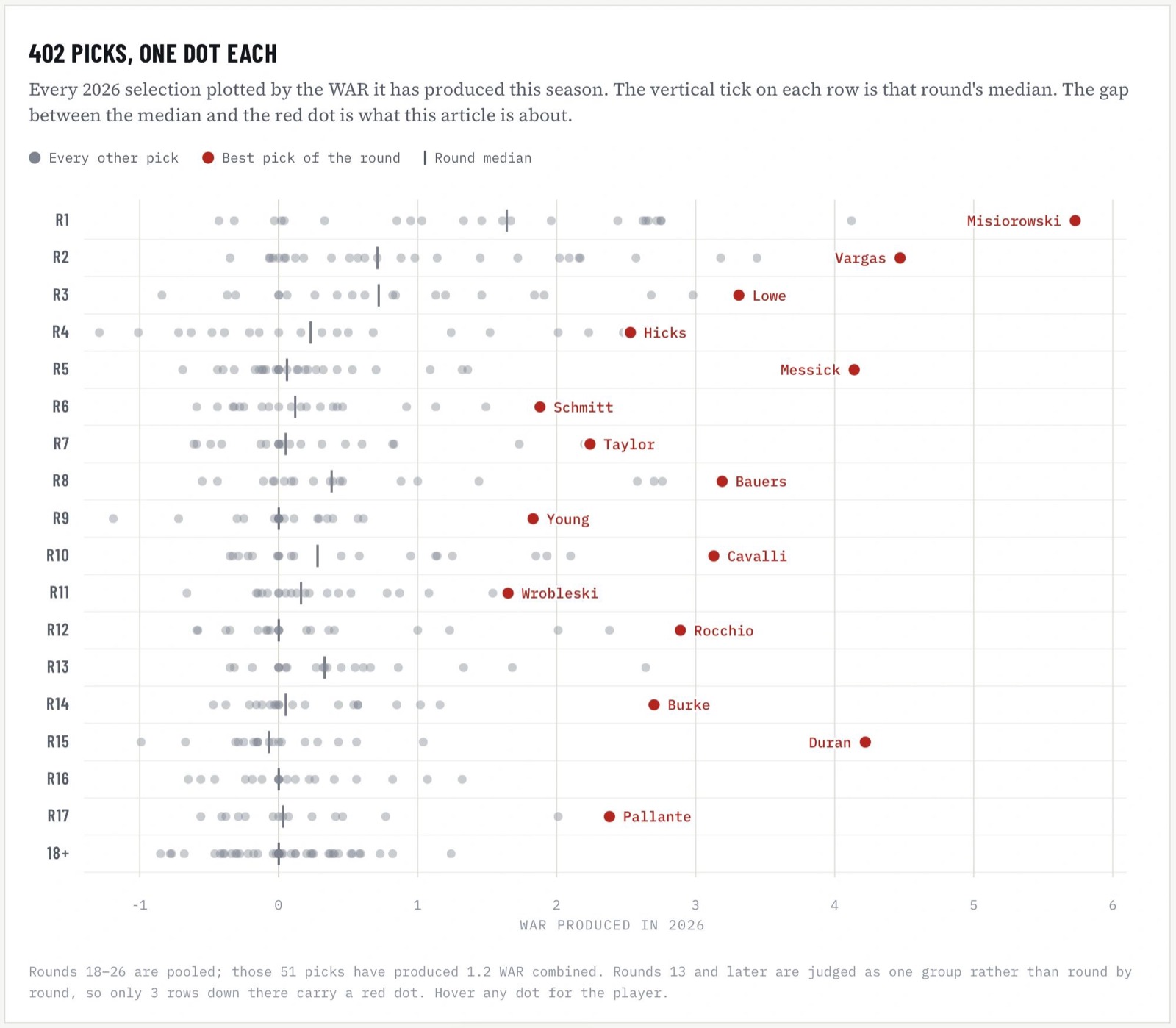
402 players came off the board in the 2026 MMDBL Rookie & Free Agent Draft in January. As of Friday's MLB games, with roughly a month still to play, 215 of them — 53% — have produced 2 tenths of a win or less in terms of Wins Above Replacement (WAR). 44 have not yet recorded a big-league plate appearance or tossed a third of an inning so far this season. Only 42 picks in the entire draft have cleared 2.0 WAR, and 6 have cleared 4.0.
That is not an indictment of anybody's process. That is what a 26-round draft is: 20 owners taking turns being wrong, punctuated by the occasional pick when somebody is spectacularly right. A player's 2026 major league season determines what he's worth to an MMDBL roster in 2027. That makes this a different exercise from a prospect list or a fantasy re-draft, and 2 things drive it, neither of which is the thing most people reach for first.
- What happened; not what should have happened. As MMDBL GMs know, next season is reconstructed from the current MLB season's actual results. That inverts the usual analytical instinct. Estimators like Fielding Independent Pitching (FIP) — which strips out defense and sequencing to isolate the 3 outcomes a pitcher controls by himself — exist to predict next year's Earned Run Average (ERA) and they're very good at it. They are the wrong tool here. A pitcher allowing a .250 Batting Average on Balls in Play (BABIP) behind an ordinary strikeout rate is getting lucky and will regress, but the season he delivers in MLB is the season that carries forward into the next MMDBL season. This cuts both ways, and it decides at least 2 rounds below.
- Playing time is a key input. Rate and volume are separate purchases. A 150 Weighted Runs Created Plus (wRC+ is total offensive production adjusted for park and league, where 100 is exactly average) across 200 plate appearances is a useful part-time bat. A 125 wRC+ across 500 is an everyday lineup spot, and the second one is worth roughly twice the first no matter what the rate stats say. The same logic applies on the mound, where innings and games are what separate a rotation piece from a name on the depth chart. Here's where this list connects with the MMDBL's Advanced Analytics Department's player value model in that playing time is a key input into a player's Expected Contribution Score.
So WAR anchors this exercise, because it is the one number that multiplies rate by playing time and then adjusts for position — a shortstop and a first baseman producing identical batting lines are not producing identical value, and WAR is the only common currency that says so. It anchors the analysis; it doesn't settle it. Position scarcity, defensive quality, bullpen role, platoon usage and age all get a vote, and where 2 picks are close, the younger player wins. MMDBL is a hybrid keeper/dynasty league, so a player who is both — a keeper and a player with dynasty value — is also likely an asset for multiple seasons beyond 2027. Note that for this analysis, supplemental picks are folded into their parent round. Round 1 runs through No. 24, Round 2 through No. 51, Round 5 through No. 118.
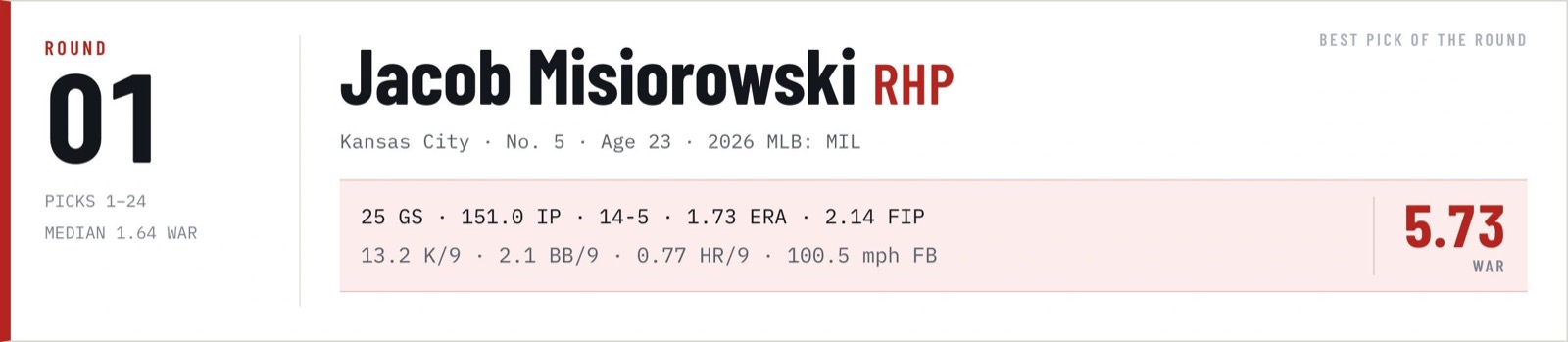
He is the best starting pitcher in baseball this season. Not "one of." The leaderboard has him 1st — ahead of Cristopher Sánchez, ahead of Chris Sale, ahead of Tarik Skubal and Paul Skenes — and Kansas City got him at No. 5 without trading up.
The stuff is the loudest in the sport, and the profile underneath it is what makes the season believable rather than lucky. A 100.5 mph average fastball producing 13.2 strikeouts per 9 innings means roughly 1 in 3 hitters never puts the ball in play against him at all. Pair that with 2.1 walks per 9 and you have a pitcher who decides outcomes by himself — no reliance on the defense behind him, no reliance on sequencing. That is why the 1.73 ERA and the 2.14 FIP agree with each other. When ERA and FIP converge on an elite number, the season is real.
The counter-argument sits 11 slots later and it is a good one. Cam Schlittler at No. 16 has thrown 12 more innings with a 2.09 ERA and 5.15 WAR of his own. If you grade picks on surplus over slot — value received minus draft capital spent — Schlittler is the round's most efficient transaction and Los Angeles should be delighted. But "best pick" is not "best bargain." Misiorowski is 23, throws 100, misses more bats than anyone in the league, and comes with 3 more seasons of team control before the age curve starts working against him. Both are wins. 1 is a franchise.
What makes this round most notable is how much future value it injected into the MMDBL. Chase Burns went No. 8 to Boston and at 22 he is already a 4.12-WAR starter — 139.2 innings, a 2.77 ERA, 10.6 strikeouts per 9, and a 14-3 record. Washington took Nolan McLean 9th; he is 23 and has delivered 148.2 innings of a 3.21 ERA with a strikeout an inning. Houston's Drake Baldwin at No. 7 may be the most underrated of the group: catchers as a class are hitting for a 98 wRC+ this season, and Baldwin has posted a 125 across 496 plate appearances while catching 600 innings. Offense from behind the plate is the scarcest commodity in the sport, and he is 24.
Then there is Roman Anthony, taken 2nd by New York, who has 130 plate appearances and a .229 batting average and is nonetheless among the more valuable assets in this draft. His 2026 contribution is negligible — 30 games doesn't fill a lineup slot. But he has walked in 15.4% of his trips at age 21, and plate discipline is the single most stable skill in a young hitter's profile; it shows up early and it persists. His .352 expected weighted on-base average (xwOBA), which estimates what his contact quality should have produced, sits 42 points above his actual .310, meaning he has been hitting the ball considerably better than the results suggest. That combination — young, patient, unlucky — is the standard shape of a hitter about to break out. New York wasn't drafting for 2027.
Nick Kurtz went 1-1 and has been excellent when available — a 138 wRC+, an 18.2% walk rate — but 99 games and 434 plate appearances is not yet a full-time contribution. Colson Montgomery at No. 3 has hit 28 home runs and has been worth 2.66 wins, and almost none of it has come from the bat: his 100 wRC+ is dead average, his 34.2% strikeout rate is the 2nd-highest in baseball among qualified hitters, and his offensive and baserunning components are both negative. He is a 2.7-win player entirely on the strength of 796 innings at shortstop at +6 Outs Above Average (OAA), the Statcast measure of how many plays a fielder makes beyond what an average defender would. Useful, but not the season 28 home runs implies. Kyle Teel, at No. 12, has only 70 plate appearances.
- ALSO CONSIDERED: Cam Schlittler (LAD, No. 16) — 163.2 IP, 2.09 ERA, 11.1 K/9, 5.15 WAR · Chase Burns (BOS, No. 8) — 139.2 IP, 2.77 ERA, 14-3, 4.12 · Nolan McLean (WAS, No. 9) — 148.2 IP, 3.21 ERA, 10.2 K/9, 2.75 · Drake Baldwin (HOU, No. 7) — 496 PA, 22 HR, 125 wRC+, 600 inn at C, 2.62 · Sal Stewart (PIT, No. 23) — 586 PA, 29 HR, 118 wRC+ at 21, 2.44 · Roman Anthony (NYY, No. 2) — 130 PA, 15.4 BB%, .352 xwOBA at 21, 0.33
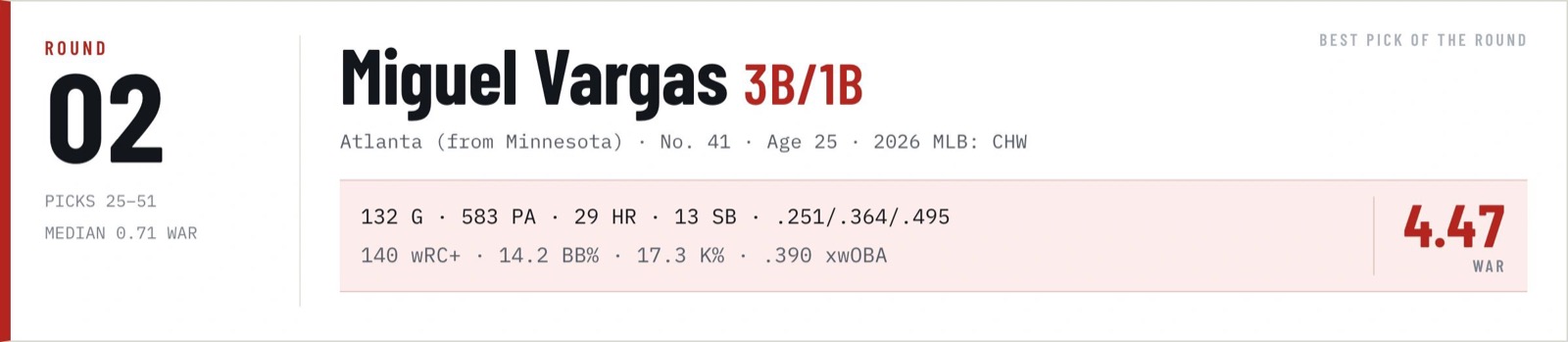
The 8th-most valuable hitter in Major League Baseball went No. 41 overall. Vargas is producing from both halves of the offensive equation at once, which is rarer than it sounds: 29 home runs and a .244 Isolated Power (ISO — slugging minus batting average, so it measures extra-base damage independent of how often he gets hits), alongside a 14.2% walk rate against a 17.3% strikeout rate. League average this season is 8.9% walks and 22.1% strikeouts. He is well above the first and well below the second while hitting for real power, and he has done it across 583 plate appearances.
The batting average understates him badly, and it's worth understanding why. His .257 BABIP is 32 points below the league's .289, which is the signature of poor luck on balls in play rather than poor contact — and his .390 xwOBA against a .370 actual weighted on-base average confirms it. He has been hitting the ball harder than the results have credited him for. The walks matter here too: a hitter who reaches base 36% of the time doesn't need base hits to be productive.
He has so far logged 930 innings at third base — poorly, at -7 OAA, but there, which matters when the alternative is a defensive slot you have to fill somewhere else. Atlanta didn't own this pick; Minnesota did, and traded it. Minnesota's consolation is that they turned around and made the best pick of the 3rd round.
3 more selections from this round deserve real attention. Dominic Canzone went No. 49 and has posted a 134 wRC+ with 20 home runs and an .818 On-Base Plus Slugging (OPS) in 411 plate appearances. The -9.2 Def — FanGraphs' fielding runs above average, which includes the positional adjustment — says the glove gives a meaningful share of that back, so he's a bat you deploy rather than a complete player. But a 134 wRC+ available in the supplemental 2nd round is a genuine find.
Troy Melton, No. 47 to Houston, is this blog's cleanest demonstration of the evaluation rule. His 1.86 ERA over 16 starts ranks 4th in baseball among pitchers with 90-plus innings. His 3.73 FIP says he has been carried there by a .230 BABIP and an 88.5% strand rate, both of which sit far outside sustainable ranges and will regress. If you were projecting Melton forward, you'd be right to discount him. But we are not projecting him forward — we are counting what he has done, and what he has done across 97 innings is allow almost nothing. Houston bought a top-of-the-rotation season for the price of a lottery ticket.
And Chandler Simpson at No. 36 is the most distinctive profile in the draft: 509 plate appearances, 37 stolen bases, a .309 batting average, an 8.3% strikeout rate, and 0 home runs. Typically 0 homers in over 500 plate appearances would be a novelty, but with Simpson power is irrelevant — his game is built on contact, speed and defense. He is a potential perennial leadoff hitter who hits, almost never strikes out at a third of the league rate, adds significant plus value on the bases, and grades at +7 OAA in left field. Toronto will get a full season of that in 2027.
- ALSO CONSIDERED: Chase Meidroth (NYY, No. 28) — 544 PA, 113 wRC+, +7 OAA at 2B, 3.44 WAR · Braxton Ashcraft (ATL, No. 25) — 155.1 IP, 3.59 ERA, 2.0 BB/9, 3.18 · Caleb Durbin (KCR, No. 29) — 483 PA, 16 SB, +5.7 Def, 2.57 · Chandler Simpson (TOR, No. 36) — 509 PA, 37 SB, .309 AVG, 8.3 K%, 2.17 · Carter Jensen (PIT, No. 35) — 502 PA, 19 HR, 682 inn at C at 21, 2.16 · Dominic Canzone (CIN→TOR, No. 49) — 411 PA, 20 HR, .818 OPS, 134 wRC+, 2.09 · Troy Melton (HOU, No. 47) — 97.0 IP, 1.86 ERA, 16 GS, 1.72
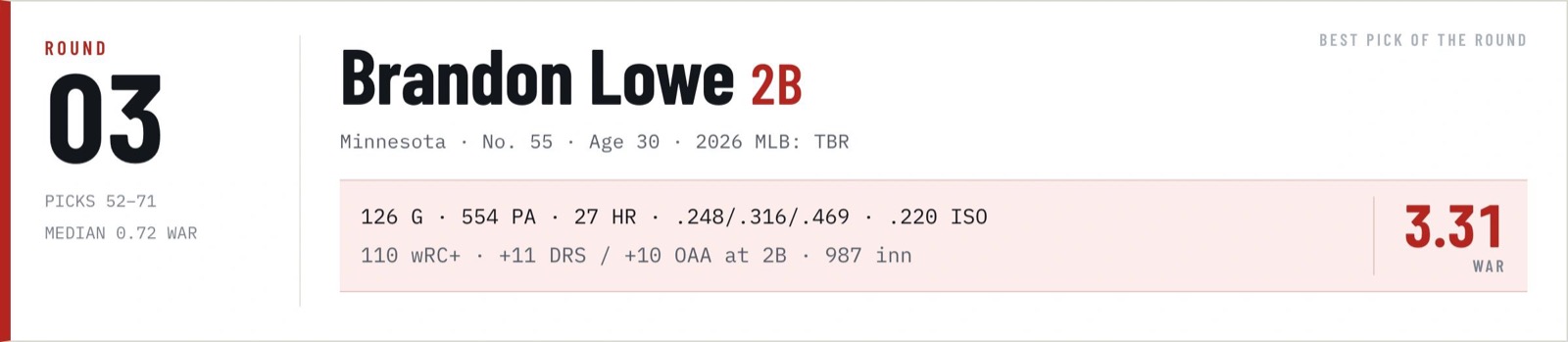
Start with how unusual the power is. Second basemen as a group are hitting 14 home runs per 600 plate appearances this season and producing a 97 wRC+ — the position is, offensively, the thinnest on the diamond outside of catcher. Lowe has hit 27 bombs. Only 3 middle infielders in baseball with 700-plus innings at second or short have reached 25 home runs, and of those, Lowe is the only one who is also a plus defender: CJ Abrams has hit 29 with a better bat but grades at -9.4 Def, while Colson Montgomery's 28 have come with a 100 wRC+.
So Lowe is providing corner-outfield power from a position that almost never supplies it, and giving nothing back in the field — +11 Defensive Runs Saved (DRS, which estimates runs prevented versus an average fielder) and +10 OAA across 987 innings. The 29.8% strikeout rate and .316 on-base percentage keep this from being a star season. It is a very good one, and it came 55th.
Mike Trout went 2 picks later and is the more entertaining answer. He has been healthy — 116 games, 517 plate appearances, a 130 wRC+, a .381 on-base percentage, a 17.2% walk rate. That is the better bat, unambiguously. It is also attached to a 33-year-old who grades at -7 DRS in center field, meaning you either absorb the defensive cost or move him to a corner where a 130 wRC+ is merely good rather than exceptional. Lowe is 3 years younger and plays the harder position.
Detroit's Louis Varland at No. 52 has a case of his own: 30 saves with a 1.20 ERA and a 1.81 FIP across 67.2 innings, and a 55.3% ground-ball rate that suppresses home runs structurally rather than by luck. In fact, he has yet to yield a home run this season. Relief seasons this good are usually gone in the 1st round.
San Francisco spent this round on 2 players who could not be less alike, and both will contribute. Riley O'Brien at No. 62 has saved 34 games, 3rd-most in baseball, with a 3.63 FIP and a 0.49 HR/9 — the ERA of 3.95 is ordinary, but the leverage role and the save volume are what you're buying, and closing jobs are not easy to find in the 3rd round. Jake Mangum at No. 56 is the opposite profile: a .285-hitting 4th outfielder with 21 steals, 810 innings spread across all 3 outfield positions, and a 97 wRC+. He has been worth 1.46 wins essentially by being competent everywhere at once.
- ALSO CONSIDERED: Mike Trout (MIL, No. 57) — 517 PA, 130 wRC+, .381 OBP, 2.98 WAR · Louis Varland (DET, No. 52) — 67.2 IP, 30 SV, 1.20 ERA, 1.81 FIP, 2.68 · Logan Henderson (SEA, No. 69) — 76.1 IP, 2.48 ERA, 1.7 BB/9, 1.91 · Joey Cantillo (MIN, No. 71) — 136.1 IP, 3.70 ERA, 1.84 · Jake Mangum (SFG, No. 56) — 403 PA, .285 AVG, 21 SB, 3 OF spots, 1.46 · Riley O'Brien (SFG, No. 62) — 54.2 IP, 34 SV, 3.63 FIP, 0.49 HR/9, 0.53
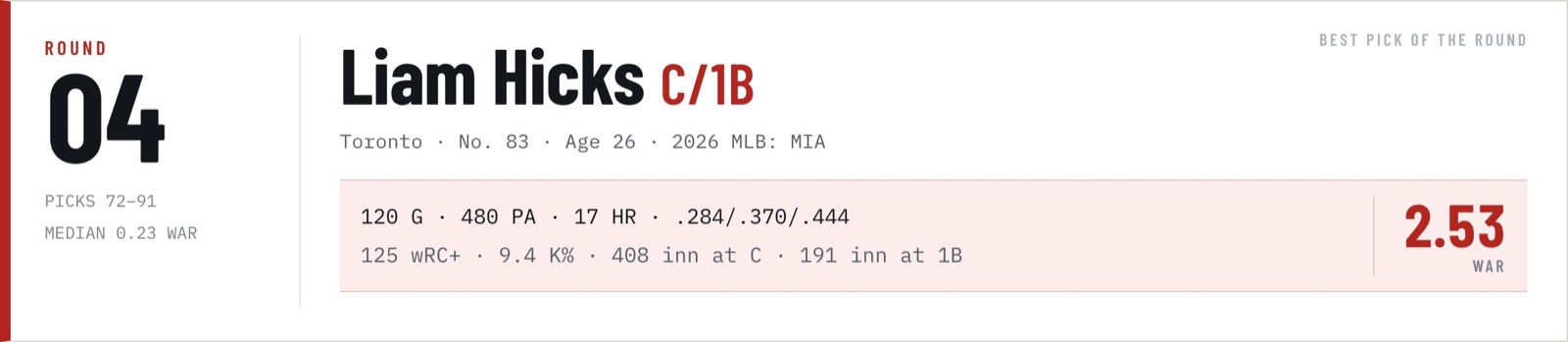
The 6th-most valuable catcher in baseball, at No. 83, with a strikeout rate under 10%. Read that again: 9.4%, against a league average of 22.1%. He puts the ball in play 9 times out of 10.
That skill is worth unpacking, because it is not the same thing as being a good hitter and it ages differently. Contact rate is among the most durable tools a hitter has — it declines slowly and predictably, unlike power or speed. A catcher who almost never strikes out, walks at a double-digit clip, gets on base at .370 and still runs into 17 home runs is producing a 125 wRC+ at a position where the league average is 98. He has caught 408 innings and played 191 more at first base, so he is genuinely available at 2 spots rather than nominally so.
Jac Caglianone at No. 86 is the harder question, and reasonable people will land differently. He is 22, he has posted a 129 wRC+ with 23 home runs and a .500 slugging percentage, and he is a better long-term asset than Hicks by a wide margin. Right now he is a corner outfielder with a 6.0% walk rate and a -7 OAA glove in right field, and corner offense is the most abundant commodity in baseball — the position is averaging a 110 wRC+ this season, so his 129 clears the bar by 19 points, where Hicks clears his by 27. Hicks wins 2027. Caglianone probably wins 2028 and beyond.
Cincinnati made 2 quieter picks here that both work. Heriberto Hernández at No. 73 has hit 21 home runs in 381 plate appearances with a .232 ISO and a 113 wRC+, and — the part that separates him from a generic corner masher — has played 689 innings in left field at +2 OAA. Power that doesn't cost you a defensive position is worth substantially more than power that does, and he was promptly dealt to Toronto. Mike Yastrzemski at No. 84 is the less exciting version and still useful: 337 plate appearances, a 10.1% walk rate, a 94 wRC+, and 739 innings across left and right. A 4th outfielder who can actually play defense is worth more on a 40-man roster than his 0.50 WAR suggests, because the alternative is carrying a bat you can only use as a designated hitter.
- ALSO CONSIDERED: Jac Caglianone (MIL, No. 86) — 483 PA, 23 HR, .500 SLG, 129 wRC+ at 22, 2.48 WAR · Brooks Lee (LAD, No. 87) — 517 PA, 22 HR, 3B/SS, 2.23 · Nolan Arenado (BAL, No. 78) — 492 PA, 21 HR, 1,005 inn at 3B, 2.01 · Heriberto Hernández (CIN→TOR, No. 73) — 381 PA, 21 HR, .232 ISO, 113 wRC+, 1.52 · Mike Yastrzemski (CIN, No. 84) — 337 PA, 10.1 BB%, 94 wRC+, 739 OF inn, 0.50
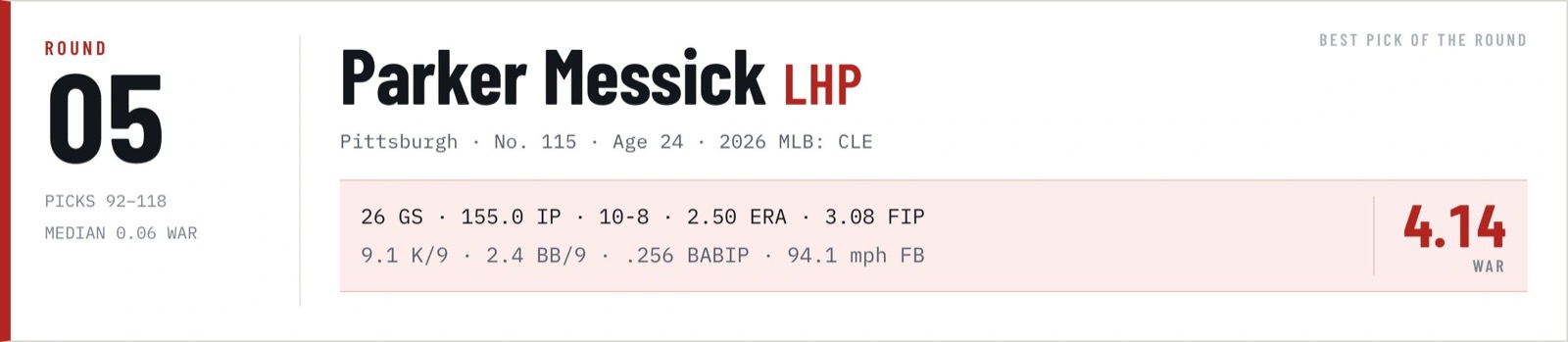
The 5th round has been a graveyard. 27 picks, a median return of 0.06 WAR, 17 of them at or below 2 tenths. Exactly 1 has cleared 2.0, and it has cleared it by more than 2 full wins.
Messick ranks 7th in baseball in pitcher WAR. Pittsburgh got a top-10 starting pitcher with the No. 115 selection, the 2nd-largest surplus over draft slot anywhere in this draft. He is doing it without velocity — 94.1 mph on the fastball, a tick below the major league average for a starter — which is exactly why he was available. Scouts discount the profile because there is no obvious margin for error when the fastball doesn't overpower anyone.
What he has instead is command and volume. 2.4 walks per 9 innings across 155 innings means he is throwing strikes deep into games, and the .256 BABIP suggests hitters aren't squaring him up when they do make contact. The gap between his 2.50 ERA and 3.08 FIP is modest — this isn't a mirage season propped up by a defense playing out of its mind. It is a legitimate mid-rotation starter who happened to be available 115 picks in.
One other selection here is worth flagging. Dylan Beavers at No. 93, taken by Texas but betrothed to Detroit, has put up 265 plate appearances with a .333 on-base percentage, a 10.6% walk rate and a 107 wRC+ at 23. Modest in isolation. What makes it interesting is the distribution: his production is concentrated against right-handed pitching, which is the profile of a strongside platoon outfielder rather than a marginal 5th bat. A hitter you deploy 400 times a season against righties and never against lefties is a materially different asset than his season-to-date rate line implies, because that line is diluted by matchups he shouldn't be taking. His slash line against righties is useful — .251/.339/.415/.755 — but his -9.6 Def across 3 outfield positions is the cost of admission.
- ALSO CONSIDERED: Dalton Rushing (ATL→BAL, No. 92) — 245 PA, 12 HR, 124 wRC+, 472 inn at C, 1.36 WAR · Ian Seymour (ATL, No. 111) — 107.0 IP, 10.8 K/9, 1.32 · Coby Mayo (TEX→BAL, No. 108) — 354 PA, 18 HR, .225 ISO, 1.09 · Jordan Lawlar (STL, No. 106) — 74 PA, 118 wRC+ at 22, 0.53 · Dylan Beavers (TEX→DET, No. 93) — 265 PA, 107 wRC+, 10.6 BB% at 23, 0.19
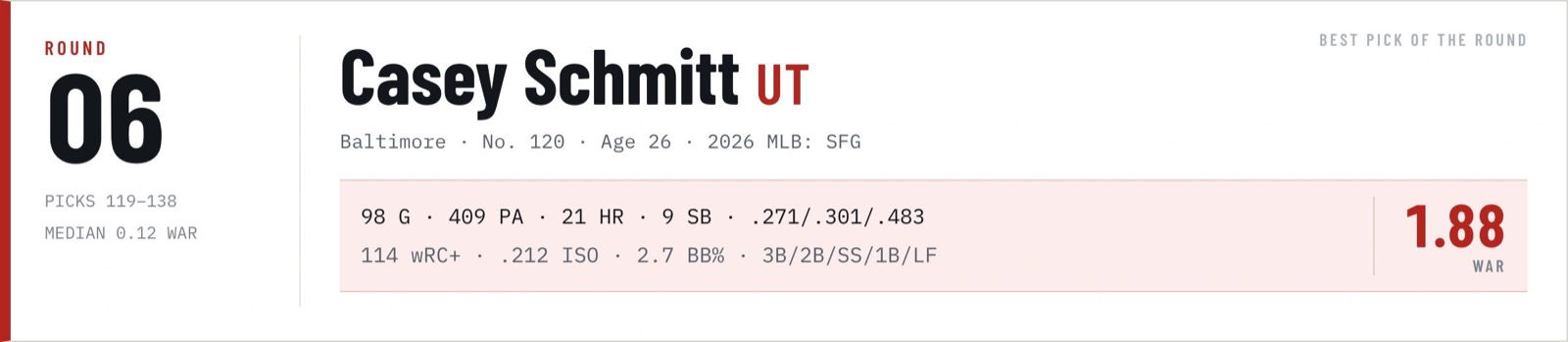
The 6th round is the only round in the first 12 that has produced nobody at 2.0 WAR. Schmitt wins it by being useful in a round where almost nobody is: 21 home runs in 409 plate appearances, a .212 ISO, and innings at 3rd base, 2nd base, shortstop, 1st base and left field.
The 2.7% walk rate is not a typo, and it defines the player. He has walked 11 times all season. That is a hitter with no secondary skills whatsoever — everything he produces has to come from the bat making contact and doing damage, and when he slumps there is nothing underneath to catch him. His .301 on-base percentage against a .483 slugging percentage is one of the widest such gaps in the league.
But defensive versatility has real, quantifiable value that box scores hide. A right-handed bat with genuine power who can legitimately stand at 5 positions solves roster problems continuously — injuries, matchups — and on a 40-man roster the alternative to Schmitt isn't a better player, it's carrying 2 specialists to do the same work. That is what makes him the pick in a round where the next-best option has thrown 98 replacement-level innings.
Behind him the round thins fast. Janson Junk has given Texas 98 innings at close to league average, which at No. 137 is a perfectly fine outcome. Austin Martin's .352 on-base percentage and 3 outfield positions make him a real bench piece. Harry Ford at No. 133 is the developmental play: 76 plate appearances now, catching ability and a 22-year-old's improvement curve later.
- ALSO CONSIDERED: Janson Junk (TEX, No. 137) — 98.1 IP, 4.21 ERA, 4.17 FIP, 1.49 WAR · Austin Martin (SEA, No. 121) — 335 PA, .352 OBP, 12 SB, 3 OF spots, 1.13 · Calvin Faucher (SFG→LAD, No. 128) — 56.1 IP, 10.1 K/9, 2.94 FIP, 0.92 · Harry Ford (MIL, No. 133) — 76 PA, 154 inn at C at 22, 0.46
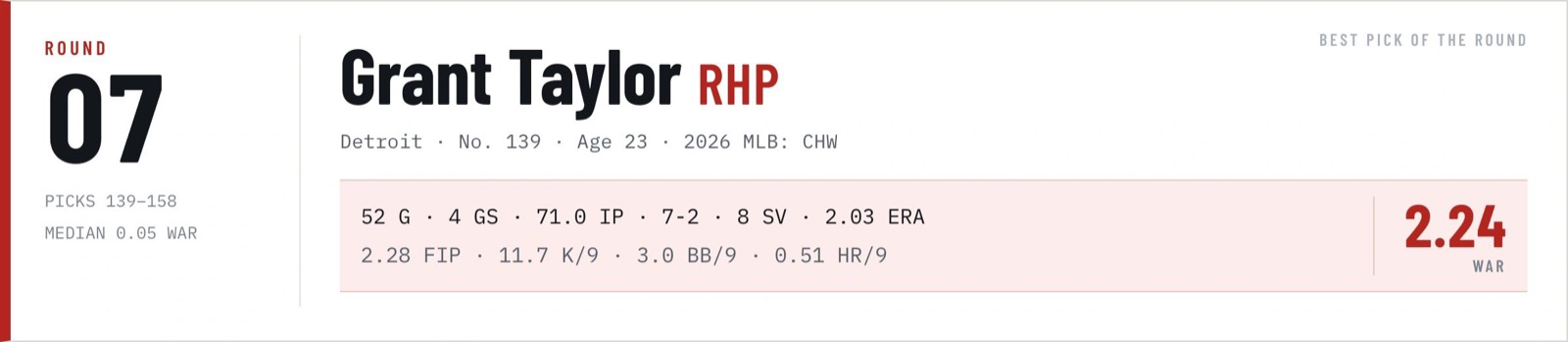
The 7th round comes down to a pair of relievers separated by 4 hundredths of a win, which means WAR isn't deciding it. The shape of the seasons is.
Taylor has thrown 71 innings across 52 appearances, 4 of them starts. That combination is unusual and valuable: it is a full season of high-leverage relief work plus enough length that he can be stretched into a rotation slot when one opens. The underlying performance supports the role — 11.7 strikeouts per 9 innings and a 0.51 HR/9, with an ERA and FIP that agree at roughly 2.10. Nothing here depends on luck or on the defense behind him.
He is also 23, which is the tiebreaker. The version of Taylor who shows up in 2028 and 2029 is likely to be better than this one, and relievers with this strikeout profile at this age frequently end up closing. That said, both the White Sox and Taylor have openly talked about a future move into the rotation as early as next season, so drafting a reliever who becomes a good starter could be a double dose of unexpected value.
Jacob Latz at No. 148 arguably has had the better single season: 26 saves and a 1.68 ERA. But look underneath it. His .180 BABIP is over 100 points below league average. His 3.35 expected FIP (xFIP, which additionally normalizes home-run rate to league average) says the true talent is closer to league-average relief. He is 29. He has been excellent this year and you should absolutely want the season; but it is hard to rate the Latz selection the highest value pick in Round 7.
1 more from this round: Gavin Sheets, No. 141 to Philadelphia, has produced far more than his 0.16 WAR suggests, and understanding why is a useful exercise. 408 plate appearances, 16 home runs, a 12.0% walk rate and a .179 ISO is a legitimately productive offensive profile — a 101 wRC+ despite a .210 batting average, because the walks and the power carried him. That .210 comes from a .228 BABIP, 61 points below league average, which is bad luck rather than bad contact. The reason his WAR sits at effectively zero is entirely defensive: -10.9 Def spread across left field, right field and first base. The bat plays. The glove is why nobody wanted him, but he's a solid designated hitter candidate.
- ALSO CONSIDERED: Jacob Latz (PIT, No. 148) — 59.0 IP, 26 SV, 1.68 ERA, .180 BABIP, 2.20 WAR · Andrew Alvarez (HOU, No. 152) — 84.2 IP, 3.41 FIP, 1.73 · Brooks Raley (TOR, No. 147) — 48.2 IP, 2.22 ERA at 37, 0.82 · Gavin Sheets (PHI, No. 141) — 408 PA, 16 HR, 12.0 BB%, 101 wRC+, 0.16 WAR
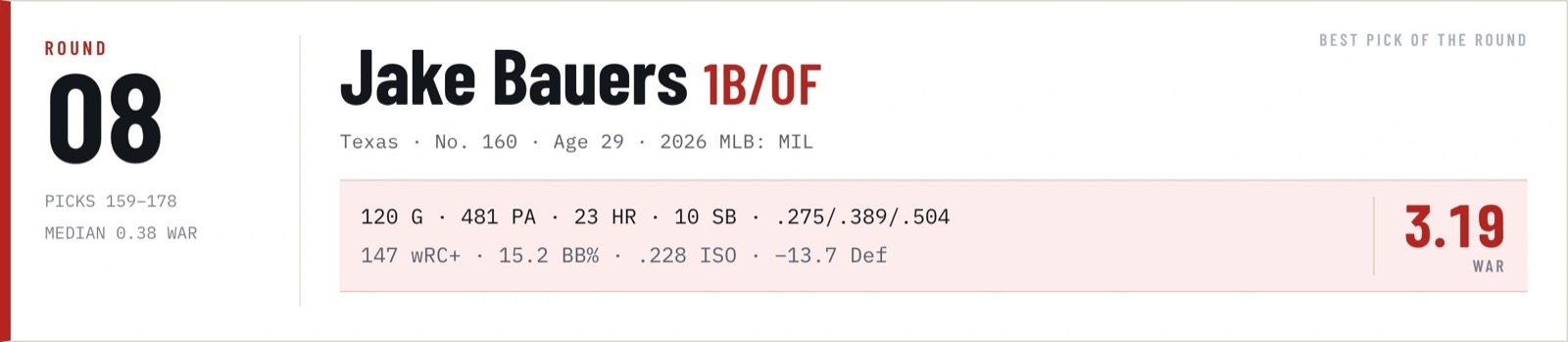
Round 8 has been the best mid-round of the draft — 4 picks at 2.5 WAR or better, more than rounds 5, 6, 7, 9 and 11 combined — and Bauers is the headline. His 147 wRC+ ranks 7th in baseball among hitters with 350 or more plate appearances and was available to Texas (through Baltimore) at pick No. 160.
The profile is the complete offensive package: a .389 on-base percentage built on a 15.2% walk rate, and 23 home runs on a .228 ISO. He gets on base at an elite clip and does damage when he swings, which is the combination that anchors a lineup rather than decorating one. First base is the most offense-heavy position in baseball — the group is posting a 120 wRC+ this season — and Bauers clears that inflated bar by 27 points.
The glove is the tax, and it's steep: -13.7 Def, -7 OAA at first base. That is roughly a win and a half of defensive value handed back, which is why a 147 wRC+ has produced 3.19 WAR rather than 4.5. But first base is where you hide a defender, and Bauers hits far too much to bench over it.
Detroit's Blaze Alexander at No. 178 is the round's best story even if it isn't its best pick. He hit .310/.364/.434 with a 127 wRC+ and played 6 positions before injury stopped his season at 83 games and 251 plate appearances. He returned to active play Friday night, going 1-for-5, so it will be interesting to see if he maintains or regresses. Some of his early season success is good fortune — his .391 BABIP is more than 100 points above league average and will not repeat — but a 26-year-old who can competently stand at 6 spots and hit .310 in the meantime is an unambiguous win at No. 178. The 251 plate appearances are what keep him from ranking higher.
Two more worth naming. Robert Gasser has given Milwaukee 82.1 innings over 15 starts with 2.7 walks per 9. Not good, exactly — a 4.59 ERA and 4.44 FIP are below average — but serviceable back-end rotation innings are among the scarcest things available after No. 150, and somebody has to throw them. And Andrew Benintendi, No. 161 to Seattle, illustrates why WAR anchors this analysis without settling it. His 0.09 WAR reads like nothing, but that figure is almost entirely a -12.4 Def. The offensive line — 397 plate appearances, 13 home runs, a 103 wRC+ — is a perfectly playable everyday bat. You simply should avoid putting him in the field at key moments of a game.
- ALSO CONSIDERED: Ty France (HOU, No. 165) — 395 PA, 138 wRC+, +14 DRS at 1B, 2.76 WAR · Garrett Mitchell (SFG, No. 168) — 441 PA, 117 wRC+, 921 inn in CF, 2.70 · Ryan Weathers (CHC, No. 172) — 137.1 IP, 3.60 ERA/3.60 FIP, 2.58 · Blaze Alexander (DET, No. 178) — 251 PA, .310 AVG, 127 wRC+, 6 positions, 1.44 · Robert Gasser (MIL, No. 173) — 82.1 IP, 15 GS, 2.7 BB/9, 0.88 · Andrew Benintendi (SEA, No. 161) — 397 PA, 13 HR, 103 wRC+, 0.09
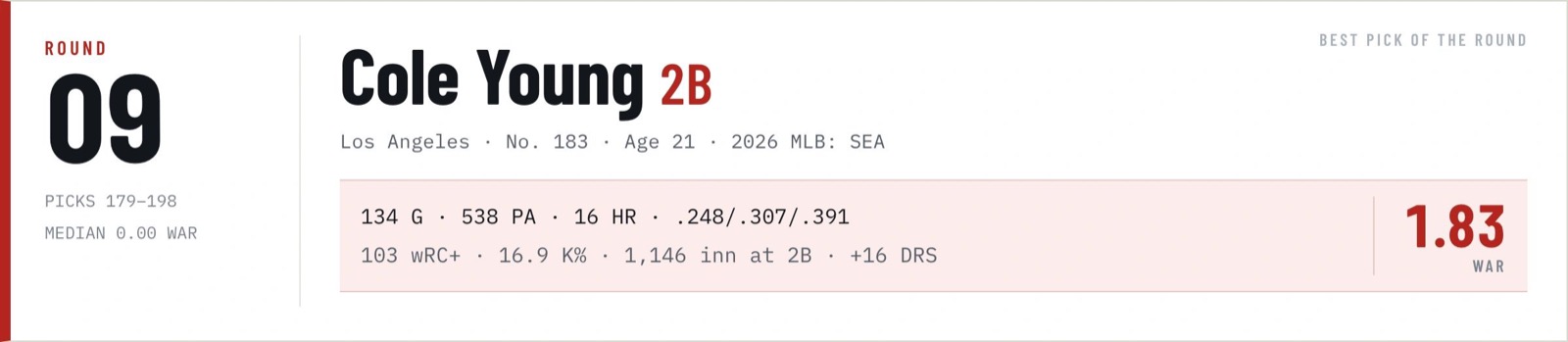
Somebody has to win the 9th round. The median return is exactly 0.00 WAR. 13 of 20 picks have come in at or below 2 tenths. Not one has cleared 2.0. It is the worst round of the draft by a comfortable margin.
Young wins on volume and age, which is the only currency available here. 538 plate appearances of league-average offense from a 21-year-old second baseman is not a season that wins a pennant. It is a player who is already a functional major league regular at an age when most of his draft class is in Double-A, at a position where the league is hitting for a 97 wRC+. His 103 clears that.
The 16.9% strikeout rate is the number that matters for projection. Young hitters who make contact this consistently tend to add power as they physically mature without giving the contact back, which is the standard developmental path from useful regular to good one. The defensive metrics disagree with each other — +16 DRS against -3 OAA across 1,146 innings — so the honest read is that he is somewhere around average at second base rather than the asset DRS implies.
St. Louis's Fernando Cruz at No. 193 is the round's other real contributor, and he is a study in contradictions. 61 appearances, 54.2 innings, and 11.0 strikeouts per 9 innings represents genuinely elite bat-missing ability. Sitting next to it is 5.3 walks per 9, which is close to disqualifying. The 3.13 ERA is what he has actually produced; the 4.16 FIP explains why a pitcher with that strikeout rate was available in the 9th round at 35 years old. Used in the middle innings with the bases empty, where a walk costs little and a strikeout ends a threat, the profile works fine.
- ALSO CONSIDERED: Fernando Cruz (STL, No. 193) — 54.2 IP, 11.0 K/9, 3.13 ERA, 0.39 WAR · Gary Sánchez (TEX, No. 180) — 238 PA, 115 wRC+, 285 inn at C, 0.61 · Eli White (PIT, No. 188) — 172 PA, 5 HR, 5 SB, 0.57 · Nasim Nuñez (DET, No. 179) — 444 PA, 43 SB, +9 OAA at 2B, 56 wRC+, 0.11
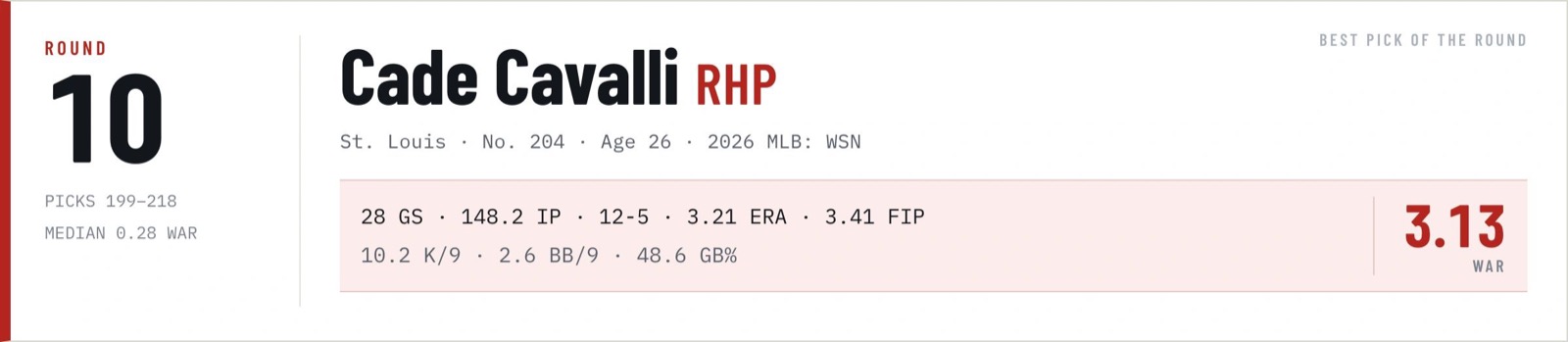
A full, healthy, 28-start season from Cade Cavalli was on nobody's board. At No. 204 it is the largest positive surprise in the draft's back half and the 3rd-largest surplus over slot anywhere in it.
What makes it more than a fluke is the durability underneath. Only 23 of the 137 pitchers who have made 15 or more starts this season have reached 149 innings; the median is 126. Cavalli has gotten to 148.2 across 28 turns, and has done it with a strikeout an inning and 2.6 walks per 9. His ERA and FIP agree within 2 tenths, which means the run prevention wasn't borrowed from his defense. That is a legitimate No. 2 starter, and it came from the 10th round of a 20-team draft. St. Louis had a quiet draft otherwise; this single pick accounts for 73% of their total return.
The round has depth behind him, which is unusual this late. Jake McCarthy is hitting .291 with 25 steals and a 107 wRC+. Nick Gonzales is hitting .305 with a .366 on-base percentage (OBP) across 525 plate appearances, though a .364 BABIP means the average will come down. Kyle Karros, 22 years old, has posted a .360 OBP.
And Jeff Hoffman at No. 212 is the sharpest illustration in this draft of the gap between how a pitcher performed and how his season will read. 13.8 strikeouts per 9 and a 2.60 FIP is genuinely excellent — back-of-the-bullpen stuff. His 4.02 ERA says otherwise, and the culprit is a .383 BABIP that is nearly 100 points above league average, which no pitcher sustains and none deserves. Everything Hoffman has controlled, he has controlled well. Everything he hasn't has gone against him.
- ALSO CONSIDERED: Jake McCarthy (HOU, No. 205) — 476 PA, .291 AVG, 25 SB, 107 wRC+, 2.10 WAR · Nick Gonzales (KCR, No. 203) — 525 PA, .305/.366, 111 wRC+, 1.93 · Kyle Karros (ATL→STL, No. 199) — 403 PA, .360 OBP at 22, 1.85 · Jeff Hoffman (CHC, No. 212) — 56.0 IP, 13.8 K/9, 2.60 FIP, 1.25
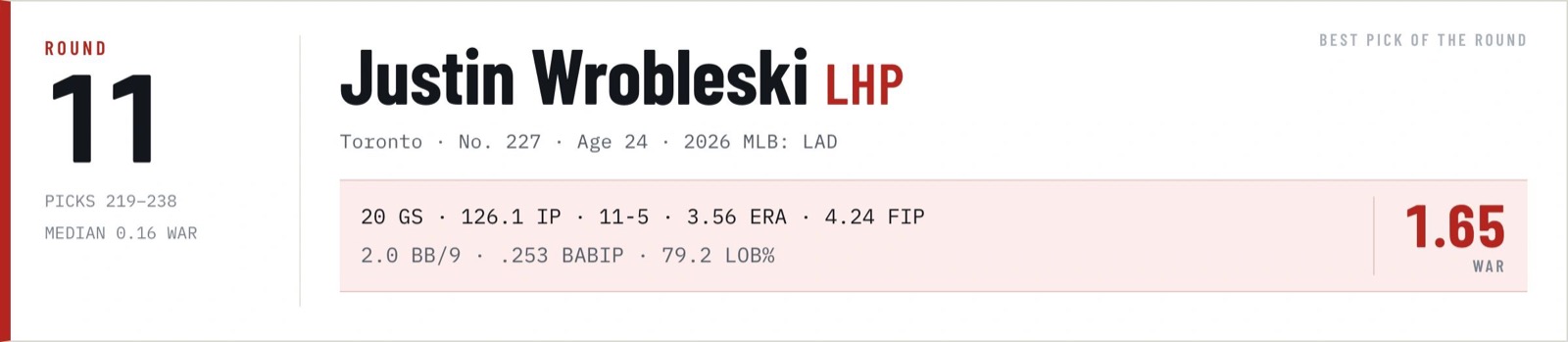
This is the round where the evaluation rule stated at the top earns its keep. By WAR, Wrobleski (1.65) and JJ Bleday (1.54) are a coin flip. By any predictive measure it isn't close — Bleday's 110 wRC+ is a real skill, and Wrobleski's 4.24 FIP against a 3.56 ERA says loudly that he has outperformed his peripherals.
He has. His .253 BABIP is 36 points below league average, his 79.2% strand rate is above the norm, and a pitcher striking out only 7.1 per 9 while allowing 1.35 home runs per 9 is not usually running an ERA in the mid-3s. If you were betting on 2027 performance you would take Bleday without much thought.
But we are counting 2026, and in 2026 Wrobleski has thrown 126 innings across 20 starts and given up very little. That volume matters: it is roughly the median workload for a major league starter this season, from a pitcher taken 227th. Bleday's season, by contrast, has a .219 batting average sitting in the middle of it. The 13.9% walk rate and 21 home runs are real value and they are why his wRC+ is 110 — but a .219 hitter is a .219 hitter, and the volume of quality innings is the scarcer commodity. Bleday's 2026 season was a bit of a breakout, however, it's beginning to seem plainly clear that he'll never be the hitter we was expected to become coming out of college.
Behind those two, Nick Fortes at No. 236 is worth more than his 0.87 WAR implies. 635 innings of catching with a 12.1% strikeout rate is a solid roster solution — teams need 2 catchers, and the second one is usually an automatic out. Fortes isn't, and he brings strong defense along with it.
- ALSO CONSIDERED: JJ Bleday (KCR, No. 234) — 447 PA, 21 HR, 13.9 BB%, 110 wRC+, 1.54 WAR · Jacob Lopez (PIT, No. 228) — 99.0 IP, 8.7 K/9, 1.08 · Nick Fortes (SEA, No. 236) — 281 PA, 635 inn at C, 12.1 K%, 0.87 · Lane Thomas (ATL, No. 238) — 366 PA, 11 HR, 9 SB, 0.78
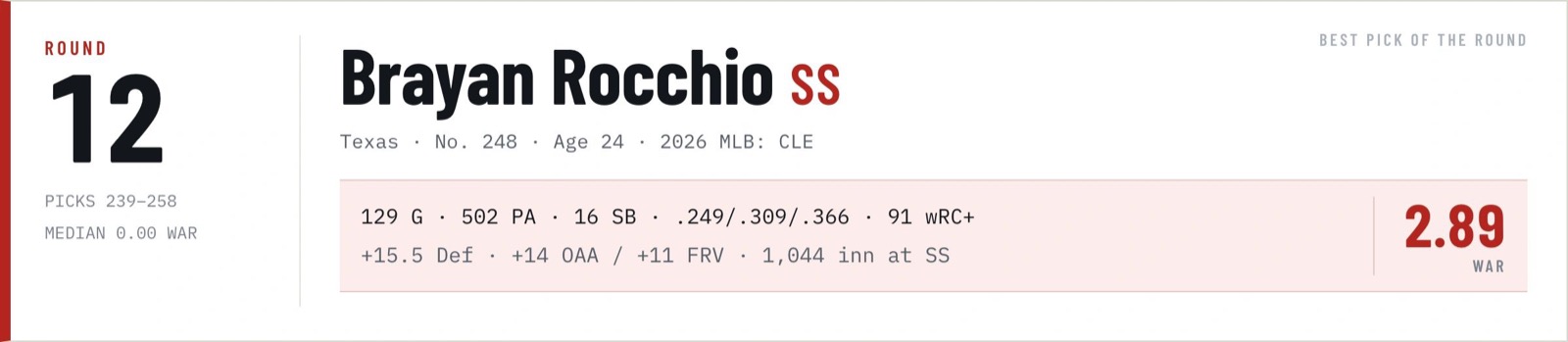
Rocchio's bat is below average — a 91 wRC+ — and nothing about this argument disputes that. It simply doesn't matter as much as it appears to. He has played 1,044 innings at shortstop and is the 5th-best defender in baseball at the position: +14 OAA and +11 Fielding Run Value (FRV, Statcast's translation of those plays into runs). His total defensive contribution of +15.5 runs is worth about a win and a half on its own.
Understand what that means in practice. Every ground ball hit toward the left side of the infield is more likely to become an out with Rocchio standing there than with an average shortstop. Shortstops league-wide are hitting for a 99 wRC+, so Rocchio's bat is 8 points below the positional norm — a small deficit he repays many times over with the glove.
Defense remains the most reliably under-drafted asset in this league and it isn't close. A shortstop who saves 15 runs in the field while hitting a bit below average is more valuable across a full season than a corner outfielder with a 110 wRC+ and a bad glove, and 1 of those goes in the 3rd round while the other went No. 248. Texas made this pick (through San Francisco) and now owns both the best 8th-round pick and the best 12th-round pick as a result of draft day trades.
The selection that will get argued about, though, is 10 slots later. Bryan Baker leads the MLBl in saves with 38, and is doing it with a 1.56 ERA, 10.0 strikeouts per 9, 2.8 walks per 9 and a 0.69 HR/9 across 54 appearances. The best relief season in baseball this year belongs to Boston's Mason Miller, who was already rostered and never entered this draft. Among players who actually came out of it, the argument is between Baker and Louis Varland, and it is a full-throated one: Varland has the better rate line — a 1.20 ERA, a 1.81 FIP, 67.2 innings — and went 206 picks earlier. Baker has the saves, a better WHIP, and was acquired 9 rounds later when teams are taking fliers.
Save totals are not a skill; they are evidence of a role, and the role is what's scarce. A pitcher who has recorded 38 of them has held the 9th inning all season on a winning team, which is information about how his own organization evaluated him. The .210 BABIP and 87.3% strand rate underneath say he is unlikely to repeat this, but Detroit bought the MLB's saves leader in the 12th round.
- ALSO CONSIDERED: Davis Martin (KCR, No. 243) — 125.0 IP, 24 GS, 3.71 FIP, 2.38 WAR · Trevor Larnach (LAD, No. 254) — 393 PA, 120 wRC+, 2.01 · Bryan Baker (DET, No. 258) — 52.0 IP, 38 SV (MLB lead), 1.56 ERA, 10.0 K/9, 1.23 · Erik Sabrowski (CHC, No. 252) — 39.0 IP, 15.0 K/9, 2.75 FIP, 1.00
Round 13 to the End
144 picks. 28 combined wins so far. A median of 0. 5 selections have cleared 2.0 WAR, and these are the 3 that matter.
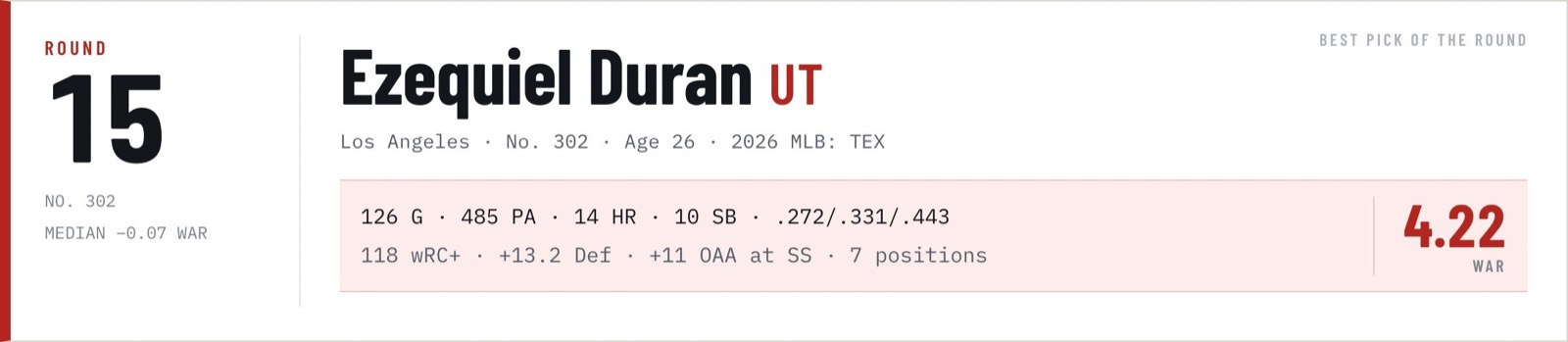
This is the best pick in the draft. Not the best pick after round 12 — the best pick, at any point, on any board. Ezequiel Duran is the 12th-most valuable position player in the MLB this season, and he came off the board at No. 302, in a round whose median selection has been actively harmful.
The batting line alone would justify the pick: he is hitting .272 with a 118 wRC+ across 485 plate appearances, with 14 home runs and 10 steals. What elevates it is where he stood while producing that. He has played 7 positions — 383 innings at shortstop at +11 OAA, 289 at third base, 171 at second, plus innings in all 3 outfield spots and at first. He is not a utility man in the pejorative sense, meaning a player parked wherever he does the least harm. He is an above-average defender at the hardest position on the field who happens to be eligible everywhere else too.
That combination is genuinely rare, and it compounds. Most versatile players are versatile because they can't hit enough to hold a position; Duran hits well enough to start at any of them. He absorbs injuries, covers rest days, and fills whatever hole opens next, without the lineup getting worse when he does it. Round 15's median return is negative. Los Angeles has gotten 4.22 wins.
3 picks earlier, at No. 299, Detroit took Ildemaro Vargas, who is the modest version of the same idea and still useful. 423 plate appearances, a 9.9% strikeout rate — less than half the league norm — and innings at 2nd, 1st, 3rd, shortstop and left field, including +5 DRS across 438 innings at first base. His season-to-date 87 wRC+ is unimpressive on its face, but the production is concentrated against left-handed pitching where he is slashing .316/.338/.522/.860 and will anchor the short side of a platoon.
- ALSO CONSIDERED: Nick Sogard (MIN, No. 301) — 169 PA, .367 OBP, 113 wRC+, 1.04 WAR · Ildemaro Vargas (DET, No. 299) — 423 PA, 9.9 K%, 5 positions, +5 DRS at 1B, 0.61 · Kirby Yates (ATL, No. 317) — 38.2 IP, 10.7 K/9 at 38, 0.43
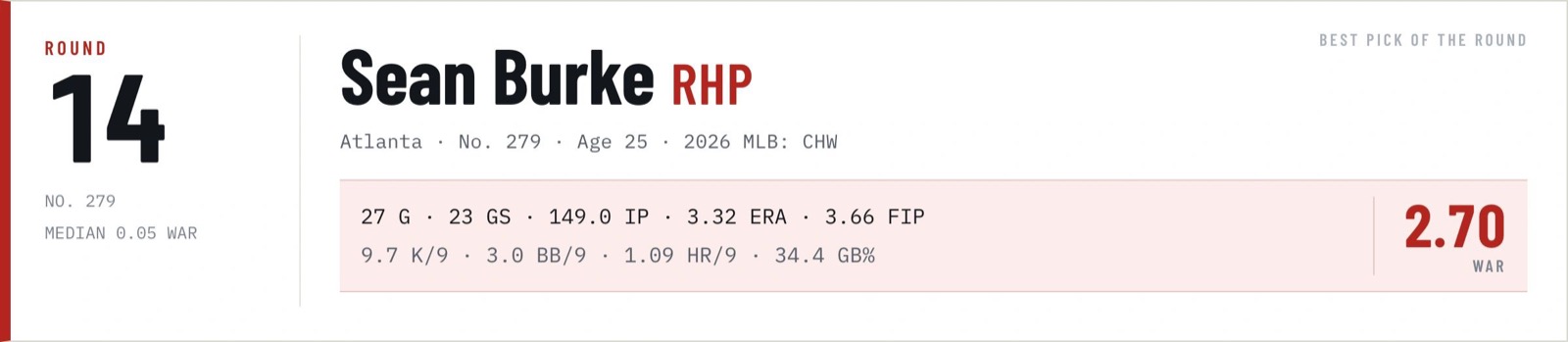
149 innings of mid-3s run prevention with a strikeout an inning, taken 279th, out of a round that returned 5 hundredths of a win at the median. Every part of that sentence is unreasonable.
The innings are what make it. Only 23 pitchers in baseball who have started 15 or more games have reached 149 innings this season — the median starter has thrown 126 — so Burke is in the top fifth of the league in workload at 25 years old. Durability of that kind is worth more than an equivalent rate line spread across 90 innings, because the gap between a starter who gives you 149 innings and one who gives you 90 has to be filled by someone worse.
The flaws are real and worth naming. A 34.4% ground-ball rate is well below average, which means a lot of balls in the air, and 1.09 home runs per 9 is the predictable consequence. He will give up runs in bunches on the wrong night. He has also taken the ball 27 times, which nobody else available at No. 279 was going to do.
Two position players from this round will outperform their WAR lines. Nathaniel Lowe, No. 298 to Detroit and traded in the deal that sent Logan Webb to Milwaukee for Eury Perez and Jack Leiter, has hit 14 home runs with a .785 OPS and a 113 wRC+ in 353 plate appearances, and his value concentrates against right-handed pitching, where the OPS pushes past .850. His 0.57 WAR is almost entirely explained by a -10.5 Def at first base; the bat is a legitimate strongside starter. Taylor Walls at No. 297 is the pure defensive play — 920 innings at shortstop with +18 DRS. Worth a caveat, though: OAA and FRV both grade him slightly negative, and when 2 defensive systems disagree that violently the truth usually sits between them. Walls is 20-steal shortstop who starts virtually everyday has value even with a 71 wRC+, however, just don't underwrite him as an elite defender on what one metric indicates especially when other metrics tell a different story.
- ALSO CONSIDERED: Tyler Alexander (NYY, No. 282) — 57.1 IP, 2.80 FIP, 61 G, 1.16 WAR · Matthew Liberatore (BAL→CIN, No. 280) — 129.0 IP, 26 GS, 9.2 K/9, 1.02 · Nathaniel Lowe (DET→MIL, No. 298) — 353 PA, 14 HR, .785 OPS, 113 wRC+, 0.57 · Taylor Walls (TEX→NYY, No. 297) — 382 PA, 20 SB, 920 inn at SS, +18 DRS, 0.54
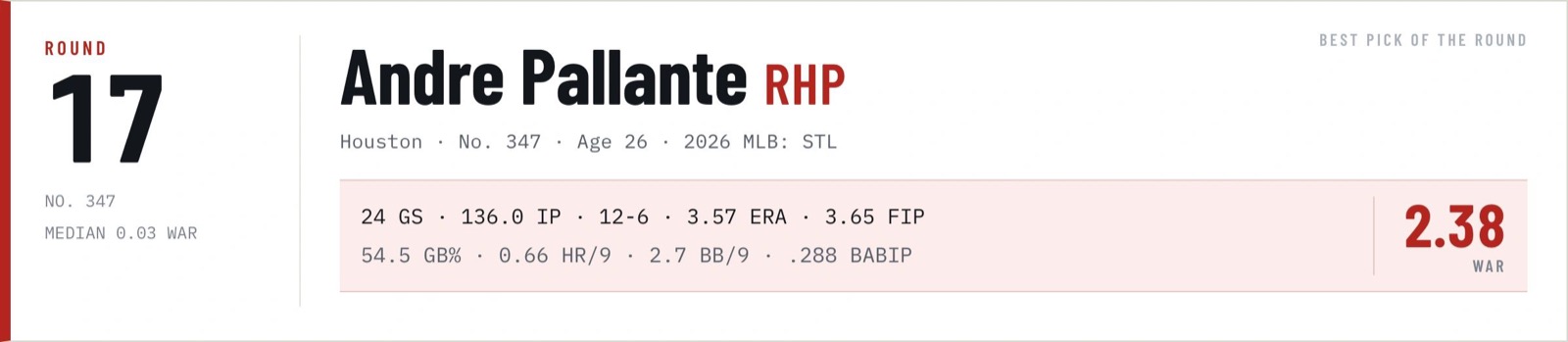
The 3rd slot is the one worth arguing about, so let's argue about it. Dustin May went 88 picks earlier — No. 259, the first selection of round 13 — and has produced more WAR, 2.64 to 2.38, on the strength of a 3.36 FIP.
Under a predictive lens, May is the better pitcher and it isn't especially close. His FIP is 3 tenths lower, his 4.56 ERA is inflated by a .318 BABIP and a 66.1% strand rate that are both worse than he deserved, and a forecast for 2027 would favor him comfortably.
But we are counting what happened. Pallante has thrown 12 more innings, allowed a full run less per 9, and has done it with a 54.5% ground-ball rate — the mechanism matters here, because keeping the ball on the ground is a repeatable skill that suppresses home runs structurally rather than by luck. His 0.66 HR/9 is 3rd-lowest among starters in this draft. May's season is the better performance; Pallante's is the better outcome, delivered 88 picks later out of a round with a median return of 3 hundredths of a win.
The back half of the draft produced two more names worth writing down. Drew Gilbert, No. 336 to Detroit, is the same archetype as Dylan Beavers 240 picks earlier: a 24-year-old outfielder whose season-to-date 101 wRC+ conceals a materially better platoon profile, with the OPS clearing .800 and the power climbing against right-handed pitching. Add 637 innings of +3 OAA center field and you have a strongside starter who can also handle the premium outfield position — a 16th-round pick who belongs in a lineup. And Brady House, No. 274 to Kansas City, is the developmental pick of the group: 278 plate appearances, 10 home runs and a .335 xwOBA at 22, with 485 innings at third base.
ALSO CONSIDERED: Dustin May (DET, No. 259) — 124.1 IP, 3.36 FIP, 25 GS, 2.64 WAR · Ben Brown (NYY, No. 350) — 68.0 IP, 1.85 ERA, 2.48 FIP, 0.26 HR/9, 2.01 · Sean Newcomb (LAD, No. 263) — 75.0 IP, 2.28 ERA, 2.94 FIP, 1.68 · Michael McGreevy (TEX→HOU, No. 260) — 142.1 IP, 26 GS, 1.33 · Kumar Rocker (KCR, No. 322) — 126.2 IP, 23 GS, 1.32 · Edgardo Henriquez (BOS, No. 372) — 54.1 IP, 2.59 FIP, 10.3 K/9 at 23, 1.24 · Drew Gilbert (DET, No. 336) — 332 PA, 101 wRC+, 637 inn in CF, 1.07 · Brady House (KCR, No. 274) — 278 PA, 10 HR, .335 xwOBA at 22, 0.33
3 Things This Draft Says
- Defense is still free. Brayan Rocchio went No. 248 with a 91 wRC+ and the 5th-best shortstop glove in baseball. Ezequiel Duran went No. 302 and has saved 13 runs across 7 positions. Taylor Walls went No. 297 after 920 innings at short. Chase Meidroth went No. 28 and has been worth 3.4 wins largely because he can play second base. Defensive value accrues on nearly every batted ball and never slumps, and it is consistently available 200 picks after the offense is gone. The league is paying for slugging percentage and getting run prevention thrown in.
- Innings are the currency of the back half. Of the 8 winners from round 7 on, 5 are pitchers, and 4 of those have thrown 126 innings or more — at or above the median major league starter's workload. Once the everyday bats are gone, and they are gone by round 8, the only way left to buy something that contributes every week is a starter who takes the ball. Rate statistics are cheap after No. 200. Volume is not.
- The 1st round is still the 1st round. 24 picks have produced 44.0 of the draft's 197.4 total WAR. That is 22% of the value from 6% of the selections, and the top 3 alone — Misiorowski, Schlittler, Burns — account for 15.0 wins, more than rounds 9 through 26 combined. Everything after is scavenging. Which, to be fair, is the fun part.
Methodology: 402 selections from the 2026 Draft tab of the MMDBL Master Database (08/16/2026), matched by name to FanGraphs batting, pitching and fielding leaderboards through games of August 28, 2026. WAR is the sum of a player's batting and pitching WAR. Supplemental picks are folded into their parent round (Rd. 1 = picks 1–24, Rd. 2 = 25–51, Rd. 5 = 92–118). The 44 selections with no 2026 major league appearance are carried at 0.0 WAR. Ownership shown is the drafting team; where a player has since changed hands it is noted in the text. The post-draft mulligan slot is excluded. Every figure here is a season-to-date total with roughly a month of the major league schedule still to play, and all of it will move. Platoon-split observations are qualitative; the FanGraphs exports used here are full-season only.