
For Openers, the Phillies Will be Doing This All Season
It should be evident by now that the Phillies are double-down on the concept of “The Opener.” While some teams roll out an occasional “bullpen game”, the Phillies are the MMDBL’s version of the real-life Tampa Bay Rays. They use The Opener as a means of existence and, through 24 games, as a cornerstone of success.
The Phillies are 17-7, tied for the best record in the league. They’re 6th in OPS and 13th in WHIP. More importantly, they’re 4th in runs scored and 2nd in runs allowed. Clearly, there’s a disconnect when a team is able to pivot from the league’s 13th best WHIP to allow fewer runs than all but one other team. This is like saying a player with a 1.40 WHIP has a league-leading ERA. In this scenario, you’d probably surmise that the player either bears down and gets clutch outs. He may walk a guy and give up a hit, but with 2 on and 1 out, he gets the key double play or strikeout. A shutout inning with 2 earned baserunners is a 2.00 WHIP and 0.00 ERA. That’s what the statline will show, and the scoreboard will show a zero.
At closer inspection, this example is actually extremely applicable to the Phillies. But the way in which Philadelphia is achieving the end result – putting zeros on the board – may be more systematic and, dare I say, strategic that one might think. In fact, it might be part of the plan, and that plan starts with The Opener.
First the macro stats. Here’s what the Phillies allow with runners in scoring position (RISP) relative to the top 5 teams in terms of overall WHIP and the team most like them from a pitching statistical perspective (Boston):
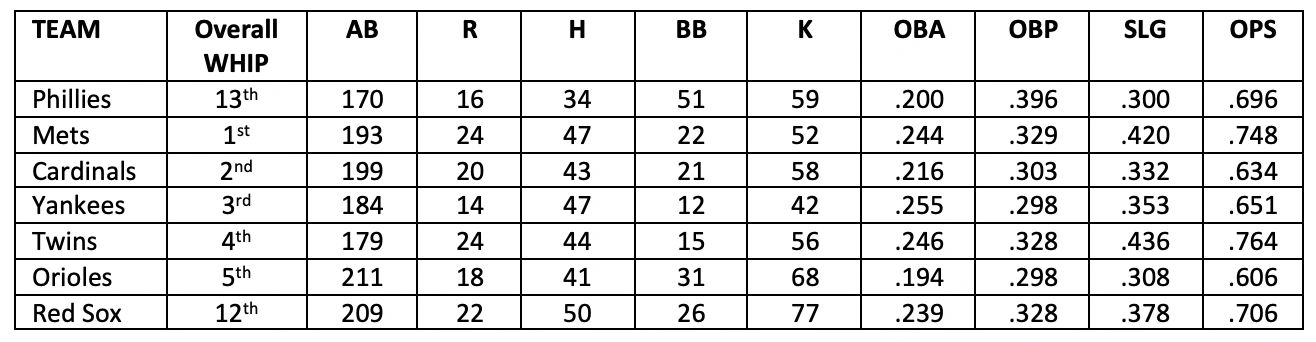
The first thing we notice is the walks. Oh the walks! The Phillies lead this group by a large margin in walks allowed with RISP. And this leads to a group-leading OBP of .396, a whole 67 points ahead of the next closest team. However, the Philiies also yield the fewest hits with RISP among this group of overall WHIP leaders, and that results in two key results – an opponent batting average of .200 and a group-low slugging average of .300 with RISP.
This is proof that a walk isn’t as good as a hit, at least not with runners in scoring position. The Phillies opponent batting average and slugging metrics with RISP are in elite company. This trend continues when you widen the aperture to “runners on” situations, as well. They yield walks, fewer hits, and even less damage.
So is this pure luck or strategy? It appears these results are managed, from start to finish, throughout each game. The use of an Opener enables the Phillies to keep all options on the table as the game progresses, to match up opponents in key situations, and to turn their opponent’s lineup potentially multiple times in a game. Phillies Openers, themselves, are middling at best, sporting a 3-3 record, 4.11 ERA and 1.48 WHIP while facing an average of 13.5 batters per outing and lasting an average of 3 innings. When you take out Openers not named Kershaw, Keuchel or Kluber, the results are worse – 5.05 ERA and a 1.83 WHIP over 15 games. (The “Three Ks” are a combined 2.42 ERA with a 0.85 WHIP as Openers.)
Still, Phillies games are not won or lost by the Openers. The Three Ks are 1-1 as Openers, and the others are 2-2. Phillies games are won or lost – or more notably, won – with who follows the Opener. In all 24 games, the Phillies have had at least 3 pitchers, and in 21 games they’ve gone 4 deep. It’s worth noting that in 18 games they’ve gone 5 deep, and in 16 games – or 2 of every 3 games played so far – they’ve used 6 pitchers. While pitchers No. 5 and 6 are important, pitchers No. 2, 3 and 4 are most critical to the Phillies’ early season success. Combined the 2-4 slots have combined for 42% of the team’s innings versus 34% for its Openers, with slots 5-9 combining for 24%. Applying the theory of volume, he who does the most is most important, so let’s start there.
Pitchers No. 2-4 average 6.8, 4.8 and 4.9 batters faced, respectively, and account for an average of 1 2/3rd, 1, and 1 1/3rd innings, respectively. That’s a total of 16.5 batters faced over 4 innings. In Phillies games, this covers the 4ththrough 7th innings, sometimes starting earlier, but rarely ending later. Pitchers in the No. 2-4 slots are a combined 10-1, meaning that in these critical innings, the Phillies are grabbing the lead and, generally, holding onto it. With Openers at 3-3, that means pitchers No. 5-9 are a combined 4-3. The Phillies don’t win early or late – they win in the middle when other teams are focused on extending their starters to save their bullpens and keeping bats on the bench for critical late-game situations.
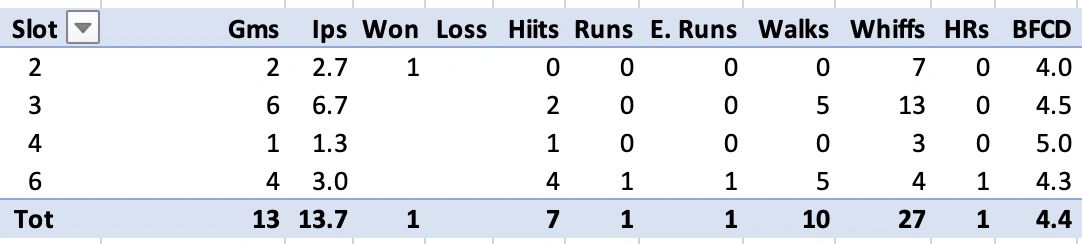
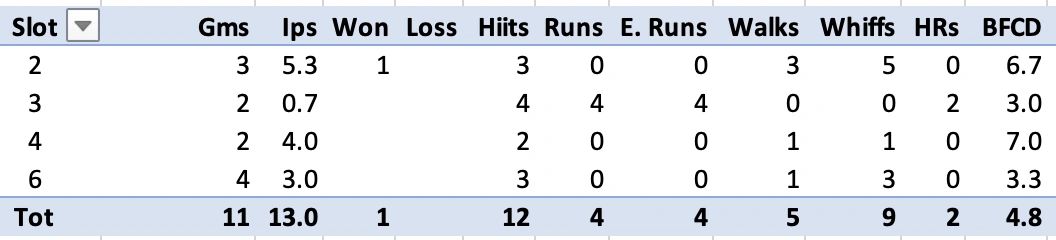
Who are these masked men who enter in the middle innings, last about 5-7 batters, and steal wins? They are whoever stands the best chance of winning the inning. They are also yesterday’s closer and, perhaps, tomorrow’s Opener. Five pitchers, in particular, have performed as Swiss Army Knives for the Phillies this year – Clayton Kershaw, Adam Kolarek, Adam Ottavino, Jarlin Garcia and Noe Ramirez. Their individual usage shows no discernable pattern, but this quintet has been the spine of the pitching staff for its collective effort in taking over the middle innings, while also opening or closing, as needed.
KERSHAW:
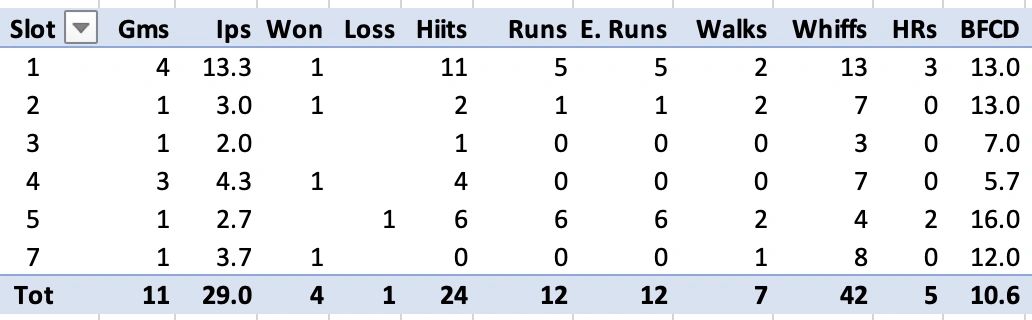
KOLAREK:
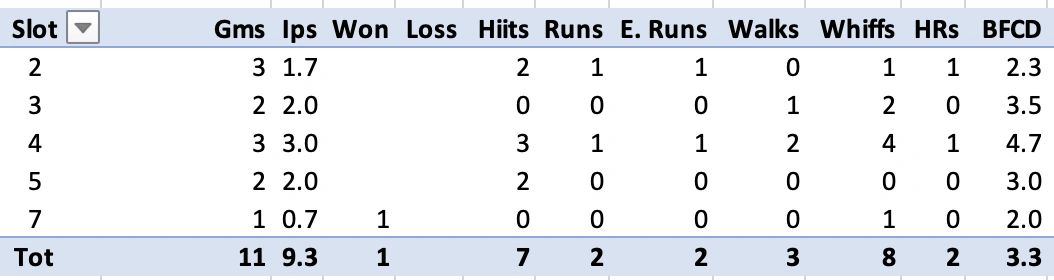
OTTAVINO:
GARCIA:
RAMIREZ:
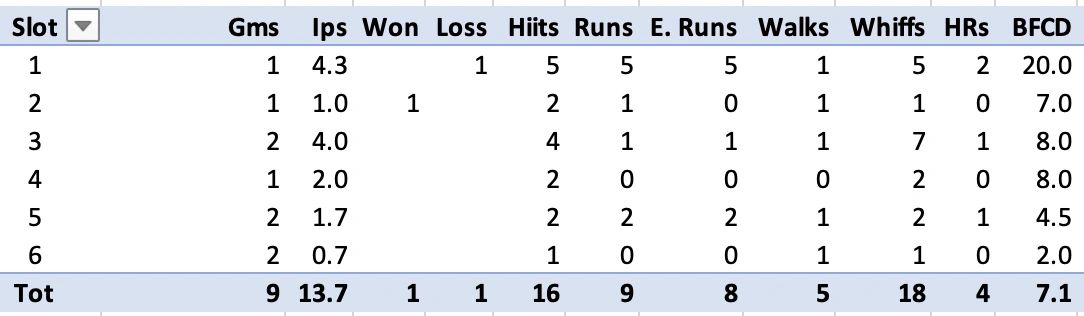
To suggest these 5 pitchers are the MVPs of the Phillies’ season would likely be a stretch. The team does have its hitting stars and it is ranked 4th in runs scored. But it would not be an understatement to say that the Opener has worked well for the Phils, and not because of quality opening or stellar closing, but because of slots No. 2-4 in the daily pitching pro-forma and the matchup victories they secure in the middle frames when, for all intents and purposes, the spotlight doesn't shine as bright. Teams may be compelled to pinch-hit in the 4th inning to improve their matchup, however, they do so at their own peril. What if the game is tied in the 9th and that already-used bat would've come in handy?
The Opener is the cornerstone of the Phillies success this season, and they're hoping it will also be the capstone on a Championship campaign.