
Orioles' Late Surge Sends Message to Rivals: It's Our Time
If getting hot at the right time is what matters most, then now must be the Baltimore Orioles’ time. And it just happens to be playoff time, too.
The Orioles (59-31) finished the season on a 27-6 roll and enter the playoffs on a 7-game winning streak that includes regular season-ending sweeps of the Washington Nationals and Minnesota Twins. Yes, those same Nationals who sat atop The Natural Division for much of the season’s first couple months, and those mighty Twins who are the only franchise in the MMDBL with more than one World Series championship.

That was more than a pair of sweeps – it was a powerful closing statement backed by documentary and physical evidence supporting the claim that the Orioles are the best team in the Natural, if not the best team in the MMDBL. Their plus-132 run differential is the best in the league by a margin of 40 runs. In their season-ending 27-6 run, the Orioles posted a plus-88 run differential for an average margin of plus 2.7 runs per game. That’s not just dominance, it’s destroying your opponents.
How did the Orioles get here? Well, for one, they were supposed to be here. Maybe not in their current unrepentant form, but when we look way back to last spring, playoffs seemed a certainty and a bye seemed a reasonable probability. Recall that the MMDBL Advanced Analytics Department (MAAD), using its Expected Wins (ExW) algorithm, projected a 54-win season for Baltimore. Only 2 teams in the Natural projected a higher ExW – Minnesota and Washington. Cincinnati, San Diego and Philadelphia were the next 3 teams in the Natural’s ExW projections and, coincidentally, they all made the playoffs as well (props to the MAAD!)
When you take a closer look, how the Orioles got here jumps of the page. The led the MMDBL in runs scored (512, or 5.7-per game), OBP (.354), SLG (.463), OPS (.817) and stolen bases (158), and were 2nd in AVE (.270) and Hits (838). Plus they packed tertiary offensive categories as well – 2nd in doubles (194), 1st in triples (27), 1st in walks (358), 2nd in OPS with RISP (.874), most homers with RISP (43), 1st in 2-out RISP (.937), and most homers in 2-out RISP (21). The offensive attack was balanced as Baltimore finished 2nd in OPS versus righties (.810) and 3rd in OPS versus lefties (.844).
Baseball history is littered with teams that shellshocked opponents with powerful offense but gave it all back in the field. In fact, the MMDBL this season had 2 of those teams – the Braves and the Cubs. If there are teams ahead of Baltimore in any of the aforementioned offensive categories, the Braves and/or the Cubs are among them. Perhaps fittingly, the Braves and Cubs tied for 3rd in runs scored this season with 490, behind Baltimore and Philadelphia. But when you look at who yielded the most runs this season, the Cubs top the list with the Braves in 3rd.
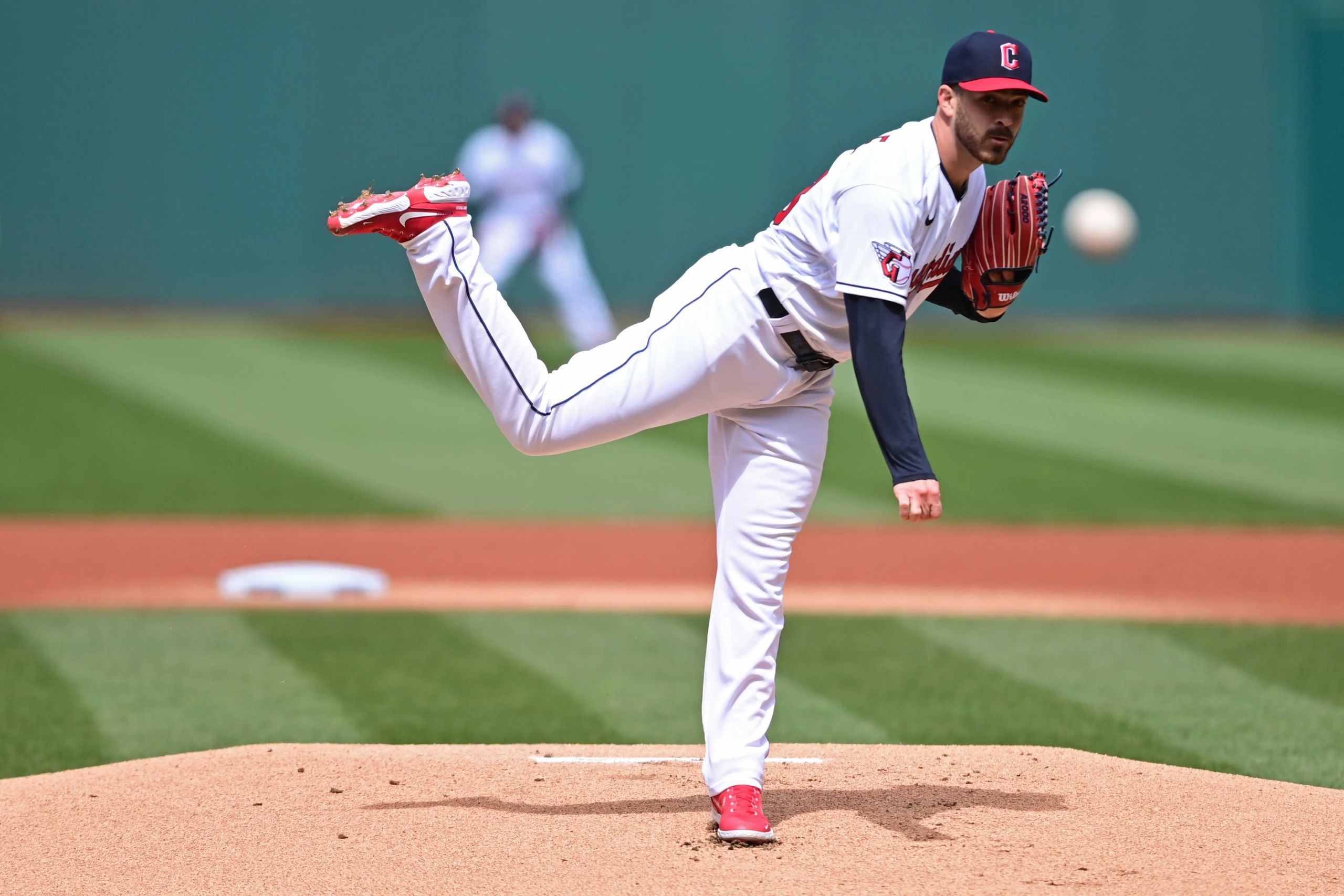
Baltimore didn’t give it back in the field. The club yielded the 4th fewest runs, tied for 3rd in ERA (3.92) and tied for 5th in WHIP (1.30). When your offense is as potent as Baltimore’s was this season, the pitching just needs to be “good enough.” Baltimore’s staff is more than that. Post-season success generally requires a Big 3 rotation (OK, let’s set aside the anomaly that is the Phillies for now), and the Orioles have a stout Big 3 in Justin Verlander (8-5, 4.22 ERA, 1.13 WHIP), Aaron Civale (10-4, 3.42, 1.26), and Kodai Senga (8-6, 5.80, 1.68). Senga struggled with command this season (73 walks in 108 2/3rd innings) but the playoffs offer a fresh start. Baltimore’s bullpen – anchored by – Felix Bautista (19 saves, 0.55 ERA, 0.85 WHIP), Robert Stephenson (6-1, 2.57, 0.81), Hector Neris (1.26, 0.98) and Bryan Abreu (1.84, 1.13) – finished with the league’s 2nd-best WHIP (1.16), lowest ERA (2.65), and is unquestionably a plus-plus strength heading into the playoffs. Three arms with sub-1.00 WHIPs puts the league on notice that they better score early against the Orioles, or else.
The Big 3 hitting stars for Baltimore will likely all get votes for the MVP. It starts with Ronald Acuna Jr, who stole a league-leading 77 bases while hitting 10 homers and slashing .313/.382/.461/.843. Corey Seager popped 22 homers while slashing .290/.391/.577/.968 and leading the MMDBL in RBIs (87); but the best season of all may have been had by Nolan Jones who hit 20 homers, added 27 steals, and slashed a gaudy .300/.404/.575/.979. Add in Ketel Marte, who hit 16 homers with a slashline of .309/.402/.550/.952, and you can see why Baltimore bashed this season.
The Orioles may see the Nationals and/or the Twins again in the post-season as both rivals have made it, but for now Baltimore can kick back and watch the Natural playoffs unfold as they’ve earned the No. 1 seed and a Wildcard Series bye.
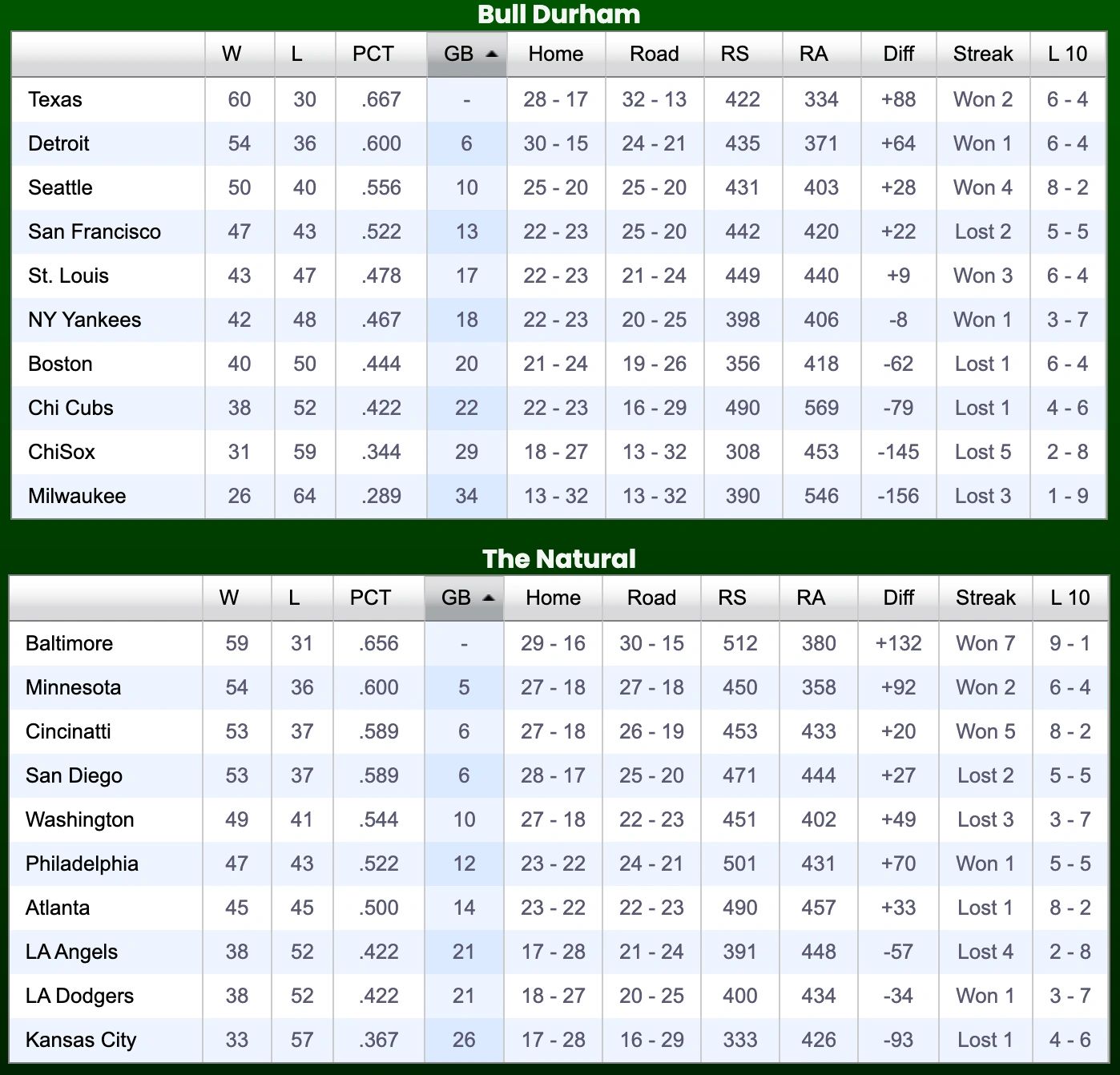
Speaking of the Twins (54-36), they’ll be the No. 2 seed in the Natural and join Baltimore in benefitting from a Wildcard Series bye. The Twins earned the bye with a thrilling 8-7 win in the regular season’s last game. Facing San Diego, the stakes were big – winner gets the bye, loser does not. Trailing 7-3 heading into the bottom of the 7th, the Twins plated 4 to tie the game, 7-7, mustering 2 hits and 4 walks off Padres reliever Alex Lange.
In the bottom of the 8th, the Twins took the lead for good on a Mauricio Dubon RBI single. Entering the bottom of the 7th, the Twins had a 4% chance of winning. And they won. That’s what the Twins do and that’s why it’s entirely plausible the Twins cap the 2024 campaign with their 3rd World Series title in the MMDBL’s 6 seasons.
Bull Durham Byes
The Texas Rangers (60-30) finished with the MMDBL’s best record, matching Detroit’s mark from last season, and posted a plus-88 run differential, best in the Bull Durham and 3rd in the MMDBL. The Rangers in early August swept Detroit, surging to a 6-game lead over the Tigers with 31 to go, and never let up. The Tigers never really got any closer so if it feels like the Rangers wrapped up the No. 1 seed in the Bull Durham at the trade deadline, well, they sort of did.
On April 17, Texas was sitting at 5-8 and then went on a 24-6 roll that included 9- and 7-game winning streaks and propelled them to a 5-game lead over the Tigers. The Tigers would claw back and tie the Rangers in mid-July with 36-21 records. From that point forward, Detroit faded, going 18-15, and Texas pulled away, going 24-9. The point is, aside from its slow start, Texas established itself as the team to beat in the Bull Durham by mid-May
The No. 2 team in the Bull Durham and earner of the other bye is the Tigers (54-36). For Detroit, the 2024 campaign can be broken into 3 parts. The 1st part was injury-marred and depressing. The Tigers started 10-16 and lost Willy Adames for 21 games, Shohei Ohtani for 15 games, Brendan Donovan for 20 games, and other key pieces for shorter injuries – pieces like ace Logan Webb and Yu Darvish. After 27 games, the Tigers were hitting .223, 2nd worst in the MMDBL.

Part 2 of the Tigers’ 2024 season was a 26-5 run that pulled them into a mid-July tie with the Rangers atop the Bull Durham. During that stretch, the club got healthy and started to hit, batting .267 with 45 homers over the next 30 games.
Part 3 was the 18-15 grind to the wire. During this stretch, more injuries popped up, including another 15-game DL stint for Ohtani and 10 games for Alex Bregman. But the big story was the disappearance of the big bats and the implosion of a bullpen that was top 3 for most of the season. The bullpen finished 10-12 with 19 saves, 10 blown saves and ranked 9th with a 1.31 WHIP. As for the bats, Ohtani has hit .184 with no homers and a 35% strikeout rate since returning from the DL on Sept. 1 (44 plate appearances). Bregman had 10 homers on June 13 and finished the season with 10 homers, going his last 43 games played without a dinger.
If Texas winds up facing Detroit in the Bull Durham League Championship Series (LCS), before you place any bets you might want to know that Texas swept Detroit, 6-0, in the season series and it really wasn’t even close.
Bull Durham No. 3 Seattle Mariners (50-40) versus No. 6 New York Yankees (42-48)
Seattle won the season series, 4-2, and owns the run-differential advantage by 36 runs (plus-28 versus minus-8). Seattle beefed up at the trade deadline, adding Mookie Betts, LaMonte Wade, Garrett Cooper and almost fully remade its pitching staff. The club was 29-28 at the trade deadline, and 21-12 after. It challenged for the No. 2 seed and a bye for a while but settled in with the No. 3 seed.
Using MAAD’s post-trade deadline Expected Wins analysis, Seattle grades as a 55-win team, with the Yankees grading as a 42-win team. In terms of hitting, Seattle slashed .248/.329/.400/.728 (14th in OPS) and the Yankees slashed .251/.324/.411/.734 (13th in OPS). Relative to pitching, Seattle posted a 1.30 WHIP (5th best) and the Yankees finished with a 1.27 WHIP (4th best).
Bull Durham No. 4 San Francisco Giants (47-43) versus No. 5 St. Louis Cardinals (43-47)
San Francisco won the season series, 4-2, and owns the run-differential advantage by 13 runs (plus-22 versus plus-9). San Francisco was momentarily at the top of the Bull Durham early in the season but eventually faded despite acquiring Aaron Nola, David Robertson and others to bolster the roster. Luis Arraez became the first player in MMDBL history to bat .400, finishing with a gaudy slashline of .409/.466/.523/.989.
Using MAAD’s post-trade deadline Expected Wins analysis, San Francisco grades as a 34-win team, with St. Louis grading as a 38-win team. In terms of hitting, San Fran slashed .266/.342/.398/.741 (11th in OPS) and the Cardinals slashed .252/.334/.411/.745 (10th in OPS). Relative to pitching, San Fran posted a 1.36 WHIP (11th best) and the Cardinals finished with a 1.44 WHIP (17th best).
The Natural No. 3 Cincinnati Reds (53-37) versus No. 6 Philadelphia Phillies (47-43)
The teams split the season series, 3-3, but the defending World Champion Phillies own the run-differential advantage by 50 runs (plus-70 versus plus-20). Using MAAD’s post-trade deadline Expected Wins analysis, Cincinnati grades as a 53-win team, with the Phillies grading as a 49-win team. In terms of hitting, Cincy slashed .252/.346/.432/.779 (tied for 4th in OPS) and the Phillies slashed .261/.341/.438/.779 (tied for 4th in OPS). Relative to pitching, Cincinnati posted a 1.40 WHIP (15th best) and the Phillies finished with a 1.47 WHIP (18th best).
The Natural No. 4 San Diego Padres (53-37) versus No. 5 Washington Nationals (49-41)
Washington won the season series, 4-2, and owns the run-differential advantage by 22 runs (plus-49 versus plus-27). Using MAAD’s post-trade deadline Expected Wins analysis, Washington grades as a 57-win team, with the Padres grading as a 52-win team. In terms of hitting, Washington slashed .256/.334/.419/.753 (9th in OPS) and the Padres slashed .261/.337/.425/.762 (7th in OPS). Relative to pitching, Washington posted a 1.39 WHIP (tied for 13th best) and the Padres finished with a 1.35 WHIP (tied for 8th best).