
The Texas Rangers Are Self-Maeda World Champions
When Cam Bedrosian blew a 1-2 fastball past Matt Olson to seal the Texas Rangers first world championship, the visitors’ dugout erupted and the Lone Star State Boys jumped the rail, stormed the mound and formed a dogpile for the ages. First to the mound was catcher Yasmani Grandal, who bear-hugged Bedrosian before both were overrun by exuberant teammates and knocked to the infield grass at Busch Stadium as the hometown Cardinals watched glumly from under the brims of their pulled-down caps.
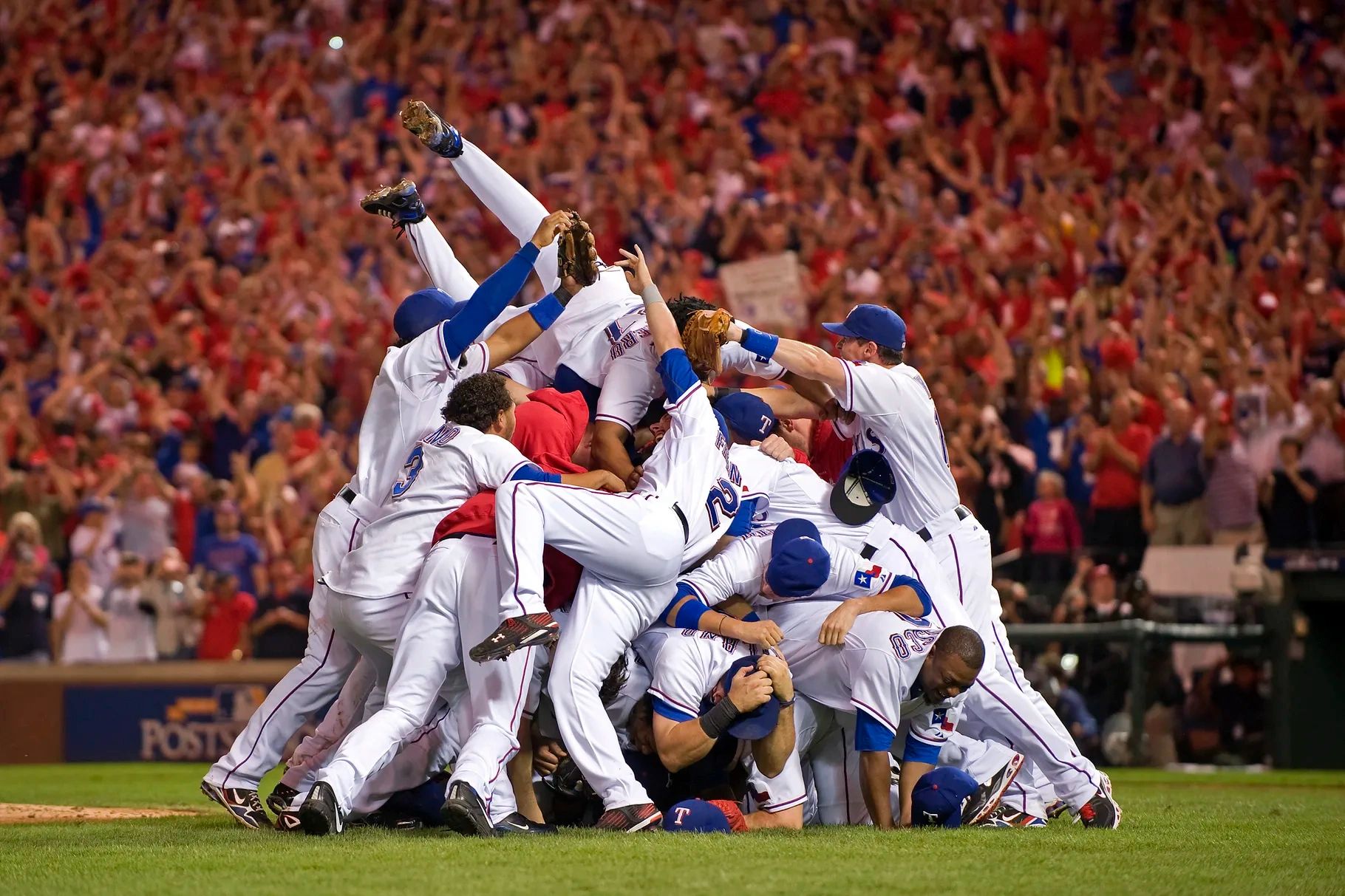
The Metro-Milwaukee Dynasty Baseball League (MMDBL) World Champions were acting in the moment, releasing the stress and drama of a post-season run and 54-game pandemic-shortened season. While the dogpile itself was spur of the moment, it had been forming for weeks, perhaps months. To the untrained eye, the Rangers looked like a formidable team, one that could contend with the Phillies, Twins and Yankees in the senior-circuit Natural League. The trained eye, however, might have seen the separation from the pack coming as Texas strategically added key pieces to its lineup, rotation and bullpen as the season wore on.
The outcome of the Rangers’ 2021 campaign was hard to see when Texas was 13-11 and in 3rd place, a game behind the Yankees and Twins in The Natural’s Tommy Division and coming off a 2-5 stretch. After that, however, the club went 34-12, including a 12-3 playoff run, to walk away with the MMDBL trophy in the league’s 3rd season. From Game 25 forward, the Rangers won every series except two – a mid-season bout against the then-surging Braves and the season-finale at Yankee Stadium – and never lost more than 2 games in a row. Talk about dominance.
Dominance at some point, during some stretch, is needed to win a World Championship and the Rangers were dominant when it mattered most. In the MMDBL’s first two seasons, the Rangers never flashed dominance. The Rangers cast a mold as a contender that would score runs in bunches. The lineup featured prodigious power but was prone to offensive droughts as is often the case for teams that live (and die) by the 3-run homer. In each of its first two seasons, the Rangers bashed 85 homers. The pitching was solid, as one would expect with a rotation featuring Shane Bieber and Luis Castillo, but the team’s offensive inconsistencies were maddening. Moreover, while Bieber and Castillo anchored the staff, the bullpen had just enough inefficiency to undermine post-season aspirations.
Texas GM Andy Rowe methodically addressed each of the team’s deficiencies one by one. The post-draft pre-season trade to acquire 2B Cesar Hernandez instantly changed the Rangers’ makeup. The light-hitting Hernandez brought something to Texas few other Rangers could offer – he put the ball in play and got on base. Hernandez played his role exquisitely, slashing .316/.416/.446/.862 for the Rangers while bashing 17 doubles, a triple and 2 homers.
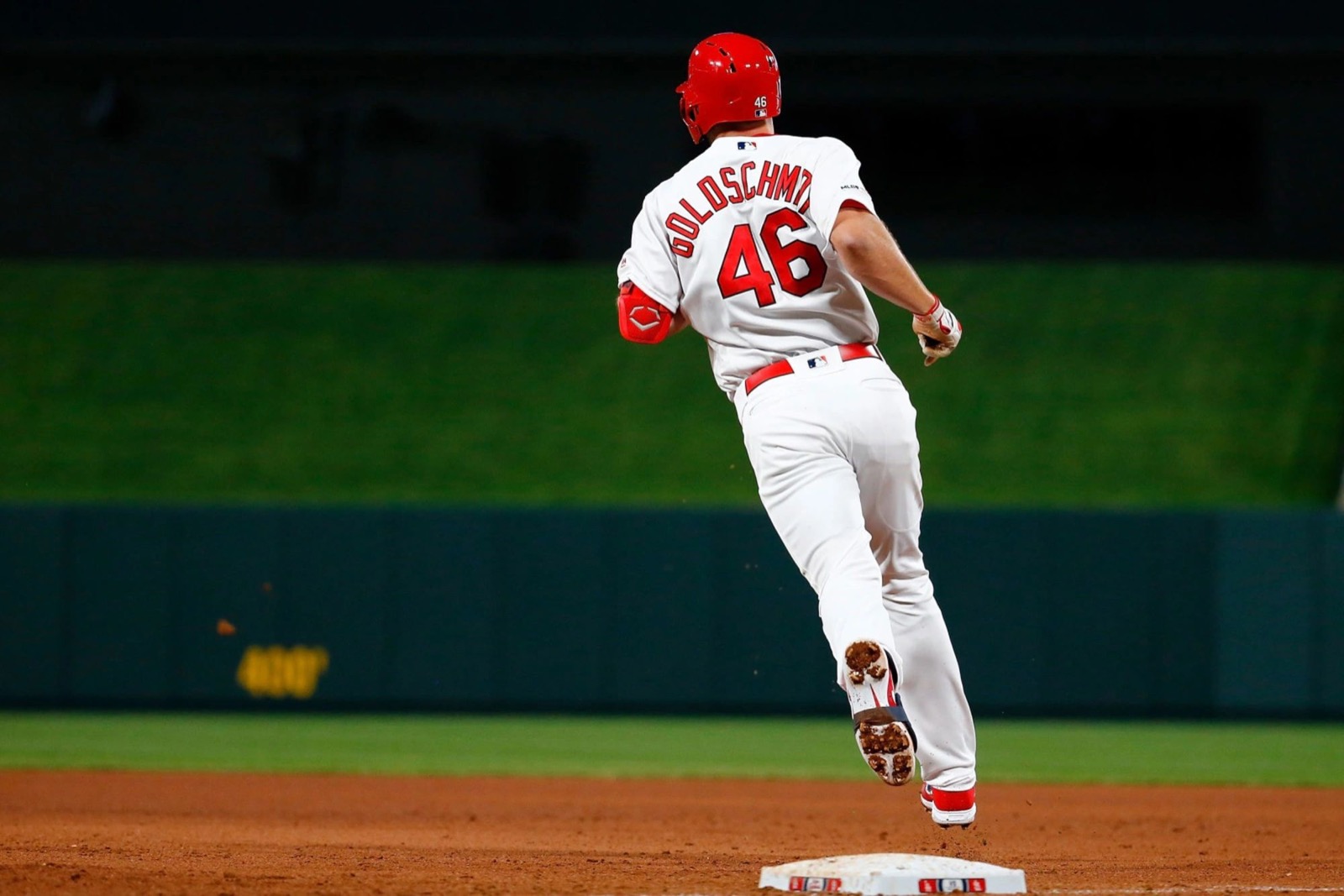
What if the Rangers had another guy like Hernandez but with more power? You know, someone who could anchor the lineup as a legitimate No. 3 hitter? That was the question Rowe contemplated as the early season wore on with uninspiring results. It was this thinking that led to the acquisition of 1B Paul Goldschmidt. The righty came to Arlington and eventually slotted into the top half of the lineup and proceeded to slash .329/.476/.563/1.039 with 12 doubles and 7 homers in 45 games.
Hernandez and Goldschmidt gave Texas a pair of offensive metronomes to offset the temperamental but explosive remainder of the lineup that featured Cody Bellinger (.279/.400/.520/.920 with 8 homers), Jesse Winker (.225/.384/.503/.886 with 12 homers), Jeff McNiel (.290/.364/.495/.859 with 5 homers) and Grandal (.215/.376/.329/.705 with 3 homers). The lineup also got key contributions from role players such as draftees Jared Walsh and Tommy Pham (a combined .305 with a 1.107 OPS and 11 homers in just 105 plate appearances!) and trade acquisition Rowdy Tellez (11 homers and an .841 OPS).
It all added up to the Rangers best offensive season. The team slashed .272/.378/.469/.847 and was 3rd in OPS (Minnesota, NY Yankees) and 2nd in runs scored (344 behind Minnesota’s record-setting 354). The team hit a middle-of-the-pack 68 homers but discovered that players like Hernandez and Goldy were the missing swizzle sticks to a potent offensive cocktail.
Still, dominance was elusive until the pitching finally clicked. Through 24 games, the Rangers staff had a middling 1.40 WHIP and a disastrous 5.00 ERA. Starting pitching was so faulty that the team was one of four that had more relief innings than starting innings pitched. At closer inspection, both the rotation and bullpen needed to tighten it up. The bullpen was 7-4 with a league-worst 7 blown saves. The rotation had a 1.45 WHIP and a bottom-quartile 5.92 ERA. With that performance, how did Texas even manage a 13-11 start?
In the last 30 games, both the rotation and bullpen did, in fact, tighten it up. The rotation logged the same WHIP over the last 30 games (1.45) but went deeper into games and shaved 1½ runs off its ERA (4.40). This paved the way for the bullpen to dominate. Over the last 30 games, the bullpen went 13-1 and earned 9 saves while blowing only 2. Moreover, the bullpen’s 1.21 WHIP over the last 30 games was league-best during that stretch and its Opponent Batting Average (OBA) of .220 was second-best (Philadelphia.) For the season, the bullpen amassed a 20-6 record, leading the league in wins and winning percentage (minimum 10 wins), and finished 3rd in WHIP (1.28).
The bullpen got solid performance from trade acquisitions Matt Andriese, Daniel Bard and AJ Cole, as well as draftee Nick Tropeano. Blake Treinen contributed a 6-1 record but blew all 4 of his save opportunities. He eventually settled into a 6-7th inning role as Trevor Rosenthal locked down and locked up the closer role (10 saves, 1.99 ERA, 0.92 WHIP and 58 Ks in 31 1/3rd innings.) In the playoffs, the bullpen notched a 1.12 WHIP, .208 OBA and 2.09 ERA but blew 4 saves as opponents matchup up key at-bats.
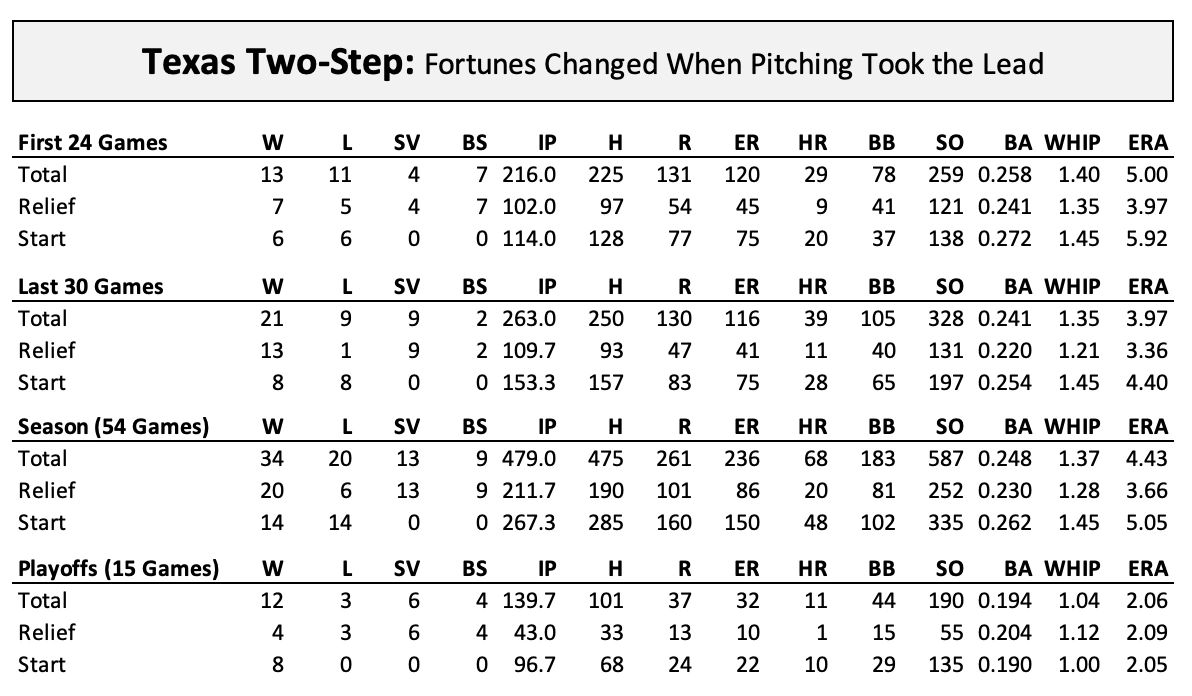
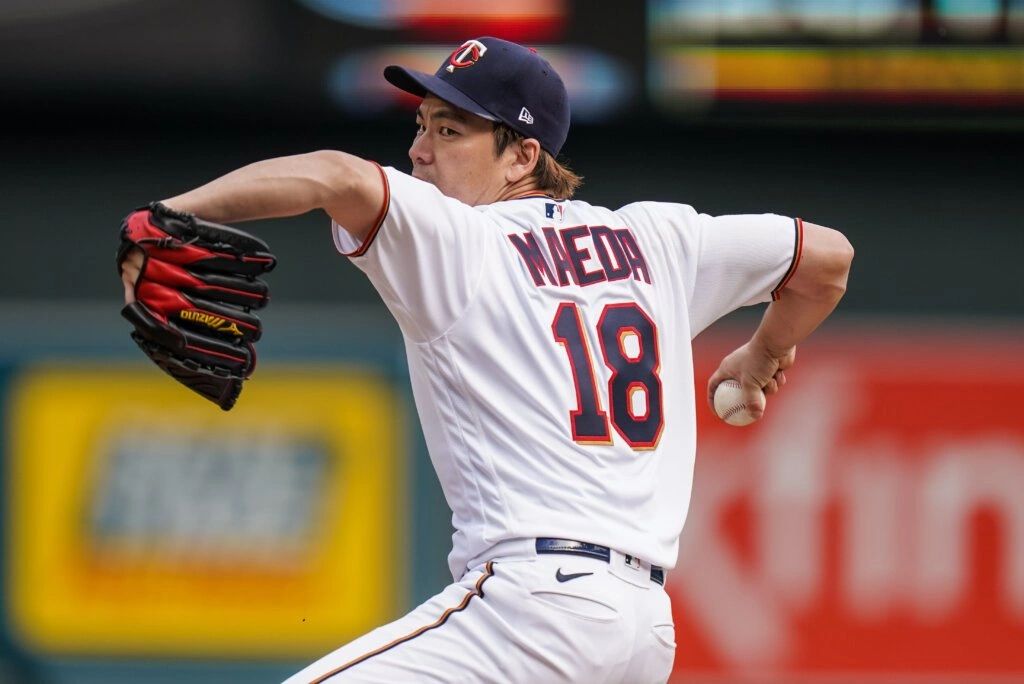
While still very good, the dominance the bullpen showed in leading the Rangers’ 2nd half surge didn’t fully carry into the playoffs. The rotation, however, stepped up big time. Texas starters went 8-0 in the playoffs with a 1.00 WHIP, .194 OBA and 2.05 ERA. Bieber was 3-0 (1.01 WHIP, .171 OBA, 1.42 ERA) in his 4 starts; and while not as stifling, Castillo was 2-0 with a 2.57 ERA (1.43 WHIP, .244 OBA) in his 4 starts. The real star of the post-season rotation was the club’s big trade-deadline target, Kenta Maeda. The righty led the team in post-season starts (5) and posted a 3-0 record with an amazing 0.82 WHIP and .196 OBA. The key to Maeda’s success was impeccable control as he walked only 4 against 54 strikeouts over 39 innings of post-season work.
All told, the Rangers led the post-season with a 1.04 WHIP .196 OBA and 2.06 ERA. The next lowest playoff ERA was Toronto (3.69) – a full 163 basis points behind! In the 15-game post-season, Texas amassed a +46 run-differential, versus a +83 run-differential for the 54-game regular season. The hitting was generally solid all season, but better after Goldy arrived. The bullpen kicked it into high gear in the 2nd half of the season. And in the playoffs, it was the rotation’s turn to shine.
The Rangers season had a feel of continually building momentum. Sluggish at first, but like the runaway locomotive in Back to the Future III, every new acquisition was like Doc Brown’s chemically treated Presto logs tossed into the fire. The result was an explosion that made the train go faster. So if Hernandez and Goldy were the green logs, and Maeda and the bullpen acquisitions were the yellow logs, who was the red log? During the regular season, Josh Donaldson hit a miserable .156 with a .521 OPS in 21 games after being acquired from the Angels for Corey Dickerson. In the playoffs, however, Donaldson slashed .364/.533/.955/1.488 with 4 homers in 12 games. He was the red log that fueled the Rangers’ engine to burn white hot in the playoffs.
Donaldson’s post-season heroics were timely, though one could argue that Winker had the most valuable post-season performance for the Rangers with his team-leading 5 homers and 10 RBIs while slashing .264/.371/.623/.994. One could also argue that Rosenthal’s 6 post-season saves make him the MVP. However, it’s hard to overlook Maeda, who was dominant in every post-season start and got the win in Game 1 of all 3 of the Rangers’ playoff series while average 7 2/3rd in those series-opening starts.
So Maeda it is – your 2021 playoff MVP. And the Rangers it is – your 2021 MMDBL champions. And as far as season-ending dogpiles go, the Rangers were self-made through strategic acquisitions of key hitters, contributing relievers and one starting pitcher that made all the difference when it mattered most.