Does the MMDBL's Add/Drop Add Anything?
One feature of the MMDBL is the Add/Drop process. Conducted twice per season (three times in the MMDBL's inaugural season), it enables a franchise to release any player and add a player from the free agent pool.
But does Add/Drop actually add anything?
Add/Drop is part of the MMDBL's toolkit for ensuring parity and competitiveness. The worst performing teams pick first in each session and the order is set according to worst-to-best record. Teams can go one of two ways with their pick. They can look for more help to compete this season, perhaps adding depth at a position of need. Or they can look for a player who will help them compete in the future but may offer little current value. This may be a young prospect or a resurgent veteran.
The idea is that teams not expecting to compete in the current season can add a player for the future, while teams looking to compete now will look away from future prospects and focus on current needs. In this way, the worse teams are bettering themselves for the future, whereas the better teams are not. Presumably, this will be yet another way in which the MMDBL can narrow the competitive gap. While this is true in principle, the large majority of selections have been focused on getting future value -- even for teams locked in on competing in the current season.
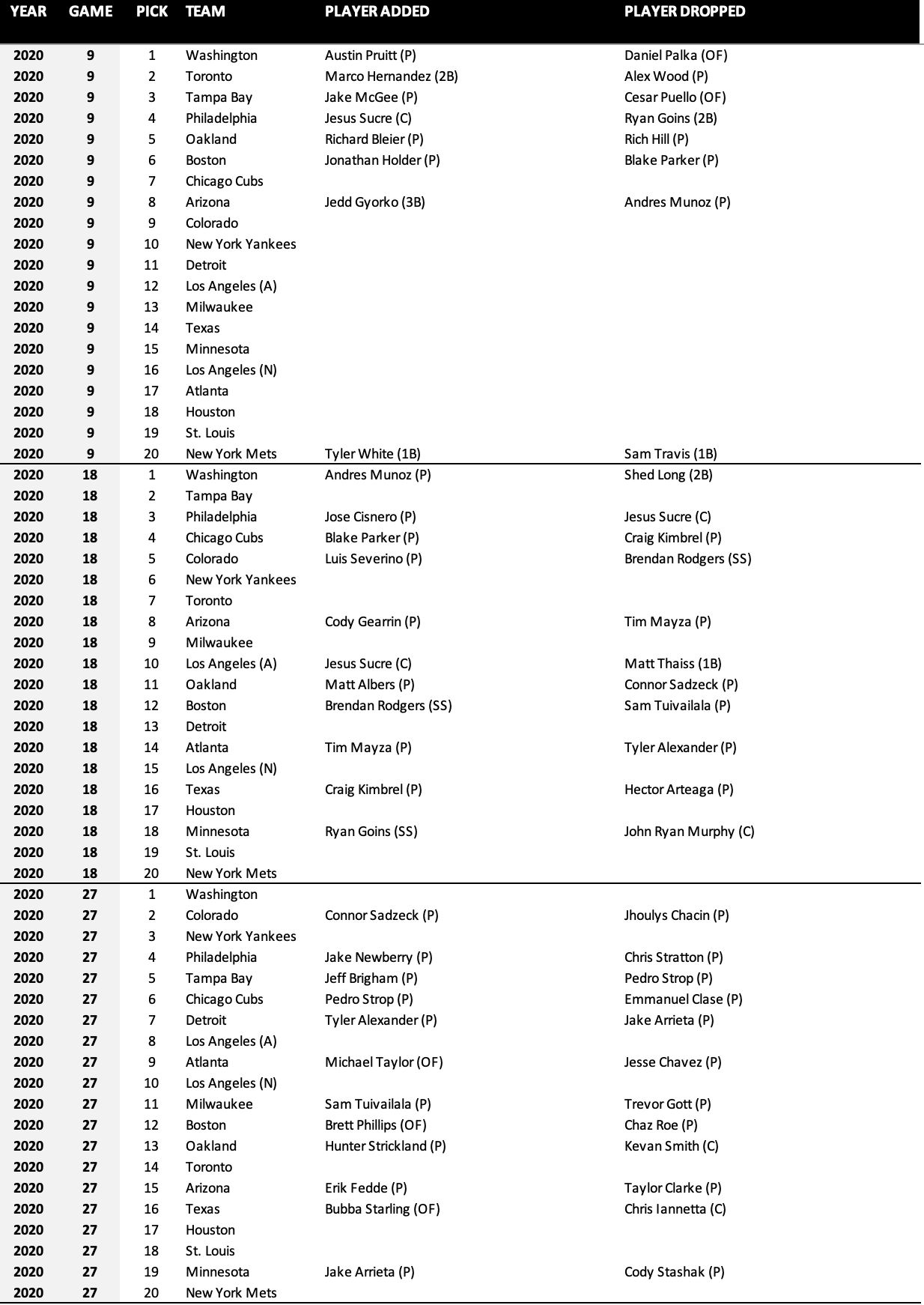
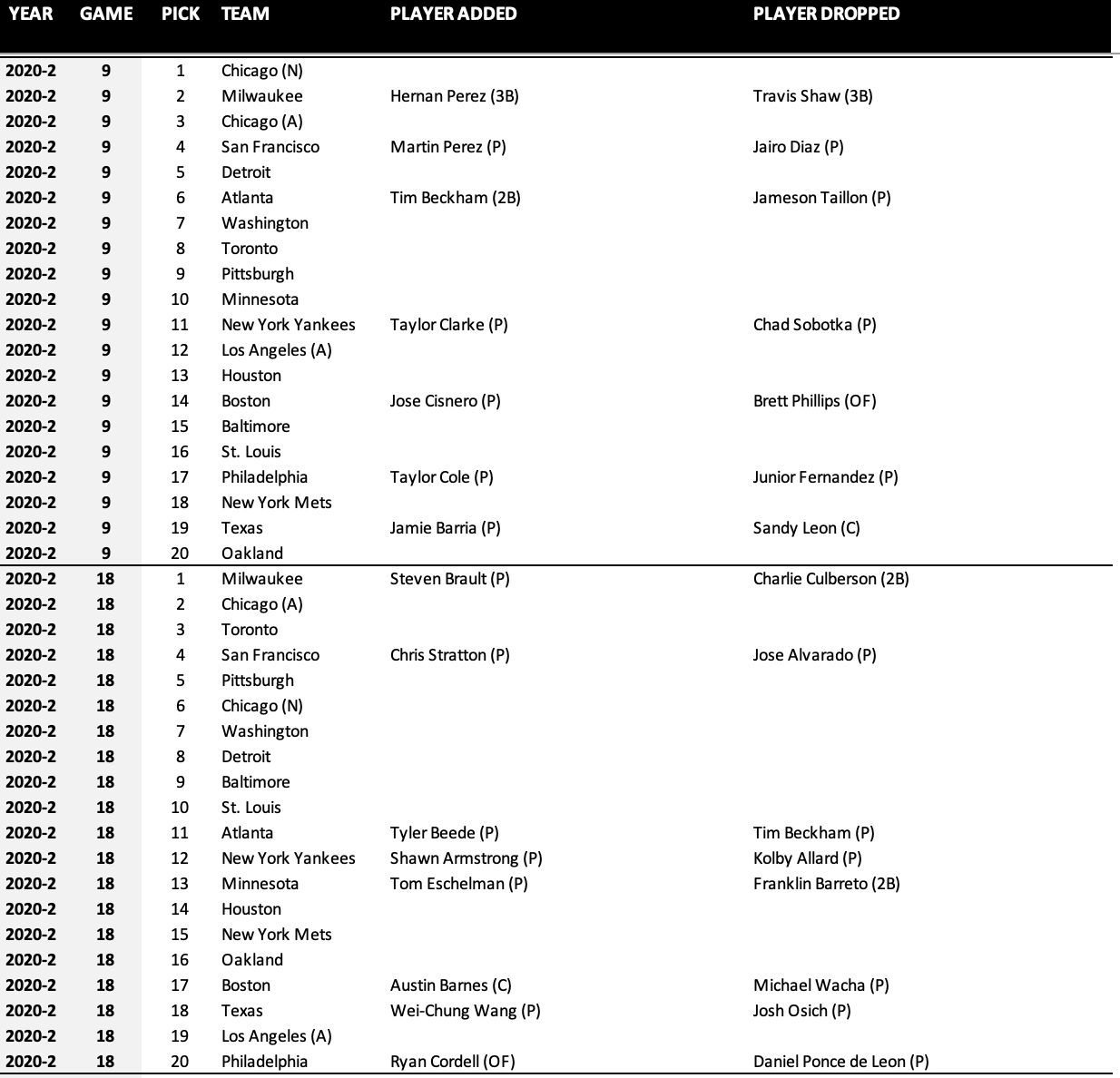
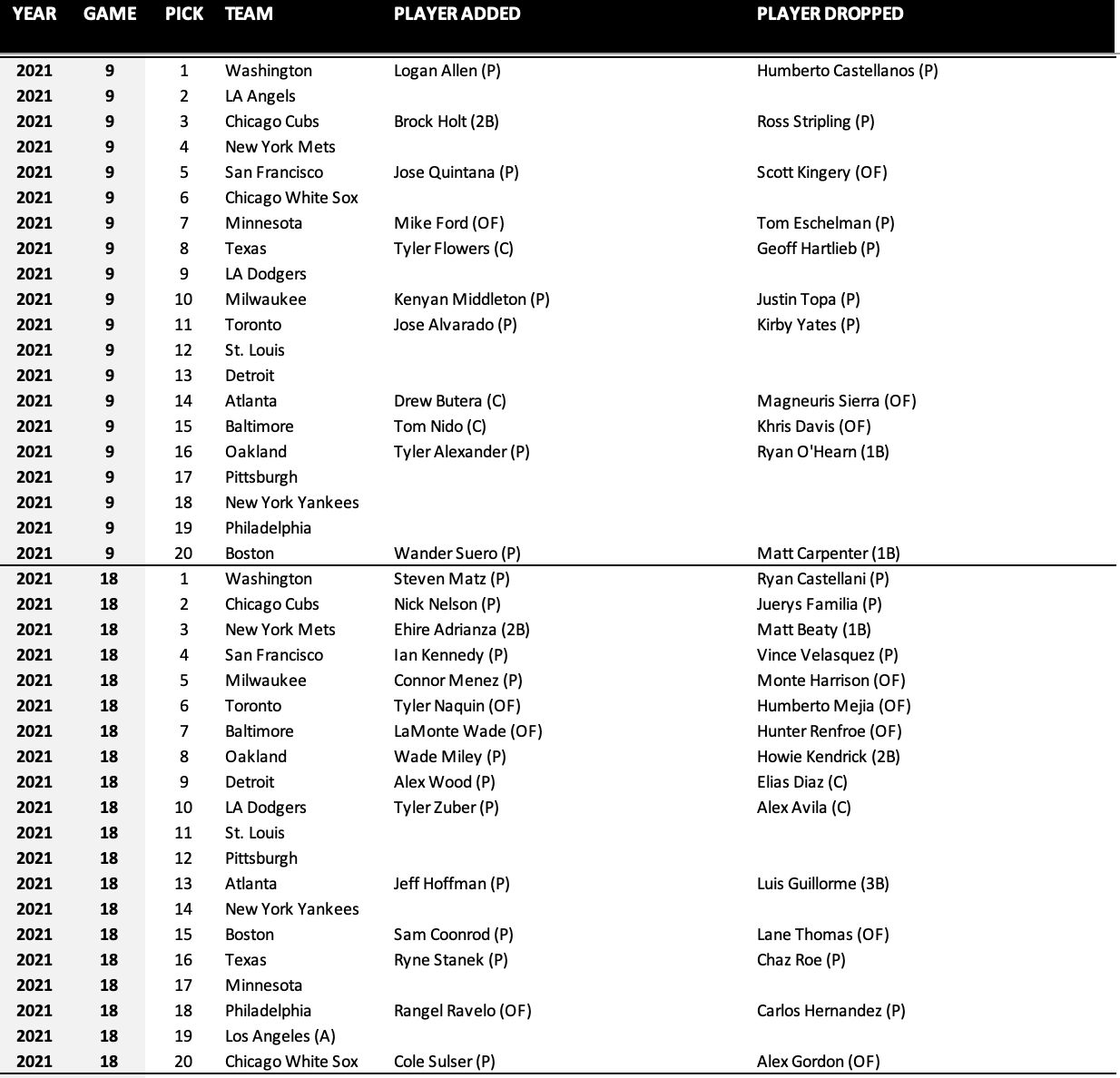
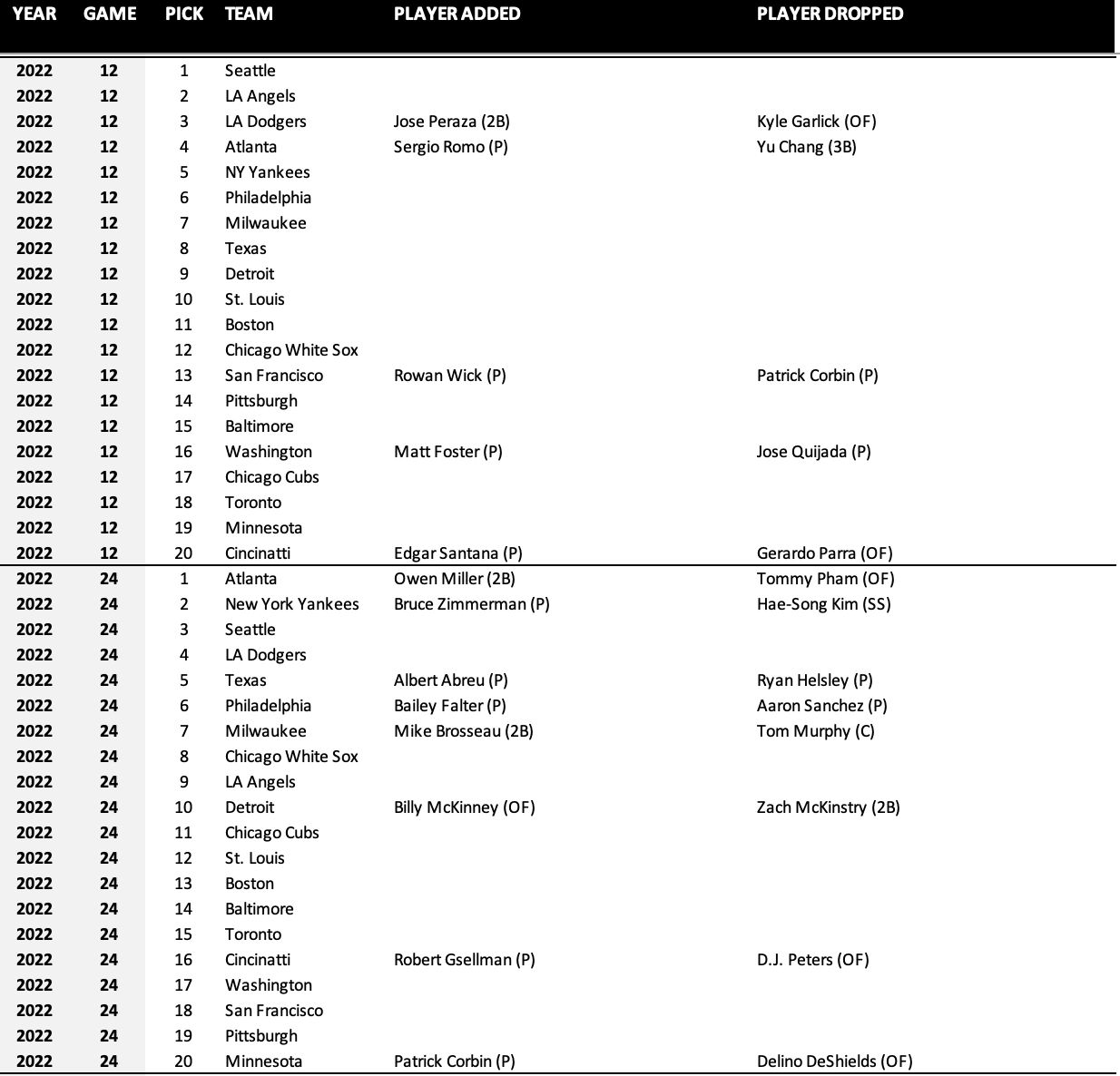
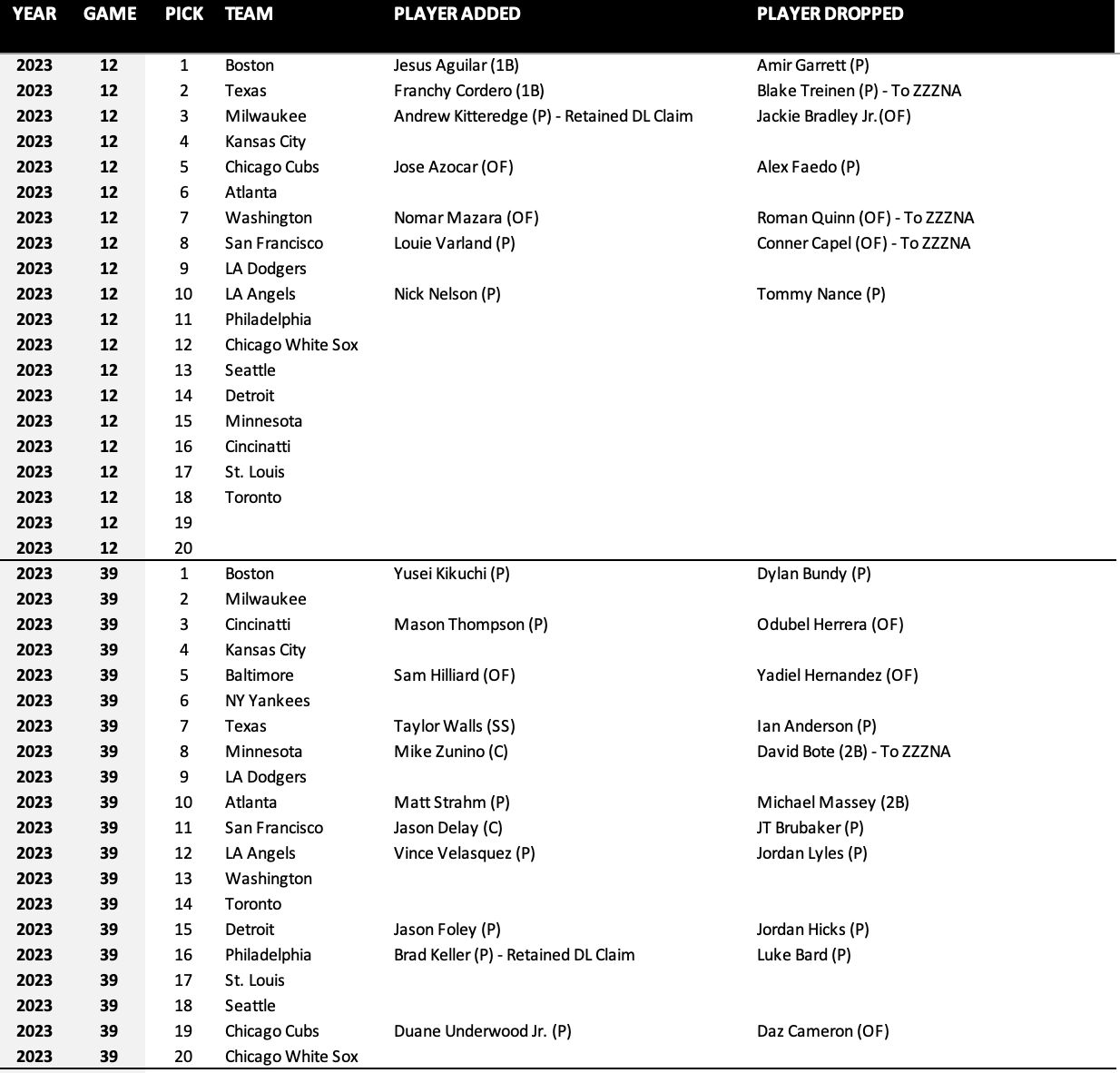
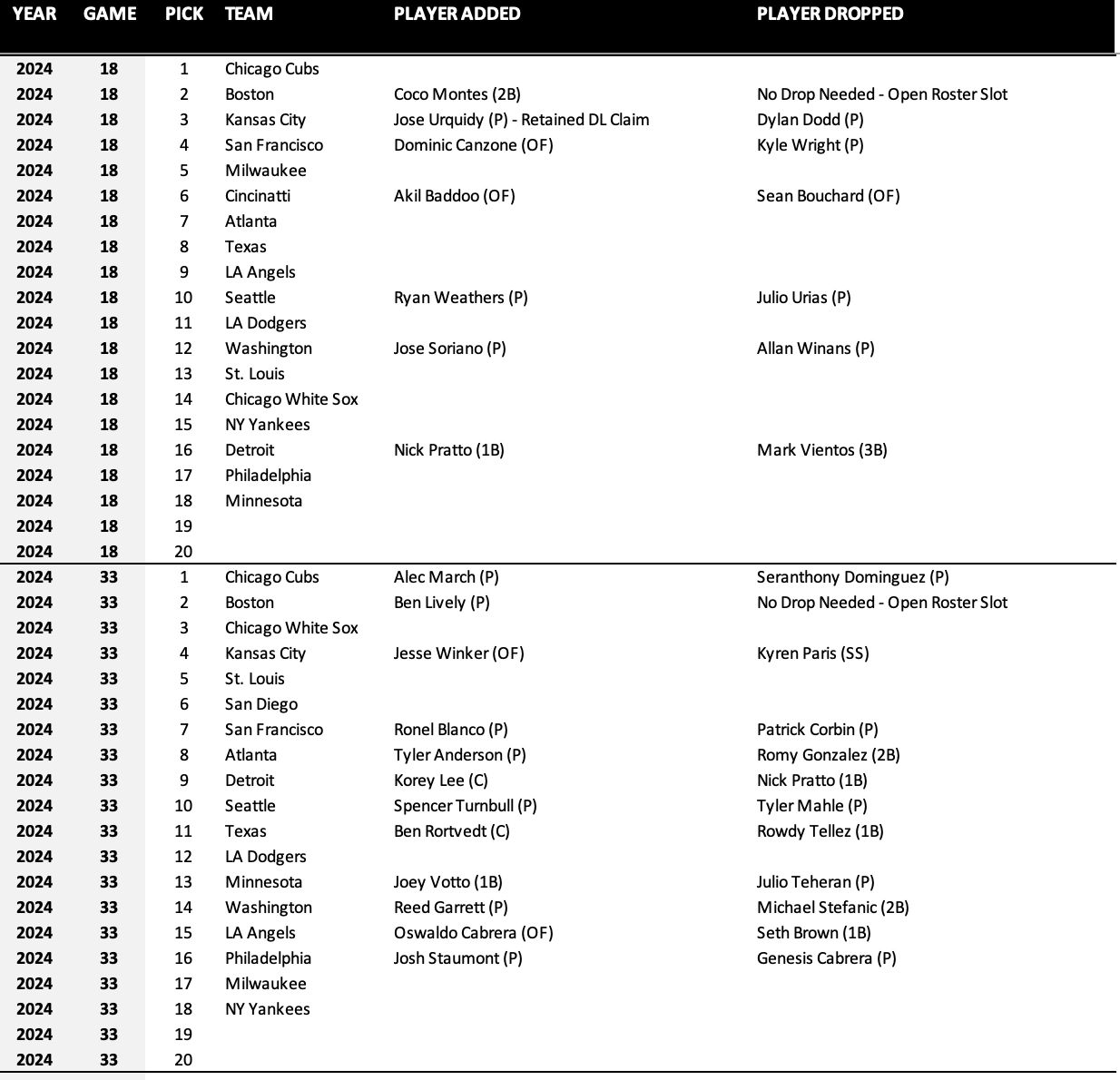
With the second Add/Drop session of the 2024 season just completed, we now have had 13 Add/Drop sessions in the MMDBL's young history -- 3 in the inaugural season and 2 in every season since. This adds up to a total of 260 draft slots of which 122, or 46.9%, have been used. Below, in pictures, is the full history of the Add/Drop session so far -- all 122 Adds and the associated Drops. The results look slightly more compelling than the MLB's Rule 5 Draft in that very few of the Adds actually added anything of value to the team's current season or even the next one. In fact, one could argue the Drops have been, on balance, better than the Adds in the next season.
Some Add/Drop Highlights
In 2020 Season No. 1, Arizona added Jedd Gyorko and dropped Andres Munoz. At the time Munoz was hurt and wasn't going to pitch in the MLB's 2020 season. In fact, he only pitched 2/3rd of an inning in the MLB's 2021 season. He since has logged 127 quality innings and is the MLB Mariners' closer.
In 2020 Season No. 1, Washington added Munoz and dropped Shedd Long. Long was a compelling 2B prospect with a rake, but he left his rake in AAA and also succumbed to injuries. Meanwhile, Washington certainly had vision grabbing Munoz, however, the club released Munoz at the end of the season. The fireballing reliever is now on the Cardinals.
In 2020 Season No. 1, the Red Sox added 2B/SS Brendan Rodgers and dropped reliever Sam Tuivailala. It was the right move. While Rodgers added nothing to the Red Sox current-year campaign, he was a key piece in an offseason deal with the Brewers that netted Jose Berrios. The Brewers then dealt Rodgers back to Boston the next season. So far, Rodgers has significantly underperformed in the MMDBL but remains a centerpiece of the MLB Rockies.
In 2020 Season No. 1, the Cubs added Pedro Strop and dropped Emmanuel Clase. At the time, Strop was a functional reliever and Clase was a project looking for a project manager. Clase did not pitch in the MLB 2020 season but has since saved 126 games, including 40 in back-to-back seasons.
In 2020 Season No. 2, the Braves added 2B Tim Beckham and dropped oft-injured Jameson Taillon after using up 2 of his 3 starts. Boston claimed Taillon of the DL and the righty tossed 7 strong innings in the 2020 Season No. 2 World Series, albeit in a loss. Taillon was eventually drafted by the Dodgers and has since pitched 246 effective innings in the MMDBL, with a 1.26 WHIP and 4.50 ERA.
In 2021, Toronto added Jose Alvarado and dropped Kirby Yates -- a lefty for a righty. Yates was marred with injuries and would not contribute in the MLB for another year-plus. Meanwhile, the Alvarado pickup was a pure future play. He had only tossed 9 innings in the 2020 MLB season but has since averaged 50 quality innings per year. In the MMBDL, now as a member of the Giants (who actually dropped him in the last 2020 Season No. 2 session), Alvarado has tossed 38 career innings.
In 2021, Baltimore added "Late Night" LaMonte Wade Jr. and dropped Hunter Renfroe. So who's had a better career? In the MLB, Renfroe is outpacing Wade in WAR, 4.9 to 4.7, since the trade. However, Wade is better offensively against the strong side of the platoon (righties) and Renfroe gets much of his WAR from defense. In the MMDBL, Renfroe has totaled a slash line of .231/.299/.447/.746 with 30 homers in 628 at-bats. Comparatively, Wade has a slash of .222/.346/.339/.685 and 4 homers in 221 at-bats, so the advantage goes to Renfroe.
In 2021, Boston added reliever Sam Conrad and dropped OF Lane Thomas. Bad move. Since being dropped, Thomas has amassed 4.8 WAR in the MLB and contributed .257/.327/.422/.748 with 10 homers in 268 at-bats across three seasons with the MMDBL Giants.
In 2022, Texas added Albert Abreu and dropped Ryan Helsley in a swap of relievers. Abreu is now pitching with the Seibu Lions in Japan and Helsley has since tossed 42 2/3rd innings in the MMBDL, yielding a .215 opponent batting average (OBA) with a 1.23 WHIP while saving 23 games for the White Sox.
In 2023, the Tigers added Jason Foley and dropped Jordan Hicks. Foley has emerged as a decent reliever. In the MMDBL this season for the Tigers, he has a 1.34 WHIP and 2.41 ERA in 18 2/3rds innings. The best may be yet to come for Foley. He is now the real-life Tigers' closer with 8 saves, a 1.17 WHIP and 1.50 ERA so far on the young MLB season. At the time of the trade, Hicks was imploding on the MLB Cardinals. He was traded later in the season to the Blue Jays and finished the season strong, earning a Dynasty League Baseball (DLB) card that is arguably better than Foley's. This MLB season, he is pitching lights out as part of the Giants rotation with a 0.91 WHIP and 1.57 ERA in 6 starts. The jury is out on this particular move.