
The 2023 Phillies Broke the Mold of What Makes a Champion
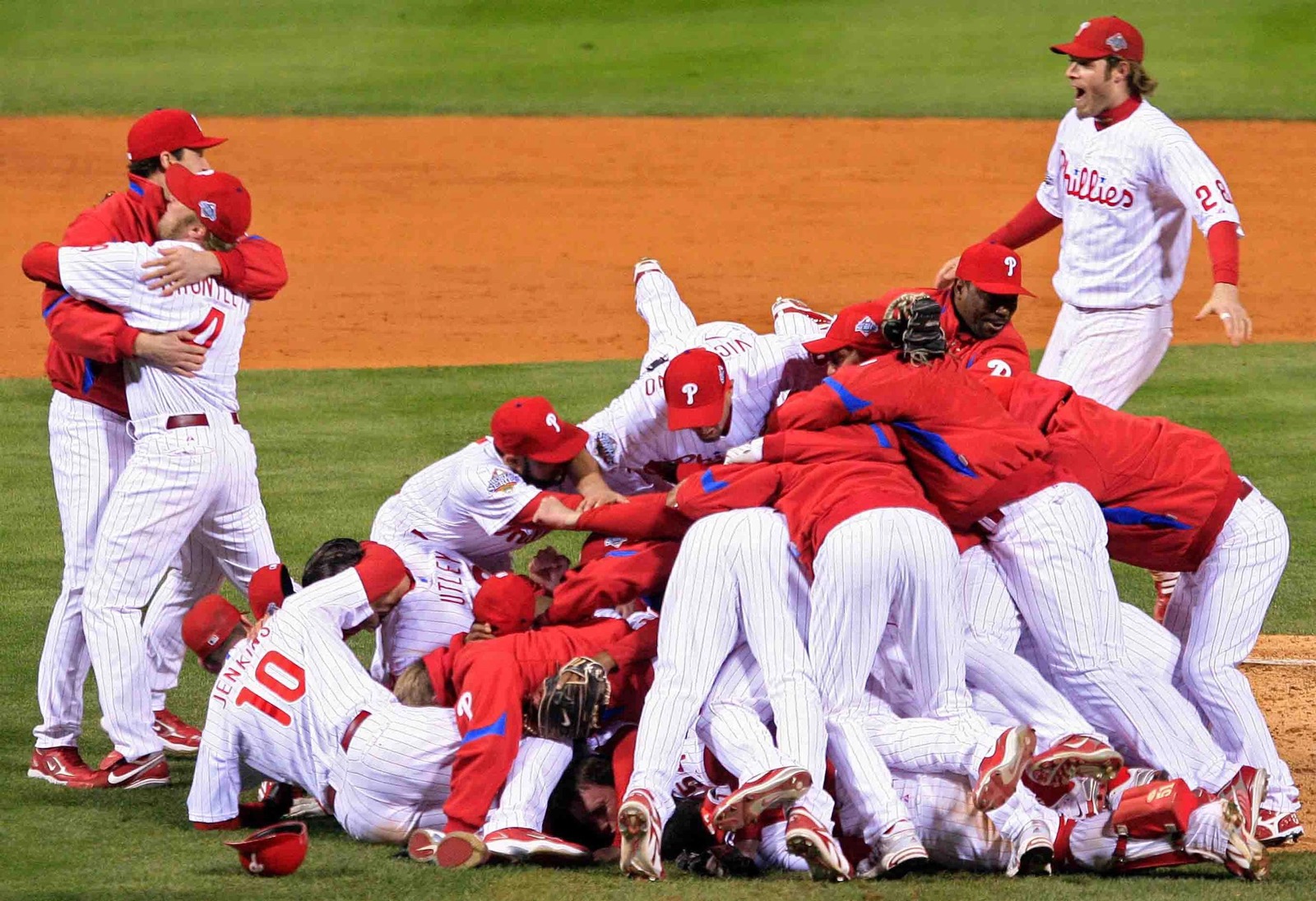
When the Chicago White Sox’s Garrett Cooper banged a 1-1 fastball from Daniel Bard on the ground to third baseman Jason Vosler, the Philadelphia Phillies’ championship celebration was a split-second from beginning. The celebration began in earnest as Vosler’s throw across the diamond nestled tightly in the glove of first baseman Christian Walker for the final out of the MMDBL’s 5th season.
The Philadelphia Phillies had become World Champions. Finally.
Long before the season-ending grounder was nabbed by Vosler, however, the questions had begun. In a league of power-hitting superstars and power-armed aces, how did the superstar-starved Phillies win it? How did a team that batted .239 and finished in the bottom-half of the league in most key hitting categories outlast its mash-minded competitors? How did a team that gave 212 plate appearances to Stuart Fairchild win it all?
What is this Sorcery?
OK, that last question may have gotten personal. Nothing against Fairchild but he entered the season as a 27-year-old journeyman with just over 100 major-league plate appearances and a .228 career batting average, yet he often batted 3rd or 4th against righties for the Phillies. It was he who hit the series-clinching homer, a 416-foot shot to left that gave Philadelphia a 2-1 lead in the bottom of the 5th in Game 7 – a lead they’d never relinquish. “Fairchild is Him” read one fan’s sign.
Game 1 of the World Series was saved by Jalen Beeks and all of the Phillies’ runs were “driven in” without a hit (walk, walk, fielder’s choice groundout) in the 7th inning of their 3-0 shutout. In their Game 2 win, it was Connor Overton who blew the save then earned the win. And the game-clinching run was again scored with an out (a sacrifice fly by Jose Altuve in the 5th). After losing Game 3, 8-7, the Phillies rebounded with a good old-fashioned butt-whooping in Game 4. The Phillies yielded just 2 hits in a 6-0 shutout – their second shutout of the series.
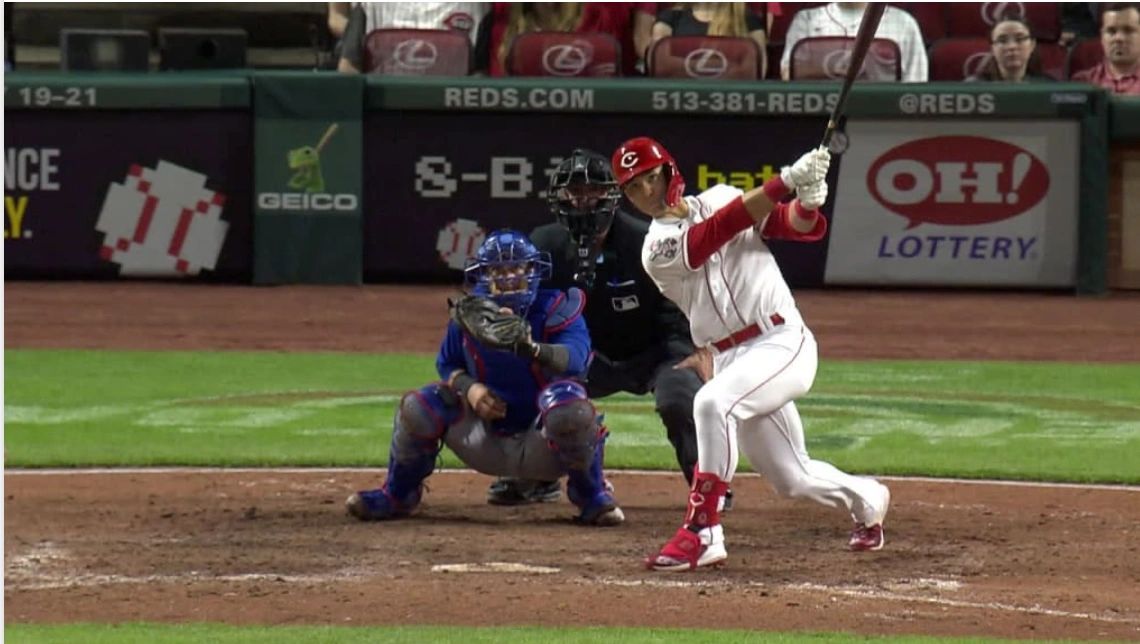
Philadelphia lost Game 5, 3-2, as Chicago’s Jake Cronenworth plated Nico Hoerner with a walk-off sacrifice fly. The White Sox then tied the series, winning Game 6, 5-4. But it wasn’t easy. The Sox took a 5-0 lead into the bottom of the 9th and the Phillies had a mere 1% chance of winning. Brandon Drury led off with a double. Three pitches later, Andres Giminez launched a homer 438-feet to right center to pull the Phillies within 5-2. Walker then got hit by a pitch, and 2 batters later, Vosler drilled a 1-out, 2-run bomb to rightfield, pulling Philadelphia within 5-4. Jorge Polanco then reached on a Cronenworth throwing error and David Peralta walked. With 1 out and runners on 1st and 2nd, Jose Altuve stepped to the plate to face David Robertson. What started as a 1% chance to win Game 6 and the World Series when the inning began, now ticked up to a 36% chance to end the MMDBL’s 5th season.
Altuve would bounce into a game-ending double play and the White Sox would successfully force a decisive Game 7, but the 9th inning rally seemed to reawaken the Phillies to who they are. Game 7 had little drama after the Fairchild go-ahead homer in the 5th and run-scoring hits by Walker, Altuve and Yadier Molina in the 6th. The Phillies rediscovered their secret sauce of shutdown pitching, anchored by the league’s best defense, and timely hitting.
The Opener Closed the Deal
The Phillies finished with the league’s 3rd best WHIP (1.17) just a few ticks behind Seattle and Toronto (1.12). They had the 3rd best team ERA (3.20) trailing Detroit (2.97) and Toronto (3.07). Philadelphia allowed the 2nd fewest runs (292) behind only Detroit (281); and the team allowed the fewest unearned runs (7). The next closest team in terms of unearned runs (Seattle, 15) more than doubled the Phillies’ total and the league-average (28 unearned runs) was four times the Phillies’ total.
That statistic underscores the quality of the Phillies' defense and the degree to which it contributed to the club’s success.
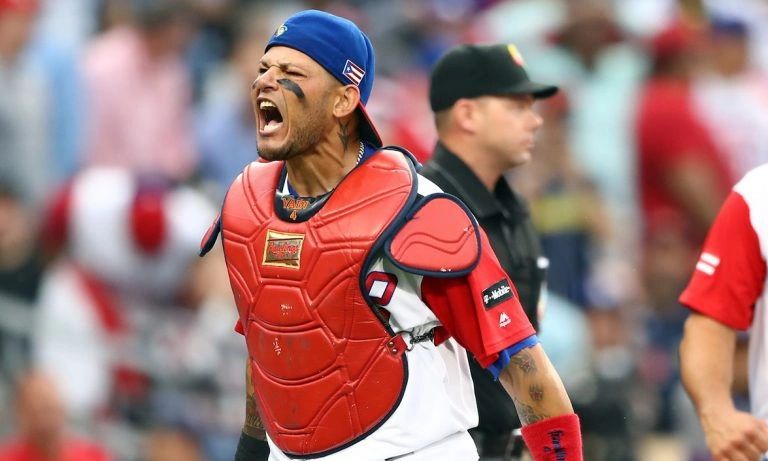
The Phillies’ run prevention strategy was obvious – minimize hits allowed, erase runners, take away runs with defense, and avoid the 3-run bomb. It worked. The Phillies allowed the fewest hits (649), the lowest opponent batting average (.218), the 3rd fewest homeruns (62) behind Detroit (54), and the fewest stolen bases (18) while gunning out a league-leading 46% percent of base stealers. There are yet a few more interesting stats. One is that Philadelphia didn’t allow a passed ball all season (kudos to Yadi on a mic drop outro!) The other is that the team was 2nd in assists, which is an indication of a high groundball rate on top of a high proficiency for gunning out baserunners – both would-be stealers and advancers. This was a critical key to the Phillies’ success since striking hitters out was not a top priority. The club notched the league’s 3rd lowest strikeout total.
Certainly, a team with this type of run-prevention record sports a rotation of Maddux-Smoltz-Glavine and is calling on Mariano Rivera to save games, right? Well, the club had 11 pitchers with a sub-1.25 WHIP. Aside from Clayton Kershaw and Tony Gonsolin, the rest are named Adam, Assad, Bard, Bard, Cimber, Effross, Holderman, Kluber and Overton.
Certainly, then, the Phillies leaned on Gonsolin and Kershaw, right? In one way, yes. They started a combined 48 games, or 53% of the team’s season. But in another way, not really. They averaged a combined 4 1/3rd innings pitched in their 48 starts. Gonsolin and Kershaw went less than 3 innings (19) more times than they went more than 7 (9). Yes, the Phillies best pitchers were generally used as Openers! In fact, Phillies’ starters tossed only 355 1/3rd innings in the regular season, or less than 4 innings per start. This was by far the lowest starting pitcher utilization rate in the league as the next lowest total (427 1/3rd innings) was 20% higher and tossed by Boston which had a really good reason to pull its starters early as they yielded a league-worst 1.67 WHIP and 6.16 ERA.
Philadelphia’s use of the Opener as a strategy has been well-chronicled for several seasons now. It’s not a gimmick, and the reward of a World Series championship is proof that the end justified the means. The Opener strategy, however, doesn’t work without good relief. Because they relied so little on starters, Phillies relievers actually tossed more innings (446 2/3rds), making them the only team in the MMDBL with this phenomenon (relievers tossed 55.7% on the team’s innings). The bullpen won 44 games (league average was 17) and had the 4th best OBA (.208), WHIP (1.17) and ERA (3.20). Normally, such high utilization would expose a bullpen’s flaws, but in the case of the Phillies it became a clinic in matchup warfare the moment the starter was yanked. In games decided by the bullpen, the Phillies’ winning percentage was 75% (44-15); in games decided by their starters, the Phillies’ winning percentage was 35% (11-20). The Phillies won more games in the middle when no one was looking, and they anchored those wins late with shutdown relief from Daniel Bard, Jason Adam and Adam Cimber. The trio combined for 24 of the team’s 27 saves and each had a WHIP under 0.90.
Maximizing Run Production
How does a team that batted .239 win the World Series? The goal of baseball isn’t to slaughter your opponents; it is simply to outscore them. One run is all it takes. You can imagine that in the dead of winter somewhere in the bowels of Citizens Bank Park, the Phillies’ brain trust met around a white board much like the one Peter Brand (Jonah Hill) drew up to show run production and run prevention goals to Billy Bean (Brad Pitt). “Your goal shouldn't be to buy players it should be to buy wins,” Brand says, “and in order to buy wins you have to buy runs.”
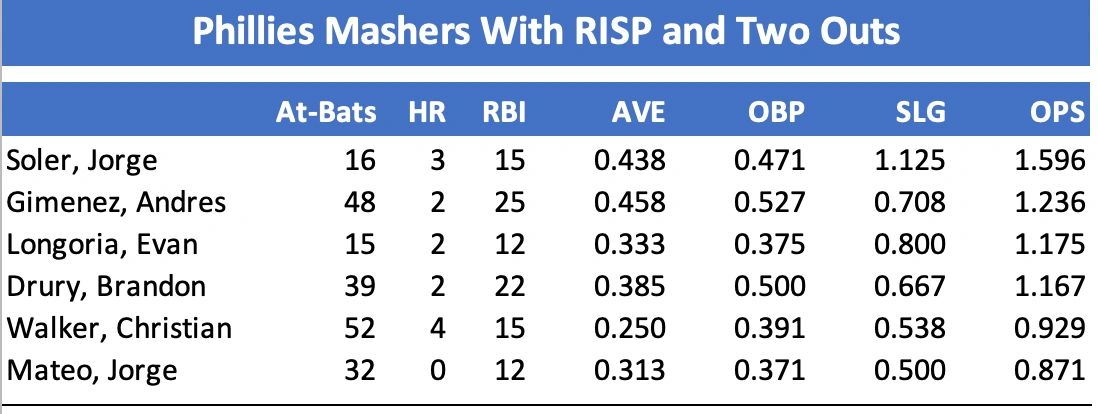
But how many runs? Well, the Phillies only allowed 3.24 runs per game so they only had to score slightly more than that to win it all. They scored 4.26 runs per game and finished with a 3rd best run differential of plus-91. They were better in every hitting category with runners on, runners in scoring position (RISP), and RISP with 2 outs than they were overall. In fact, when the situation was RISP with 2 outs the Phillies batted a 2nd-best .291 and posted a league-best .878 OPS, catalyzed by league bests in OBP and SLG. In fact, 38% of their runs batted in were produced in RSIP with 2 out situations, second only to Seattle’s 42% tally. Six players accounted for 101 RBI in just 202 clutch at-bats (see table), including 13 of the club’s 14 homers in RISP with 2 out situations.
Another aspect of the Phillies’ success was their running game. In the spirit of maximizing every opportunity to score runs, Philadelphia led the league with 116 steals. Yes, they also led the league with 42 times being caught stealing, but the successful swipes created more RISP situations which, as we noted, was where they excelled offensively. In fact, while they were only 12th in the league in terms of getting runners on base, they were 4th in plate appearances involving RISP with 2 outs.
Any time a team tosses a pair of shutouts in the World Series, one would expect the MVP to be a pitcher, perhaps the ace that started those games. Yet as defensive-minded as the Phillies are, it was an offensive player who got to lift the MVP trophy. Walker slashed .391/.481/.783/1.264 and had 9 hits, including 3 homers, to earn the honor.
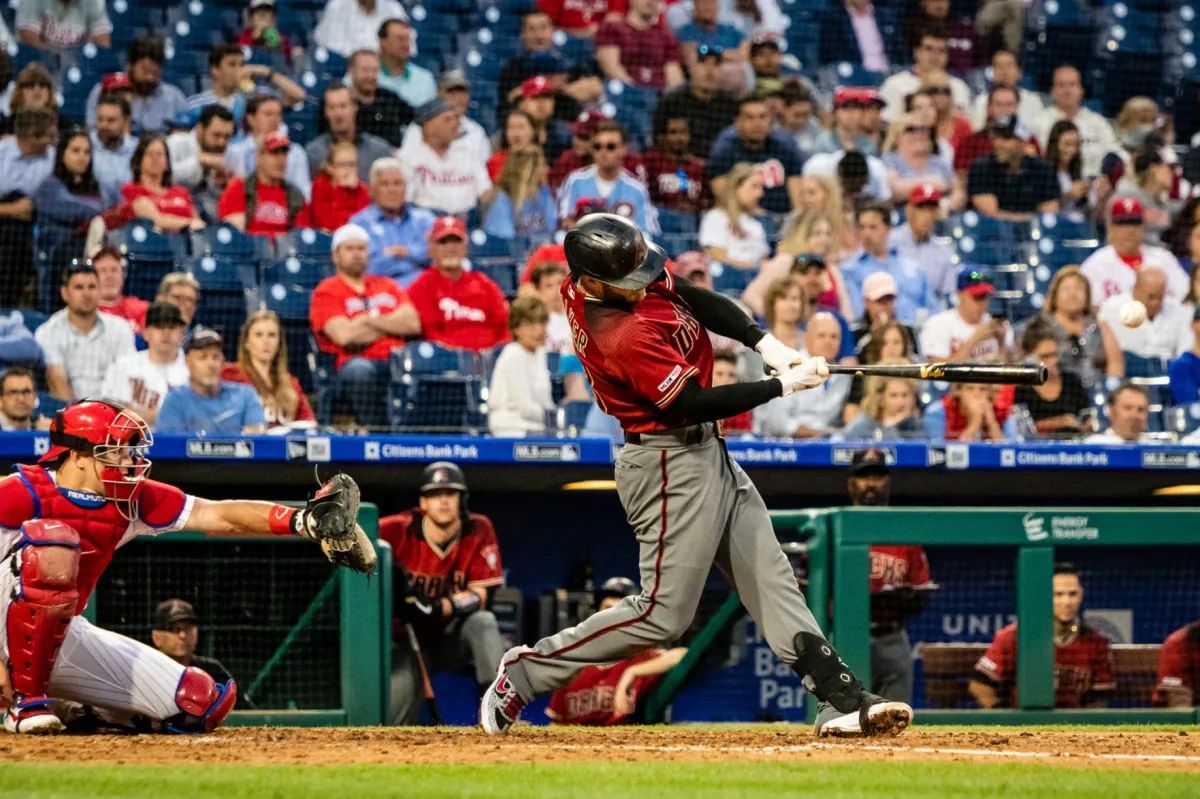
When we look back on the 2023 season, will we remember it as an anomaly? Will it be the rare season that a team more known for its defense that its offense wins it all? Or will it be the season that changes the standard of how you win championships?
The Phillies don’t really care if they become the prototype or not. They hoisted the trophy and did it their way. And the hands of both Stuart Fairchild and Clayton Kershaw were on that trophy. At the end of the day, that’s really all that matters.